Ingredients and steps on one page. Print it, or choose “Save as PDF” in the print dialog.
Sekai Gohan
Dhansak: Parsi Lamb and Lentil Curry from Western India
Steps
1Wash and soak the lentils, and pre-simmer the meat
35 min
Wash the four lentils 2–3 times until the water no longer turns cloudy, and soak them in plenty of water for 30 minutes. Cut the lamb into 1.5 inches (4 cm) cubes, put it in a pot with 3¼ cups (800 ml) water, half the ginger and 3 g salt. Bring to a boil over medium heat, skim the foam that floats up, and lower the heat. With the lid slightly ajar, simmer 40–50 minutes, until a bamboo skewer goes into the center with little resistance.
If the liquid reduces while the meat is still tough, add ½ cup (100 ml) boiling water at a time. Boiling hard tightens only the surface, so keep the heat where small bubbles rise steadily from the bottom. Don't throw out the liquid; keep it to adjust the thickness of the dhansak at the end.
2Cook the lentils and vegetables until their shape is gone
50–60 min
Drain the soaked lentils and put them in a separate heavy pot. Add 1¾ cups (400 ml) of the lamb broth, then the pumpkin, eggplant, potato, tomatoes, turmeric and 2 g salt. If short, add water so the ingredients just peek out of the surface.
Bring to a boil over medium heat, and once the first bubbles rise lower the heat and simmer 45–55 minutes. Check the bottom once with a wooden spoon, and if it looks like drying, add 3.5 tbsp (50 ml) boiling water. It is cooked when a lentil crushes under your finger, the pumpkin corners have collapsed and no core remains in the potato. Add the spinach and mint in the last 5 minutes to keep the green aroma.
3Make the lentils and vegetables into a purée that runs thick
8 min
Turn off the heat and roughly crush the contents of the pot with an immersion blender. Don't make it a complete bisque; stopping where a few lentil grains remain lets you taste the presence of the ingredients. If you have no blender, press with a masher, then pass only part through a coarse strainer. It is done when a line drawn along the bottom with a wooden spoon stays about 2 seconds and the crushed lentils flow smoothly.
The cue: tipping a spoonful, it doesn't fall in a lump but runs in a wide line. If it is firm, add lamb broth 3.5 tbsp (50 ml) at a time; if it is loose, remove the lid later and reduce. Don't settle the salt at this point; adjust after joining the meat and masala.
4Dry-roast the whole spices into a masala
10 min
Put the coriander seeds, cumin seeds, dried chilies, black pepper, cinnamon, cloves, cardamom, bay leaf and fenugreek seeds in a skillet. Dry-roast over medium-low heat for 2–3 minutes, until the cumin warms and the cinnamon aroma rises. Turn off the heat before smoke appears, cool 5 minutes and grind coarsely in a spice grinder.
If the fenugreek burns brown, the bitterness gets strong, so stop when the aroma comes out. If you use ground spices, combine 2 tsp coriander, 1 tsp cumin and 1 tsp chili, and add them straight to the onion pot without dry-roasting.
You don't need to grind the spices fine all at once. If you have a mortar, or you're making this only once, don't buy more; crushing until the grains split in half is enough. If you'll cook dhansak, sambar and chana masala often, a small grinder that coarsely grinds small amounts of whole spices is handy. If you use only ground spices, skip it.
5Fry the onion and tomato and open up the masala
15 min
In a separate pot put 2 tbsp oil and fry thinly sliced onion over medium heat for 8–10 minutes. Stop partway between pale golden and dark brown, and add the garlic, ginger and green chili. Fry 1 minute, then add the tomato and the dry-roasted masala.
Fry 3–5 minutes, until the tomato's moisture drops and oil lightly floats at the edge of the pot and the raw smell of the spices has gone. If it sticks to the bottom, add water 1 tsp at a time. Too much water at once boils the onion and weakens the savory depth.
6Combine the lentil purée, lamb and tamarind
18 min
Add the lentil and vegetable purée, the lamb and 300–500 ml of the lamb broth to the onion pot. Simmer over medium-low heat for 15 minutes, at small bubbles rising steadily from the bottom. In the last 5 minutes add the tamarind thinned with water, the sugar and the rest of the salt.
It is done when it runs from the spoon in a wide line and a little red-brown oil floats on the surface. If it lacks sourness, add tamarind 5 g at a time; if it is too bitter, add sugar 2 g at a time. Hot food tastes saltier, so turn off the heat, wait 2 minutes, and make the final adjustment.
7Cook the caramelized rice and serve with salad
25 min
Wash the basmati, soak 20 minutes and drain. In a pot put ghee or rice bran oil, cinnamon, cloves, cardamom and onion, and fry over medium heat until the onion is translucent. Add the sugar, and when the bubbles turn fine and it becomes a pale amber, pour in 2 cups (450 ml) water at once. The water spatters, so don't bring your face close to the pot.
Add the rice and salt, bring to a boil, and cook over low heat 15–17 minutes. When no water is visible, turn off the heat and steam covered for 10 minutes. If the sugar goes black, bitterness spreads through all the rice, so don't use scorched caramel; wash the pot and start over.
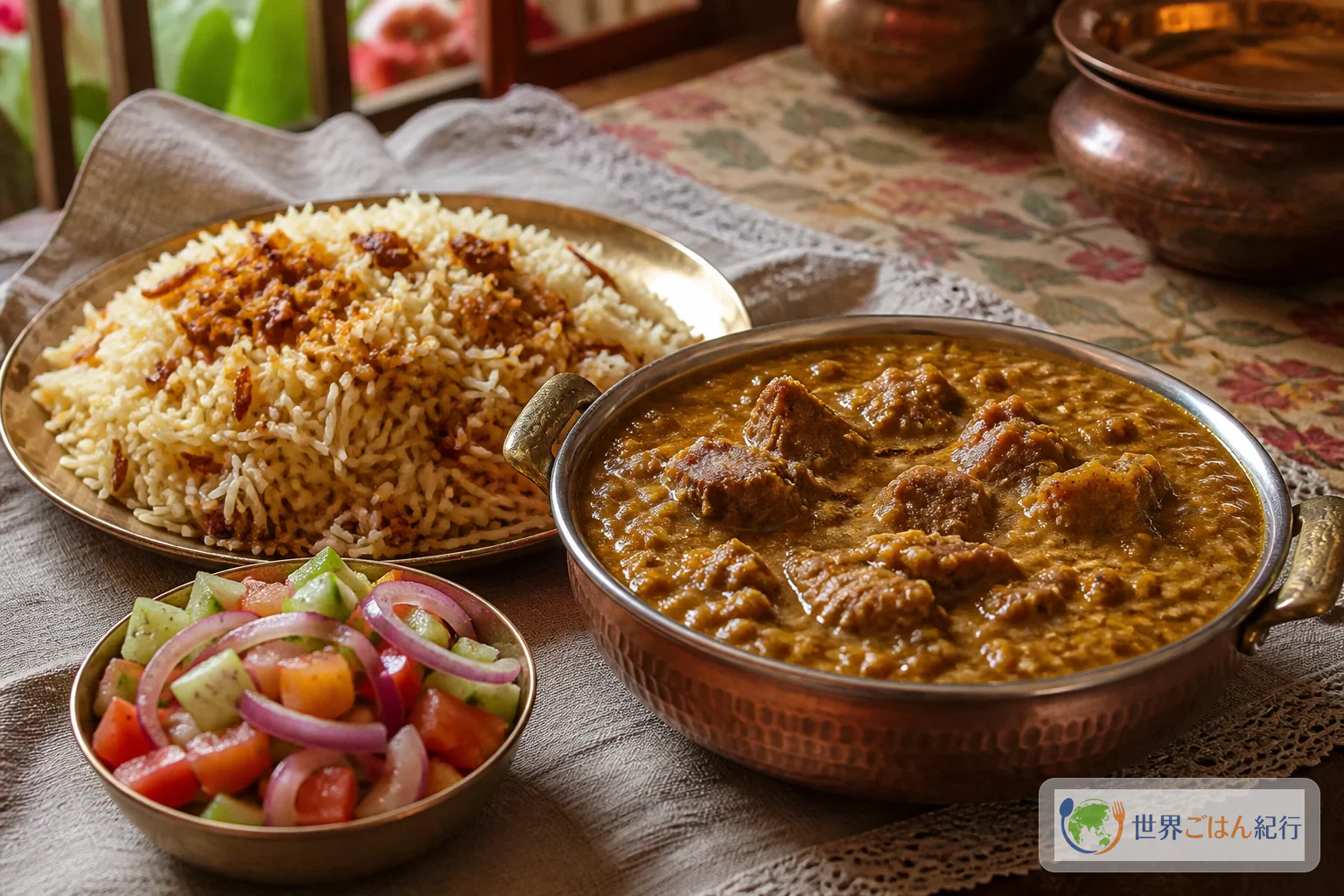
Cut cucumber, tomato and red onion into 0.5 inches (1 cm) cubes and toss with a little salt and lemon just before eating. Serve the dhansak in a deep bowl, the rice on a separate plate, and raw vegetables between, so each mouthful can change between thick lentils and meat, sweet rice and cold sourness.