Ingredients and steps on one page. Print it, or choose “Save as PDF” in the print dialog.
Sekai Gohan
Dosa: South Indian Fermented Rice and Urad Dal Crepes
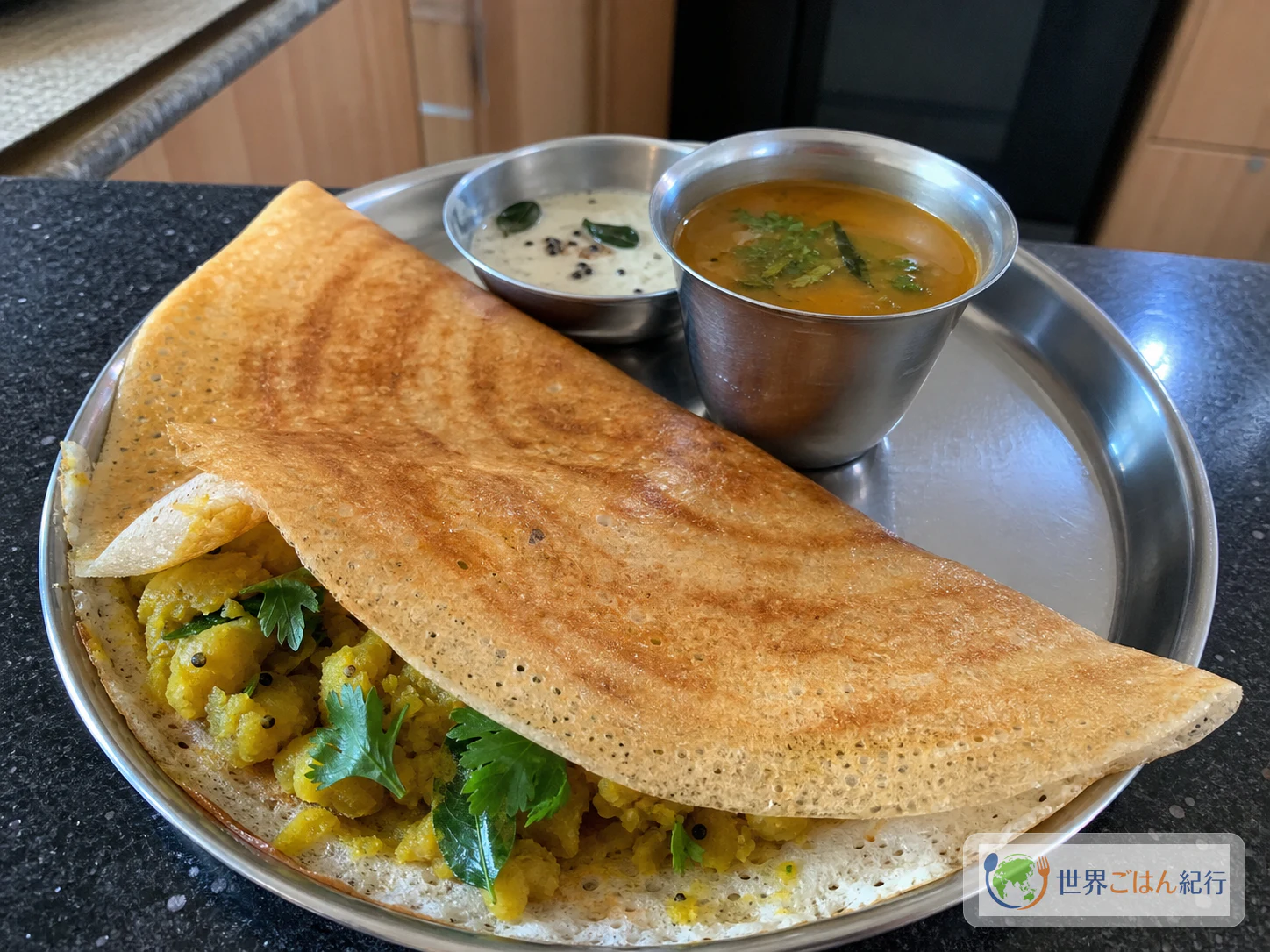
Ingredients
Fermented batter
| Ingredient | Amount | Shopping & substitutes |
|---|---|---|
| Rice | 300 g | Indica rice, short-grain rice, or half short-grain and half long-grain. Glutinous rice alone makes it heavy |
| Urad dal | 100 g | The skinned white kind. Red lentils or chickpeas won't give the same stickiness |
| Fenugreek seeds | 1/2 tsp | Helps the fermented aroma and the browning. Too much turns it bitter |
| Cooked rice | 30 g | Makes the batter a little more supple. Optional |
| Water | 300 ml + more as needed | About 120 ml for the dal and about 180 ml for the rice (about 1 1/4 cups total). Add more 1 tbsp at a time while checking the consistency |
| Salt | 7 g | Mix in after fermenting. In summer you can add half before fermenting to keep it from overfermenting |
| Rice bran oil or untoasted sesame oil | 2–3 tbsp | Used a little at a time while cooking |
| Ghee | 4 tsp | For finishing. Use oil instead to make it vegan |
Potato masala
| Ingredient | Amount | Shopping & substitutes |
|---|---|---|
| Potatoes | 1 lb (450 g) | Floury potatoes (like russets) turn crumbly; waxy ones hold their shape |
| Onion | 7 oz (200 g) | Thinly sliced |
| Green chile | 1 | For less heat, use 2 mild peppers such as shishito |
| Ginger | 10 g | Finely chopped |
| Curry leaves | 8–10 leaves | Frozen ones are easy to keep. If you can't find them, leave them out; the aroma will be different |
| Mustard seeds | 1 tsp | The signature South Indian aroma. Don't burn them |
| Cumin seeds | 1/2 tsp | Optional, but it sharpens the sweetness of the potatoes |
| Turmeric | 1/2 tsp | Color and an earthy aroma |
| Salt | 3/4 tsp | Adjust at the end |
| Water | ¼ cup (80 ml) | Brings the potatoes together |
| Rice bran oil | 2 tbsp | For sautéing the masala |
| Lemon juice | 2 tsp | For finishing. Lime works too |
| Cilantro | 10 g | Roughly chopped. Use scallions if you don't like cilantro |
Easy coconut chutney
| Ingredient | Amount | Shopping & substitutes |
|---|---|---|
| Desiccated coconut | 1.5 oz (40 g) | Rehydrate in lukewarm water |
| Plain yogurt | 2.75 oz (80 g) | For vegan, use unsweetened soy yogurt |
| Ginger | 5 g | Grated |
| Salt | 1/4 tsp | Taste and adjust |
| Lemon juice | 1 tsp | Adds acidity |
| Water | 2–4 tbsp | Just enough for the blender to run |
Steps
1Soak the rice and lentils
10 min + 6 hr soaking
Rinse the rice lightly and cover it with water. Soak the urad dal and fenugreek in a separate bowl. Use about twice as much water as the depth of the ingredients and leave them for 6 hours at a room temperature of 20–25°C (68–77°F). On hot days, check at 5 hours; once the dal is soft enough to split between your fingers, move on.
2Grind the batter
15 min
Drain the rice and the dal. First grind the urad dal and fenugreek with ½ cup (120 ml) water into a smooth, slightly sticky paste. Then grind the rice and cooked rice with about ¾ cup (180 ml) water, until just a little fine grit remains. Combine both in a large bowl and adjust to a consistency that falls slowly when lifted with a spoon. If it's stiff, add water 1 tbsp at a time.
3Ferment at 28–32°C
8–12 hr
Cover the bowl loosely and leave it somewhere around 28–32°C (82–90°F). Set a yogurt maker to 30°C (86°F), or an oven proof setting to around 30°C. Fermentation is done when the batter has risen 1.3–1.5 times, fine bubbles appear on the surface, and it smells sour but not unpleasant. Mix in 7 g salt and, if needed, 30–80 ml water to bring it to a consistency slightly thicker than drinkable yogurt.
4Make the potato masala
18 min
Peel the potatoes, cut them into 2 cm (3/4-inch) cubes and put them in cold water, then bring to a boil and cook. Drain once a skewer slides in easily. In a separate skillet, heat 2 tbsp oil over medium heat and add the mustard seeds. When they start popping after about 30 seconds, turn the heat down and add the cumin, curry leaves, ginger, green chile and onion. Sauté over medium heat for 5 minutes until the onion turns translucent, then add the turmeric, potatoes, 80 ml water and salt and simmer for 6 minutes, roughly mashing as you go. When no liquid remains on the bottom and the mixture holds together moistly, stir in the lemon juice and cilantro.
5Heat the tawa and spread the batter
5 min
Preheat a tawa or heavy skillet over medium-high heat for 3 minutes. Aim for a surface temperature of 190–200°C (375–390°F). Without a thermometer, flick on a drop of water: it should immediately bead up and skitter across. Brush on a thin film of oil, wipe the surface for just a moment with a damp cloth to settle it, then pour on one ladleful of batter. Spread it thin in circles from the center outward without pressing.
6Drizzle oil around the edge and cook until crisp
4 min
Lower the heat to medium and drizzle 1 tsp oil or ghee around the edge. Cook until the surface is no longer white, the areas around the holes are dry, and the edge starts to lift by 2–3 mm. You don't need to flip it. If the center is still thick, lower the heat slightly and cook another 30–60 seconds. If it looks like it will burn, cool the tawa with a damp cloth before cooking the next one.
7Add the masala and fold
3 min
Turn the heat to low and place the potato masala in the center. Fold one side over with a spatula into a half-moon. A fresh dosa softens within minutes, so serve it as soon as it's on the plate. If you have chutney and sambar, tear off pieces of dosa and dip them in a little of each.