Ingredients and steps on one page. Print it, or choose “Save as PDF” in the print dialog.
Sekai Gohan
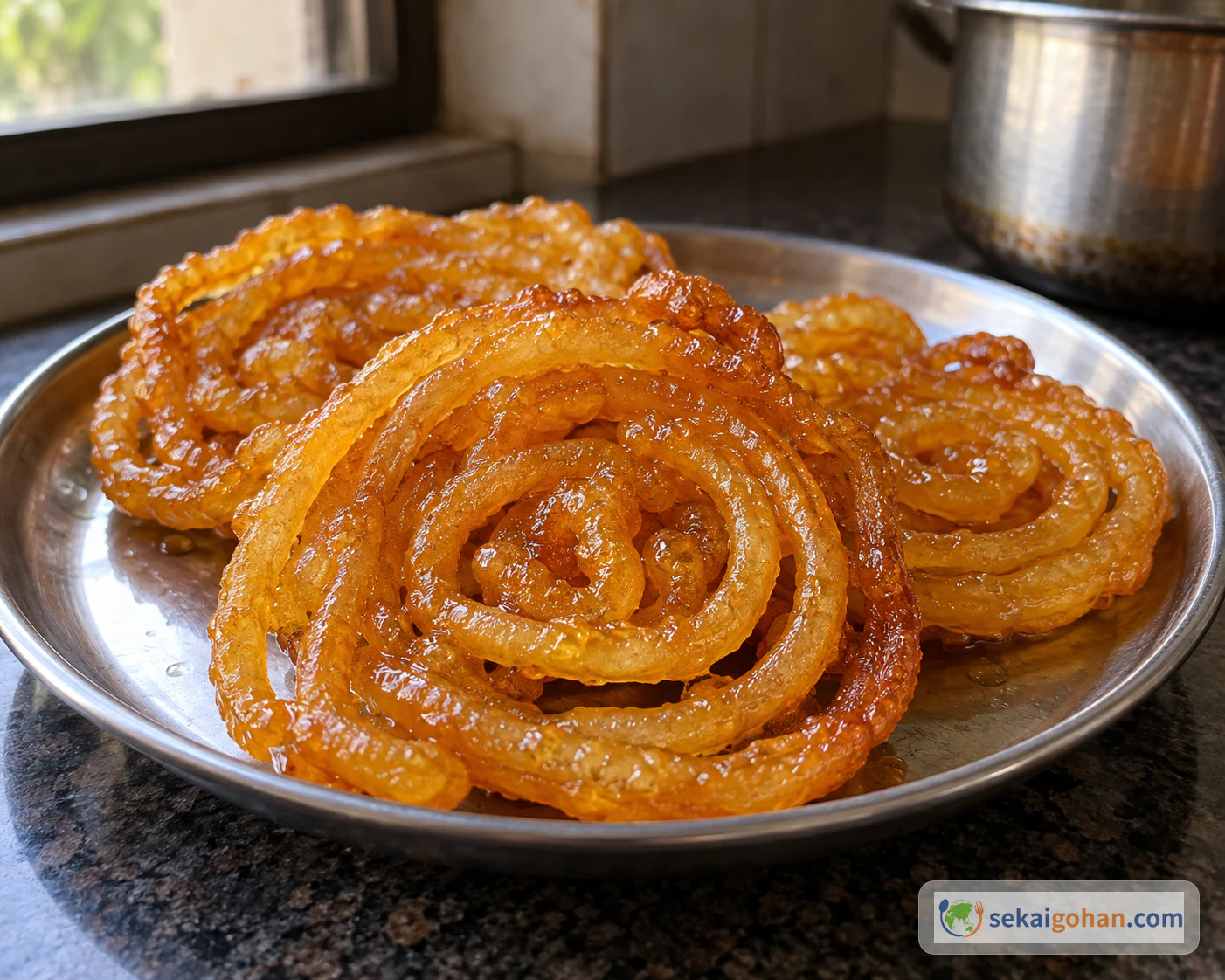
Jalebi: Indian Syrup-Soaked Spirals from a Fermented Batter (जलेबी)
Ingredients
Batter
| Ingredient | Amount | Role |
|---|---|---|
| All-purpose flour (maida) | 4.5 oz (125 g) | The main body of the batter |
| Besan (gram flour / chickpea flour) | 2 tbsp | Nutty flavor and structure |
| Turmeric | 1/8 tsp | A natural pale gold. Optional |
| Baking soda | a pinch | Helps lightness; it does not replace fermentation |
| Water | ¾–1 cup (180–240 ml) | Start with ¾ cup (180 ml) and add more only as needed |
| Extra all-purpose flour, for after fermentation | 1–2 tbsp | Only if the fermented batter has thinned. Separate from the first 4.5 oz (125 g) |
Syrup
| Ingredient | Amount | Role |
|---|---|---|
| Sugar | 5.5 oz (150 g) | The syrup |
| Water | ½ cup (120 ml) | To dissolve the sugar |
| Lemon juice | 1/4 tsp | Helps keep the syrup from crystallizing; not added for sourness |
| Saffron | a pinch, optional | Aroma and golden color |
For frying
| Ingredient | Amount | Role |
|---|---|---|
| Neutral oil | about 4–5 cm deep in your pot | For deep-frying. The amount depends on the pot |
Steps
1Mix the batter
In a mixing bowl, combine 4.5 oz (125 g) all-purpose flour, 2 tbsp besan, 1/8 tsp turmeric and a pinch of baking soda. Add ¾ cup (180 ml) water first rather than all of it, and whisk for about 4 minutes until no lumps remain. If it is too stiff, add more water 1 tbsp (15 ml) at a time, up to 1 cup (240 ml) in total.
The batter is right when it falls from the whisk in a continuous ribbon but does not run like water. Starting with less water lets you allow for differences in how your flours absorb it.
2Ferment until bubbles appear
Transfer the batter to a clean bowl, cover it and leave it somewhere warm at room temperature for 12–24 hours, or 6–10 hours in warm climates. A warm summer kitchen ferments faster and a cold winter one slower.
Stop by what you see and smell, not only by the time: small bubbles across the surface, a gently sour aroma, and a batter that still flows in a thick ribbon. Judge it by bubbles, smell and thickness; do not taste the raw batter to check sourness. If it has a sharp, unpleasant smell, any mold, or unusual discoloration, do not use it.
Stir the batter once and check its thickness again. If it has thinned during fermentation, add the extra flour from the 1–2 tbsp a little at a time, about 1 tsp at a time, until it can hold a thin line again. Add only what you need, and note how much you actually used for next time.
3Make the one-string syrup
Put 5.5 oz (150 g) sugar and ½ cup (120 ml) water in a saucepan over low to medium heat and stir until the sugar dissolves. Bring it to a boil and simmer until it reaches one-string consistency. If you are using saffron, add it here.
To test, take a small amount onto a plate and let it cool until it is comfortable to touch. Pinch the cooled drop between a finger and thumb and pull them apart: if a single thread forms, the syrup is ready. A thin stream running off a spoon is not the same test. Do not dip a finger into the hot syrup in the pan.
Add 1/4 tsp lemon juice, turn off the heat and keep the syrup warm. Under-reduced syrup makes the coating soft; syrup cooked past one-string tends to crystallize as it cools.
4Heat the oil and pipe the spirals
Pour oil into a deep pot to about 4–5 cm, leaving plenty of room below the rim, and heat it to about 350°F (176°C), checking with a thermometer. Fill the piping bag with batter.
Pipe a single small test first. A small piece of batter should not stay on the bottom; it should rise quickly and color slowly. If the line spreads thick and blurry, the batter is too thin; if it won't come out or keeps breaking, it is too stiff. Adjust the batter or the opening of the bag before going on.
Pipe from the center outward, making a thin spiral of 2–3 rounds. Fry only 2–3 at a time and don't crowd the pot. The rings do not need to be perfect circles; the overlapping lines are part of jalebi's charm.
5Fry both sides until light gold
When the underside has set and turned light golden, turn the spiral with chopsticks, tongs or a slotted spoon. When both sides are colored and the bubbling around it has become small and settled, lift it onto the rack. Take it out before it turns dark brown.
If the oil is too cool, the spirals soak up oil and their outlines blur; if it is too hot, only the outside burns.
6Soak in the warm syrup
Move the freshly fried spirals into the warm, not scalding, syrup. Turn them after about 1 minute, and lift them out onto the rack after 2–3 minutes at most.
They are ready when the surface has a glossy coat and syrup drips slowly as you lift them. The longer they soak, the darker the color and the softer the bite.
7Drain and eat warm
Let the excess syrup drain on the rack and eat the jalebi while warm. This is when the contrast between the light crunch outside and the syrup inside is clearest.