Ingredients and steps on one page. Print it, or choose “Save as PDF” in the print dialog.
Sekai Gohan
Khandvi: Gujarati Gram-Flour Rolls with Mustard-Seed Tempering
Ingredients
| Ingredient | Amount | Role |
|---|---|---|
| Gram flour (besan) | 1 cup | Main body of the batter |
| Refined wheat flour (maida) | 1 tbsp | Mixed into the batter with the besan |
| Turmeric powder | 1/2 tsp | Batter spice |
| Red chilli powder | 1/4 tsp | Batter spice |
| Salt | to taste | Seasons the batter |
| Green chilli paste | 1 tsp | Batter seasoning |
| Ginger paste | 1 tsp | Batter seasoning |
| Asafoetida (hing), for the batter | 1/4 tsp | Batter seasoning |
| Buttermilk | 3 cups | Loosens the flour and spices into a smooth batter |
| Oil, for greasing | a little | Coats the back of the thali |
| Fresh coconut, scraped | as needed | Sprinkled over the strips before rolling |
| Fresh coriander leaves (cilantro), chopped | as needed | Sprinkled over the strips before rolling |
| Oil, for the tempering | 2 tbsp | Base of the tempering |
| Mustard seeds | 1 tsp | Popped in the hot oil |
| Asafoetida (hing), for the tempering | 1/4 tsp | Added after the mustard seeds pop |
| Curry leaves | 10–15 | Added to the tempering |
| White sesame seeds | 1 tsp | Added to the tempering |
Steps
1Prepare the coconut and coriander
Rinse any dirt off the coconut shell under running water, without soap or detergent. Crack the coconut open and scrape the white flesh, handling it with washed tools. Wash the coriander thoroughly under running water, without soap or detergent, and drain it well; washing reduces bacteria but does not eliminate them. Chop the leaves, and set the scraped coconut and chopped coriander aside for the filling.
2Mix the dry ingredients and pastes
In a bowl, combine the 1 cup gram flour, 1 tbsp maida, 1/2 tsp turmeric, 1/4 tsp red chilli powder, salt, 1 tsp green chilli paste, 1 tsp ginger paste and 1/4 tsp hing. Mix until evenly combined. Keep the other 1/4 tsp hing for the tempering.
3Whisk in the buttermilk
Pour in some of the 3 cups buttermilk, adding only a little at a time. Whisk after each addition, then add more buttermilk. Continue until all of it is in and the batter is smooth, with no lumps.
4Cook the batter
Pour the smooth batter into a nonstick kadai, without adding oil to the pan. Set the kadai over low heat and cook the batter for 15–20 minutes, stirring and scraping the base of the pan with a flat spatula as it thickens. While it cooks, lightly brush oil over the back of a flat metal thali; you can do this before the batter goes on the heat if you prefer. If you are using more than one thali, oil them all and line them up within reach. The batter is ready to spread when it begins to leave the sides of the pan.
5Spread the batter on the thali
Without delay, use a broad spatula to move the hot batter onto the oiled thali, keeping your fingers off it because it is hot. Use a wide flat scraper to spread it into a thin, even layer across the surface of the thali. Leave the sheet undisturbed until it has cooled and set.
6Cut the sheet and add the filling
Use a knife to cut the cooled sheet into thick strips. Sprinkle the scraped coconut and chopped coriander over the cut strips. The strips are ready to roll once the filling lies evenly over them.
7Roll the strips
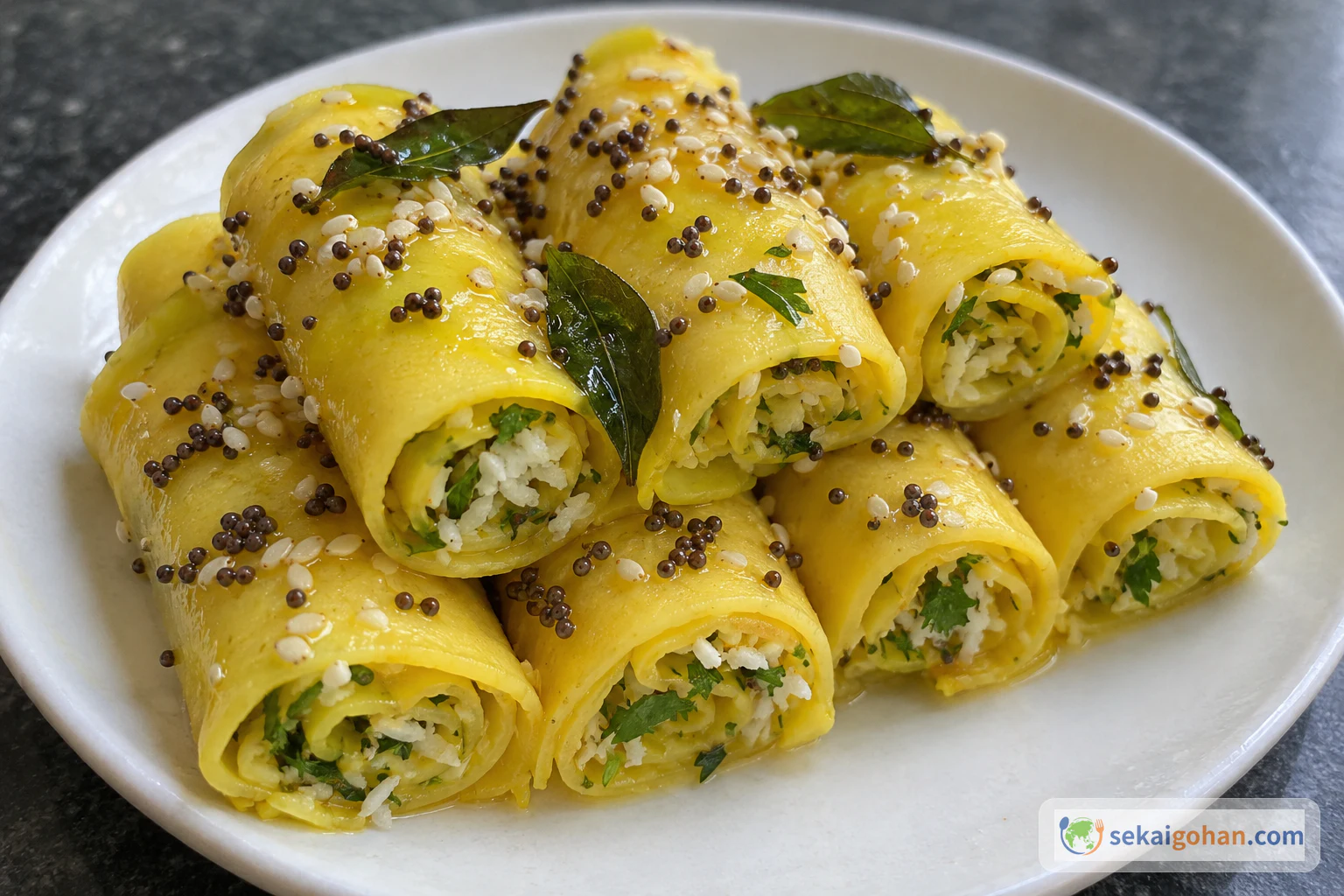
Starting from one end, roll each strip into a neat cylinder with the coconut and coriander inside. Use a spatula to move the rolls onto a serving plate and arrange them side by side. The rolls stay plain until the tempering is poured.
8Make the tempering
Heat the 2 tbsp oil in a shallow nonstick pan. Add the 1 tsp mustard seeds and cook until they begin to pop, keeping your face and hands back from the pan. Add the remaining 1/4 tsp hing, the 10–15 curry leaves and the 1 tsp white sesame seeds. Stir everything together well.
9Pour and serve
Pour the tempering over the rolled khandvi on the serving plate. Serve the khandvi as a snack. The coconut and coriander stay inside the rolls, so don't scatter more over the top.