Ingredients and steps on one page. Print it, or choose “Save as PDF” in the print dialog.
Sekai Gohan
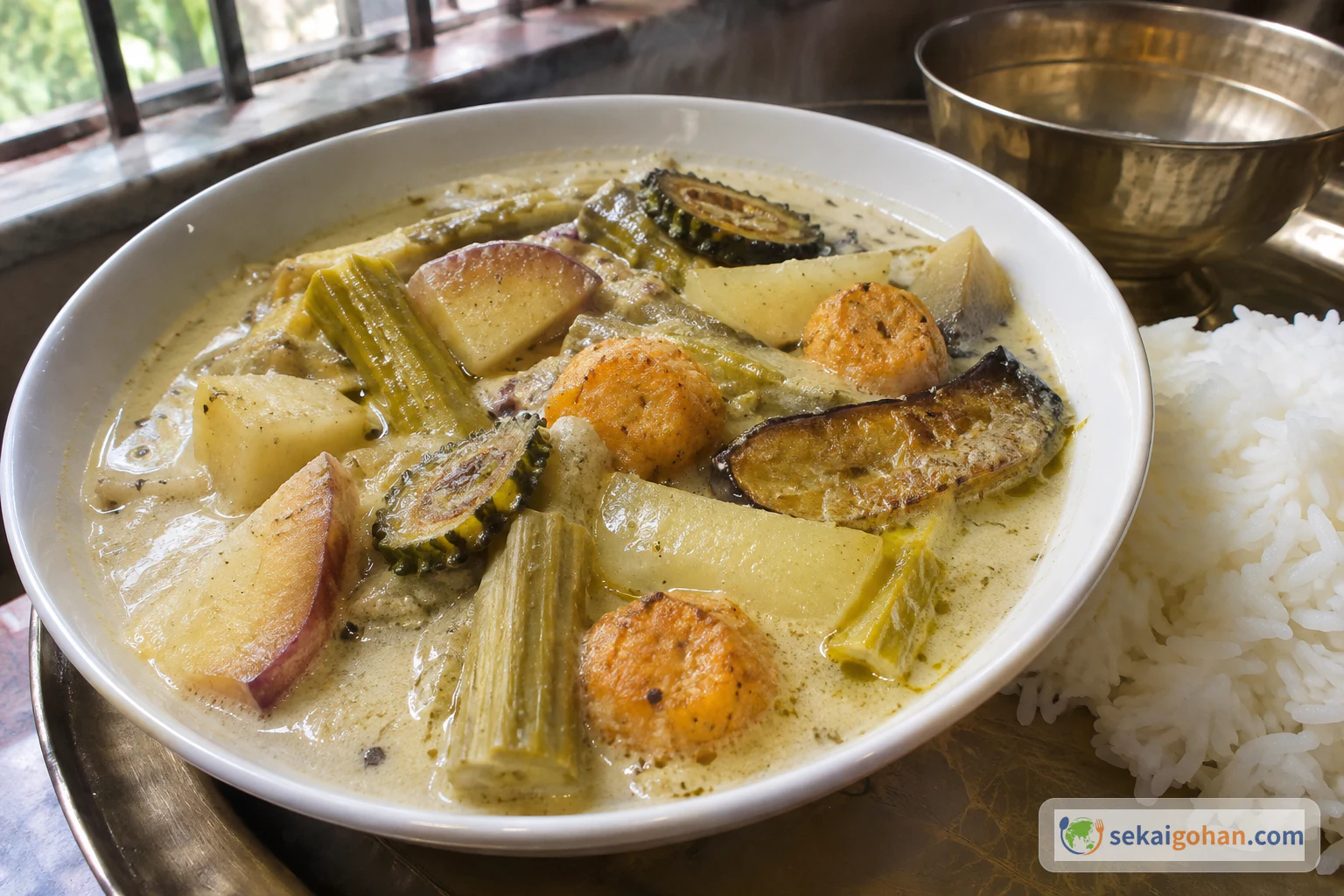
Shukto: Bengali Mixed Vegetable Stew with Bitter Gourd and Milk
Ingredients
| Ingredient | Amount | Role |
|---|---|---|
| Drumsticks (shojne data) | 5¾ oz (160 g) | Boiled. Peeled, cut into 2-inch (5 cm) lengths |
| Sweet potato (mishti alu) | 4¼ oz (120 g) | Boiled. Cut lengthwise into ¾-inch (2 cm) wedges |
| Flat beans (sheem) | 3½ oz (100 g) | Boiled. Strings removed, halved |
| Brinjal (eggplant) | 3½ oz (100 g) | Fried. Cut into 2¼ × 1¼-inch (6 × 3 cm) pieces |
| Bitter gourd (korola) | 1¾ oz (50 g) | Fried. Cut into 1½-inch (4 cm) pieces. The bitter note |
| Potato | 3½ oz (100 g) | Boiled. Cut lengthwise into ¾-inch (2 cm) wedges |
| Unripe banana (kachkola) | 5¼ oz (150 g) | Fried. Cut into 2¼ × 1¼-inch (6 × 3 cm) pieces |
| Unripe papaya (kacha pepe) | 5¼ oz (150 g) | Boiled. Cut into 2¼ × 1¼-inch (6 × 3 cm) pieces |
| Dried lentil dumplings (dal'er bori) | 10 | Fried until golden. Crunch, then soak up the sauce |
| Water | 1 lb 5 oz (600 g) | For boiling. Keep the cooking water |
| Salt, for boiling | 0.2 oz (5 g) | Seasons the boiled vegetables |
| Vegetable oil | 2 oz (60 g) | For frying and tempering |
| Bay leaves | 4 | Tempering |
| Panch phoron | ½ tsp | Five-seed tempering |
| Ginger paste | 1¼ oz (35 g) | Warmth and freshness |
| Fresh mustard paste (sorshe bata) | 1 oz (25 g) | The body and gentle pungency of the sauce |
| Grated coconut | ½ oz (15 g) | Sweetness and body |
| Milk | 3½ oz (100 g) | Makes the broth pale and mild |
| All-purpose flour (maida) | ¼ tsp | Stirred into the milk to thicken lightly |
| Salt, for the stew | ½ oz (15 g) | Main seasoning |
| Sugar | ¾ oz (22 g) | Rounds the bitterness |
| Radhuni, finely ground | ½ tsp | Finishing aroma |
| Ghee | ⅓ oz (10 g) | Finishing richness |
Steps
1Cut and sort the vegetables
Peel the drumsticks and cut them into 2-inch (5 cm) lengths. Cut the potato and sweet potato lengthwise into ¾-inch (2 cm) wedges. Cut the unripe banana, papaya and brinjal into pieces about 2¼ × 1¼ inches (6 × 3 cm). String and halve the flat beans, and cut the bitter gourd into 1½-inch (4 cm) pieces. Put the drumsticks, papaya, beans, sweet potato and potato on one plate for boiling. Put the brinjal, banana and bitter gourd on another plate for frying. You are ready when every piece in a group is about the same size.
2Parboil and save the water
Put the boiling group in a pot with the water and 5 g salt. Cover and cook over low heat for 15 minutes, stirring once halfway. Drain right away into a colander set over a bowl, and keep every drop of the cooking water. The vegetables are ready when they have softened but still hold their shape. A thin skewer should slide in easily.
3Fry the bori
Heat the oil in the wide pan. Add the bori and turn them often, because they colour fast. When they are an even golden brown and smell toasty, lift them out with a slotted spoon onto paper towels. Keep the oil in the pan.
Hot oilDry the vegetables well before they go into the oil, and slide each batch in away from you. Wet pieces make the oil spit. Keep the handle turned inward and stay at the stove while frying.
4Fry the banana, bitter gourd and brinjal separately
Fry the bitter gourd first, in a single layer, turning it until both sides are golden. Lift it out. Fry the banana next, then the brinjal, each on its own, and drain them separately. They cook at different speeds, so it is easier to judge each one alone. Each batch is done when it is golden brown on the outside.
5Temper and cook the ginger
In the same oil, add the bay leaves and panch phoron. When the seeds crackle and the bay leaves darken at the edges, turn the heat to low. Add the ginger paste and stir for 1 minute. The ginger is ready when its sharp raw smell softens into a warm, sweet aroma.
6Fry the mustard paste until the oil separates
Add the mustard paste and keep stirring over low heat. When it dries and starts to stick, add a splash of the reserved cooking water and scrape the bottom. Repeat until the paste is cooked. The cue is oil separating at the edges: a thin shiny ring appears around a soft, pale yellow-beige paste.
Splash, don't floodAdd only a spoonful or two of cooking water at a time while frying the mustard paste. Too much water at once stews the paste and the oil never separates. A little at a time lets it fry, loosen and fry again.
7Add the potatoes, then the rest
Add the boiled potato wedges and cook over low heat for 3 minutes, turning them gently in the paste. Add the rest of the boiled vegetables, the fried banana, the bori, 15 g salt and the sugar. Stir from the bottom with slow, wide strokes. You are ready to move on when the sugar has melted and every piece is lightly coated in pale paste.
8Add coconut and gravy, then fold in the fragile pieces
Scatter in the grated coconut. Pour in reserved cooking water as needed until the pot has a loose, generous gravy. Add the fried brinjal and bitter gourd last, and fold them in gently with the back of the spoon. The pot is right when it is saucy and the brinjal and bitter gourd pieces are still whole.
9Add the milk and simmer briefly
Stir the flour into the milk in a cup until no lumps remain. Pour it into the pot in a thin stream while shaking the pan gently. Keep the heat low and simmer for 3 to 5 minutes. The broth turns pale cream, and a skewer slides easily into a piece of sweet potato and papaya. Stop at a gentle simmer and never let it boil hard.
Keep the milk calmLow heat and a short simmer keep the milk smooth. Long boiling, or anything sour added to the pot, will split it into curds. The flour gives a little extra protection and a silky body.
10Finish with radhuni and ghee, then rest
Grind the radhuni to a fine powder and sprinkle it over the surface. Add the ghee in one piece. Put the lid on, turn off the heat and let the pot rest for about 1 minute. When you lift the lid, the ghee has melted into glossy pools and the steam smells of celery-like spice and toasted mustard. Serve straight away.