Ingredients and steps on one page. Print it, or choose “Save as PDF” in the print dialog.
Sekai Gohan
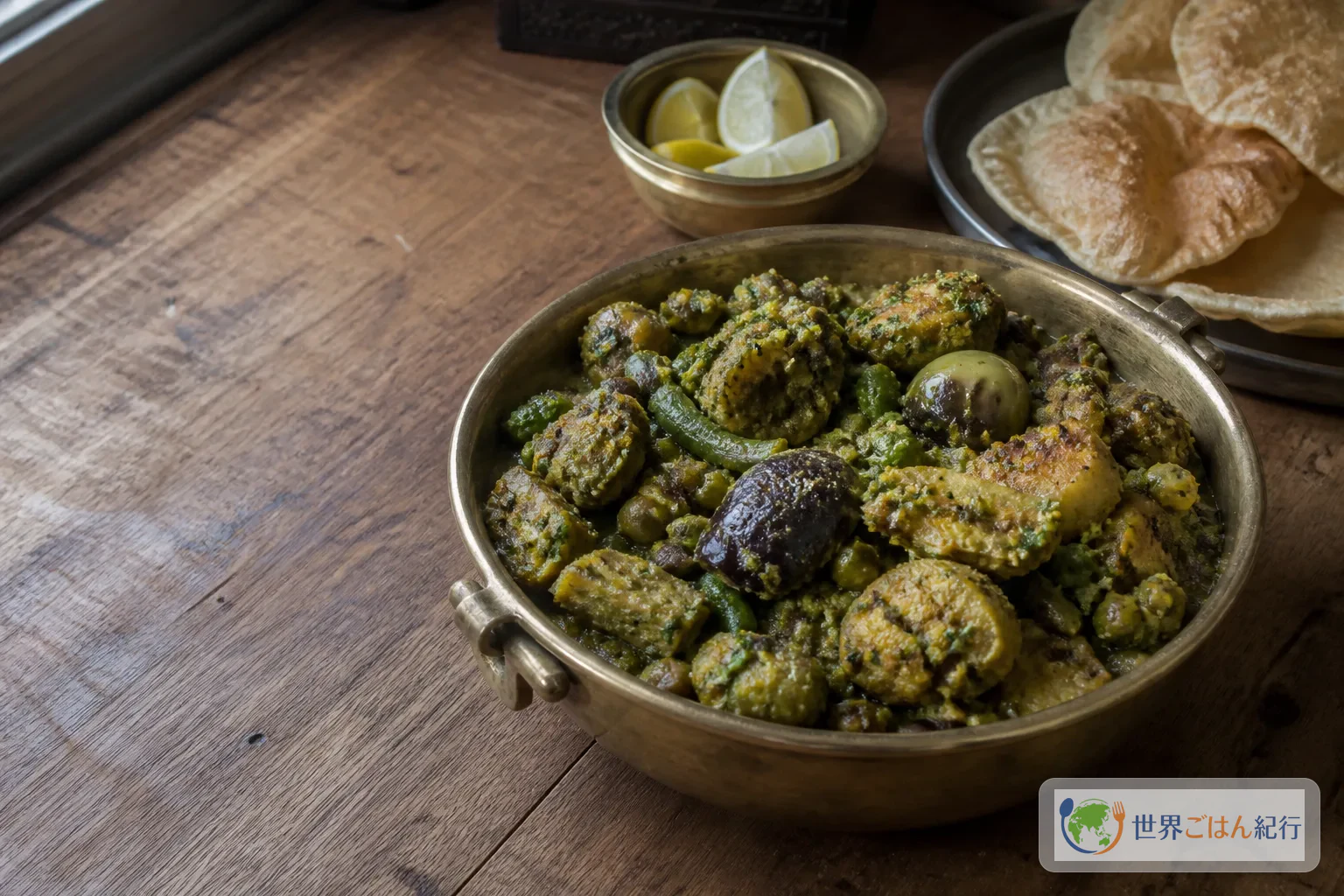
Undhiyu: Gujarat's Winter Vegetable Medley with Methi Muthia
Ingredients
Vegetables
| Ingredient | Amount | Substitutes & notes |
|---|---|---|
| Flat green beans (in place of Surti papdi) | 9 oz (250 g) | Choose thick pods. Ordinary green beans work, but the bean sweetness is lighter |
| Green peas | 5.5 oz (150 g) | Use the same amount of toor lilva (fresh green pigeon peas) if you have them. Thaw frozen and drain |
| Baby eggplant | 5.5 oz (160 g) (4–5) | With ordinary eggplant, cut into 1 inch (2 cm) rounds and place on the top layer without stuffing |
| Baby potatoes | 7 oz (200 g) | Cut large ones into 1 inch (3 cm) cubes. Make cross cuts |
| Sweet potato | 8 oz (220 g) | 1 inch (3 cm) cubes. Not a replacement for purple yam, but it matches the sweetness |
| Purple yam (kand) | 7 oz (200 g) | If unavailable, taro can substitute. Color and stickiness change |
| Green banana | 7 oz (200 g) net (1) | If unavailable, replace with 5.5 oz (150 g) lotus root and add in the final 10 minutes |
| Fresh methi leaves | 2.75 oz (80 g) | Substitute 2 oz (60 g) spinach plus 3 g dried kasuri methi. The muthia aroma is weaker |
| Cilantro | 2.75 oz (80 g) | 2.5 oz (70 g) for the masala, 10 g for finishing. If you dislike it, omit only the finishing portion |
| Green garlic or garlic scapes | 1.75 oz (50 g) | 1.5 oz (40 g) garlic scapes plus 5 g garlic. Garlic alone doesn't give the green aroma |
Methi muthia
| Ingredient | Amount | Substitutes & notes |
|---|---|---|
| Besan (chickpea flour) | 2 oz (60 g) | Using only wheat flour changes the toasty outside and the cohesion |
| Whole wheat flour or atta | 2.75 oz (80 g) | Cake or all-purpose flour tends to make the dough loose. If you have none, mix in half bread flour |
| Ajwain | 1.5 g | 1/3 tsp. If you have none, increase cumin by 1 g |
| Turmeric | 1 g | 1/3 tsp. For color; don't overdo it |
| Chili powder | 1 g | 0.5 g if reducing heat |
| Baking soda | 1 g | 1/5 tsp. Too much brings bitterness |
| Salt | 3 g | For the dough |
| Lemon juice | 2 tsp (10 ml) | Doesn't tighten the dough; balances the green bitterness of the methi |
| Vegetable oil | 1 tbsp (15 ml) | For the dough. Separate from the frying oil |
| Frying oil | 1¼ cups (300 ml) | Don't let the muthia absorb all of it. Don't strain and reuse the rest; judge its condition and dispose |
Green masala and seasoning for the pot
| Ingredient | Amount | Substitutes & notes |
|---|---|---|
| Desiccated coconut or freshly grated | 2.75 oz (80 g) | Unsweetened. Coconut milk adds too much liquid |
| Unsalted peanuts | 1.25 oz (35 g) | Coarsely crushed. If avoiding nuts, replace with 20 g besan |
| White sesame | 15 g | If avoiding sesame, omit and increase peanuts by 10 g |
| Ginger | 15 g | Grated |
| Garlic | 15 g | Minced. Used separately from the green garlic |
| Green chili | 10 g | 1–2. Removing the seeds lowers the heat |
| Jaggery or raw cane sugar | 18 g | Not to sweeten the dish, but an amount to round out the green bitterness |
| Coriander-cumin powder | 5 g | If you have none, 2 g cumin and 3 g coriander |
| Lemon juice | 2 tbsp (30 ml) | 1.5 tbsp (20 ml) for the masala, 2 tsp (10 ml) for finishing. Adjust acidity at the end |
| Salt | 8 g | Split roughly 5 g for the masala and 3 g for the pot |
| Peanut oil or rice bran oil | 2 tbsp (30 ml) | For the pot. Separate from the frying oil |
| Mustard seeds | 3 g | For tempering |
| Cumin seeds | 3 g | For tempering |
| Fenugreek seeds | 1 g | They turn bitter easily, so about 1/4 tsp |
| Asafoetida | 0.5 g | Omit if you have none |
| Water | ½ cup (150 ml) | Added from the edge of the pot. Add 1.5–2 tbsp (20–30 ml) more only if it dries out |
Steps
1Cut the vegetables and drain the methi
15 min
Remove the ends and strings from 9 oz (250 g) flat green beans and cut into 1.5 inches (4 cm) pieces. Make a cross-shaped lengthwise cut in 5.5 oz (160 g) baby eggplant and 7 oz (200 g) baby potatoes, leaving the stem, but do not cut all the way through to the bottom. Peel 8 oz (220 g) sweet potato and 7 oz (200 g) purple yam and cut into 1 inch (3 cm) cubes; peel 7 oz (200 g) green banana thickly and cut into 1.5 inches (4 cm) pieces. If the juice of purple yam makes your hands itch, use gloves, and do not soak the cut pieces in water for long; pat them dry with a cloth. Thaw 5.5 oz (150 g) frozen green peas and drain. If you can get toor lilva (fresh green pigeon peas), use the same amount, but in this home version, which layers them without blanching, they will cook too slowly if the skins are tough. Wash 2.75 oz (80 g) fresh methi leaves, remove the thick stems, chop into 2–3 mm widths, and pat dry with a cloth. No heat is used in this prep stage. The prep is done when the cut surfaces have not dried out and the width of the beans and the corners of the root vegetables are uniform.
2Make the green coconut masala
10 min
Put 2.5 oz (70 g) cilantro, 1.75 oz (50 g) green garlic or garlic scapes, 15 g ginger, 15 g garlic, 10 g green chili, 2.75 oz (80 g) desiccated coconut, 1.25 oz (35 g) unsalted peanuts, 15 g white sesame, 18 g raw cane sugar or jaggery, 1.5 tbsp (20 ml) lemon juice, 5 g coriander-cumin powder and 5 g salt in a food processor. Pulse at first, and stop when the whole has become a moist, coarse crumble. If you add water and make it a smooth paste, it flows out of the eggplant cuts and pools at the bottom of the pot. Only when the blade won't turn, add water 1 tsp (5 ml) at a time, keeping the total within 1 tbsp (15 ml). The sign is that it holds together when pinched in your fingers and grains of about 1–3 mm remain. Divide the masala, two-thirds for stuffing and one-third for the layers in the pot.
3Make the methi muthia dough
10 min
In a bowl, put 2.75 oz (80 g) chopped methi, 2 oz (60 g) besan (chickpea flour), 2.75 oz (80 g) whole wheat flour or atta, 1.5 g ajwain, 1 g turmeric, 1 g chili powder, 3 g salt and 1 g baking soda. Add 1 tbsp (15 ml) oil and 2 tsp (10 ml) lemon juice and mix with your fingertips so the flour coats the leaves. Add water starting at 1.5 tbsp (20 ml), and if it is not enough add 1 tsp (5 ml) at a time, stopping when no dry flour remains. There is no need to keep kneading the dough hard. It is enough if it holds together when pressed in your palm and the cracks don't open wide when you lift it. Divide into 12 and shape into small ovals about 1.5 inches (4 cm) long and 0.5 inches (1.5 cm) in diameter. If they crack, add 1 tsp (5 ml) water; if sticky, add 5 g besan.
4Fry the muthia, leaving the centers tender
10 min
Put 1¼ cups (300 ml) frying oil in a small deep pot and bring to 165–170°C over medium heat. Without a thermometer, drop in a small piece of dough and watch for it to float in about 3 seconds with fine bubbles around it. If it browns deeply right away, the heat is too high. Don't crowd the muthia; fry 4–5 at a time for 4–5 minutes. Take them out when the surface is a pale golden color and they spring back slightly when pressed with chopsticks. If you fry the outside to dark brown, the centers won't soften again in the later steaming and they become hard dumplings. Drain on a rack to remove the oil, and keep at room temperature until needed.
5Stuff the eggplant and potatoes with masala
8 min
Open the cross cuts in the baby eggplant and baby potatoes slightly with your fingers and press in about 2 tsp masala per piece. Keep the eggplant cuts about 0.25 inch (5 mm) wide, and the potato cuts to within 0.5 inches (1 cm) of the center, so that the skin stays connected like a ring. Press the filling deep in, but not so much that the skin splits. The leftover masala is for the vegetable layers, so don't try to use it all up. Because eggplant flesh slides out of the skin once cooked, keeping the cuts only as wide as they can hold the filling, rather than opening them fully, keeps the shape in the pot. If a potato is large, cut the cross deeper to make a path for the heat to reach the center.
6Heat the oil and build the layers
10 min
Put 2 tbsp (30 ml) peanut oil or rice bran oil in a heavy covered pot and set over medium heat. Add 3 g mustard seeds, 3 g cumin seeds and 1 g fenugreek seeds, and when they pop, add 0.5 g asafoetida. Fenugreek turns very bitter if it burns, so move on as soon as the aroma comes out. Spread the beans and peas on the bottom of the pot and scatter one-third of the remaining masala over them. On top place the sweet potato, purple yam, and the stuffed eggplant and potatoes, and scatter more masala. Do not add the green banana and muthia yet. Pour ½ cup (150 ml) water in from the edge of the pot, taking care not to pour it directly over the ingredients.
7Cover and steam-simmer the vegetables on low heat
25 min
Close the lid tightly, lower to low heat and cook for 20 minutes. You want small bubbles continuing to rise from the bottom of the pot; if steam jets out strongly from the gap at the lid, the heat is too high. If you stir along the way, the eggplant and purple yam fall apart and the masala dissolves into the water. After 20 minutes, open the lid just once and push a bamboo skewer into the center of a potato. If it is still hard, put the lid back and add 5 minutes. If the bottom of the pot is dry and there is a smell of burning oil, add 1.5–2 tbsp (20–30 ml) boiling water from the edge. If water has come out of the vegetables, don't add any. The sign is that a skewer goes into the sweet potato and purple yam, and the beans break when pressed with a finger but their fibers have not completely disappeared.
8Add the muthia and green banana to finish
12 min
When the vegetables are about 90% tender, place the 12 fried muthia and the green banana on top. If any masala remains, spread it thinly over the muthia. Cover again and simmer on low heat for 8–10 minutes. Turn off the heat when a skewer goes into the green banana and a muthia broken open with chopsticks shows no white of raw flour at the center. Finally add 2 tsp (10 ml) lemon juice and 10 g chopped cilantro, and shake the pot to move everything once. After resting 5 minutes, the masala at the bottom settles a little and the flavor reaches the surface of the muthia too.