Ingredients and steps on one page. Print it, or choose “Save as PDF” in the print dialog.
Sekai Gohan
Yomari: Nepal's Steamed Rice-Flour Sweet with Chaku Filling
Ingredients
Dough
| Ingredient | Amount | Role & substitutes |
|---|---|---|
| Joshinko or finely milled rice flour | 9.5 oz (270 g) | The rice aroma and the skeleton of the skin. Fine confectionery rice flour also works |
| Glutinous rice flour (shiratamako) | 1 oz (30 g) | Reduces cracks at the tail and seam. For the simplest version, replace with 1 oz (30 g) more joshinko |
| Hot water | 1 cup (220–240 ml) | Start with 1 cup (220 ml). Judge by how dry the flour is and add up to 1.5 tbsp (20 ml) more |
| Ghee or vegetable oil | 15 g or 2 tsp (10 ml) | Makes the dough easier to roll. Use vegetable oil to avoid dairy |
| Salt | 2 g | Keeps the filling's sweetness from blurring |
| Vegetable oil for shaping | 1 tsp (5 ml) | Rubbed thinly on palms and fingertips |
Chaku filling
| Ingredient | Amount | Role & substitutes |
|---|---|---|
| Chaku or jaggery | 5.5 oz (160 g) | The aroma of dark molasses. If unavailable, substitute 5 oz (140 g) brown sugar |
| Water | 2 tbsp (30 ml) | To dissolve the chaku. Start at 1.5 tbsp (20 ml) if using brown sugar |
| White or black sesame | 1.5 oz (45 g) | Toast and crush coarsely so some grains remain in the filling |
| Dried fine coconut | 20 g | 1 oz (30 g) if fresh coconut. Adds aroma and texture |
| Ghee | 10 g | Holds the filling together and adds aroma. 1 tsp (5 ml) vegetable oil also works |
| Cardamom (whole) | 3 pods (about 0.5 g) | Crush the seeds inside. Omit if you dislike it |
Steps
1Toast the sesame and bring together the chaku filling
10 min
Heat: medium, then low
Put the sesame in a dry frying pan and shake it over medium heat for 2–3 minutes. When white sesame turns pale gold and smells toasty, turn off the heat, let it cool a little, and crush in a granite mortar or suribachi until about half the grains remain. Grinding it to powder makes the filling monotonous, so keep some grain size.
Put 5.5 oz (160 g) chaku, 2 tbsp (30 ml) water and 10 g ghee in a small pot and stir over low heat for 2–3 minutes. When the sugar has dissolved and has a sheen, turn off the heat and add the sesame, coconut and cardamom. Don't over-reduce the filling; stop at a consistency you can still roll with your fingers after it cools. That's the key to keeping the steamed result soft. If the bubbles get large and a hard candy film appears on the bottom of the pot, add 1 tsp (5 ml) hot water and bring it back over low heat.
2Bring the rice-flour dough together with hot water
15 min
Heat: none. Hot water is used
Put 9.5 oz (270 g) joshinko, 1 oz (30 g) glutinous rice flour and 2 g salt in a bowl and mix. Pour in 1 cup (220 ml) hot water in a thin stream and moisten all the flour with a wooden spatula. Add the rest of the water 1 tsp (5 ml) at a time only where flour is still dry, and when no floury lumps remain, add 15 g ghee. Once it has cooled enough to touch, knead on the counter for 5–7 minutes, until the surface is smooth and slightly softer than an earlobe.
Cover with a damp, tightly wrung cloth and rest 10 minutes. It is right when a finger impression slowly springs back and the cracks don't open. If pressing makes floury cracks spread, add 1 tsp (5 ml) hot water; if it is sticky and leaves dough on your fingers, add 5 g joshinko and knead 2 more minutes.
3Divide the dough and make a vessel for the filling
15 min
Heat: none
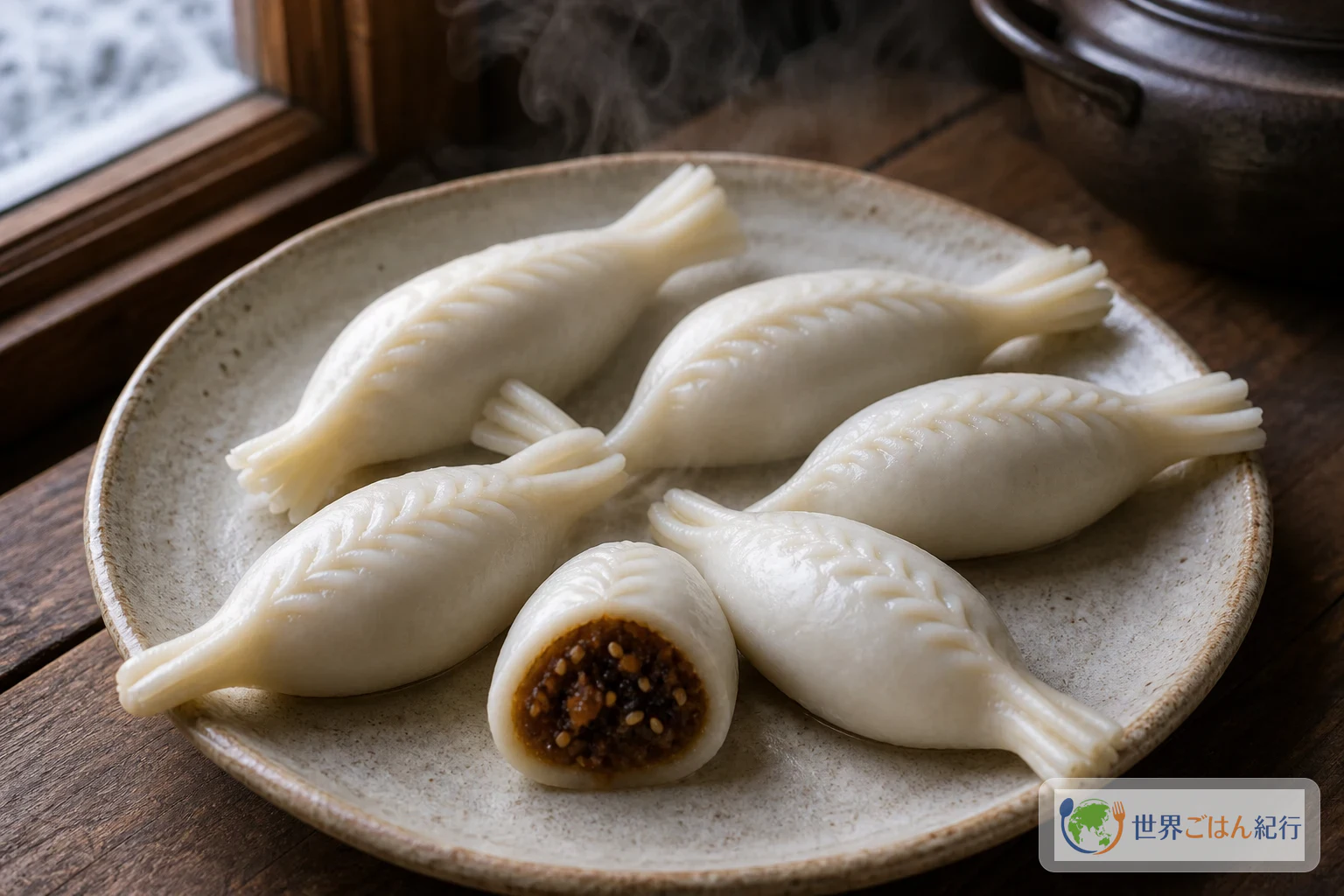
Divide the dough into 12 pieces of about 1.75 oz (50 g) each. Rub your hands lightly with the shaping oil and, in one palm, flatten a rolled piece into an oval of 2.5–3 inches (6–7 cm). Push your thumb into the center and turn the outside with your index and middle fingers to make a vessel with a rounded bottom and a slightly wider mouth. Pull the tip of the tail out thin to about 2.5 inches (6 cm), and keep the wall an even 3–4 mm thick.
If you make the hole too deep the bottom gets thin and tears from the filling's moisture. Conversely, if the wall exceeds 0.25 inch (5 mm) the center stays floury even after steaming. Stroke around the rim with your finger; once the dry cracks are gone and the inside of the vessel has a damp sheen, move on.
4Fill and seal the mouth
10 min
Heat: none
Doneness cue: the filling is completely hidden and the white cracks along the seam are gone
Divide the cooled chaku filling into 12 and roll each to about 18 g. Place the filling into the cavity of the dough, leaving about 0.25 inch (5 mm) of rim. Draw the rim together with your thumb and index finger, closing it little by little until the filling is no longer visible. Finally pinch the tip of the tail to thin it, and press the seam lightly downward.
If the filling pushes out of the mouth, don't force it in; take out just 2 g of the filling. Flour on the seam makes it likely to split after steaming, so just stroke it with a fingertip with a single drop of water. When no white lines remain on the surface, place them on oiled parchment with 1 inch (2 cm) between each.
5Cook with strong steam
15–18 min
Heat: high heat to build steam, then medium
Make sure the steamer's water is boiling and steam is coming out vigorously from the edge of the lid. Arrange the yomari 1 inch (2 cm) apart, cover, and lower to medium heat. Steam for 15 minutes; when the skin changes from a dry white to a slightly translucent white and the tip of the tail doesn't sink when you touch it with a finger, turn off the heat.
If you can't fit all 12 in a single layer, add water between the first and second batches and bring it back to a boil so the steam doesn't weaken. Opening the lid partway drops the temperature and makes the skin tacky. If the bottoms are still floury after 18 minutes, check that the water hasn't run out and extend by only 3 minutes.
6Rest, and serve warm
5 min
Heat: none
Temperature and cooking cue: no new heating; let the residual heat just after removal from the steamer settle for 3–5 minutes
Cut: split one from tail to base lengthwise and check the center of the filling
Move the steamed yomari to a plate and leave them for only 3–5 minutes. If touched immediately the skin is soft and the seam is likely to open. Once the heat has eased, break one open to check the center of the filling. If the chaku is still smoothly flowing and the skin is chewy but you can bite through it, it is done.
If the filling is hard, add 1 tsp (5 ml) hot water back into the filling before steaming the next batch. If the skin is heavy and only the bottom is damp, next time bring the steamer water to a boil first and increase the space between the yomari. Serve the finished yomari with unsweetened milk tea or black tea, and eat while the heat remains.