Ingredients and steps on one page. Print it, or choose “Save as PDF” in the print dialog.
Sekai Gohan
Kue Satu: Javanese Mung Bean Cookies
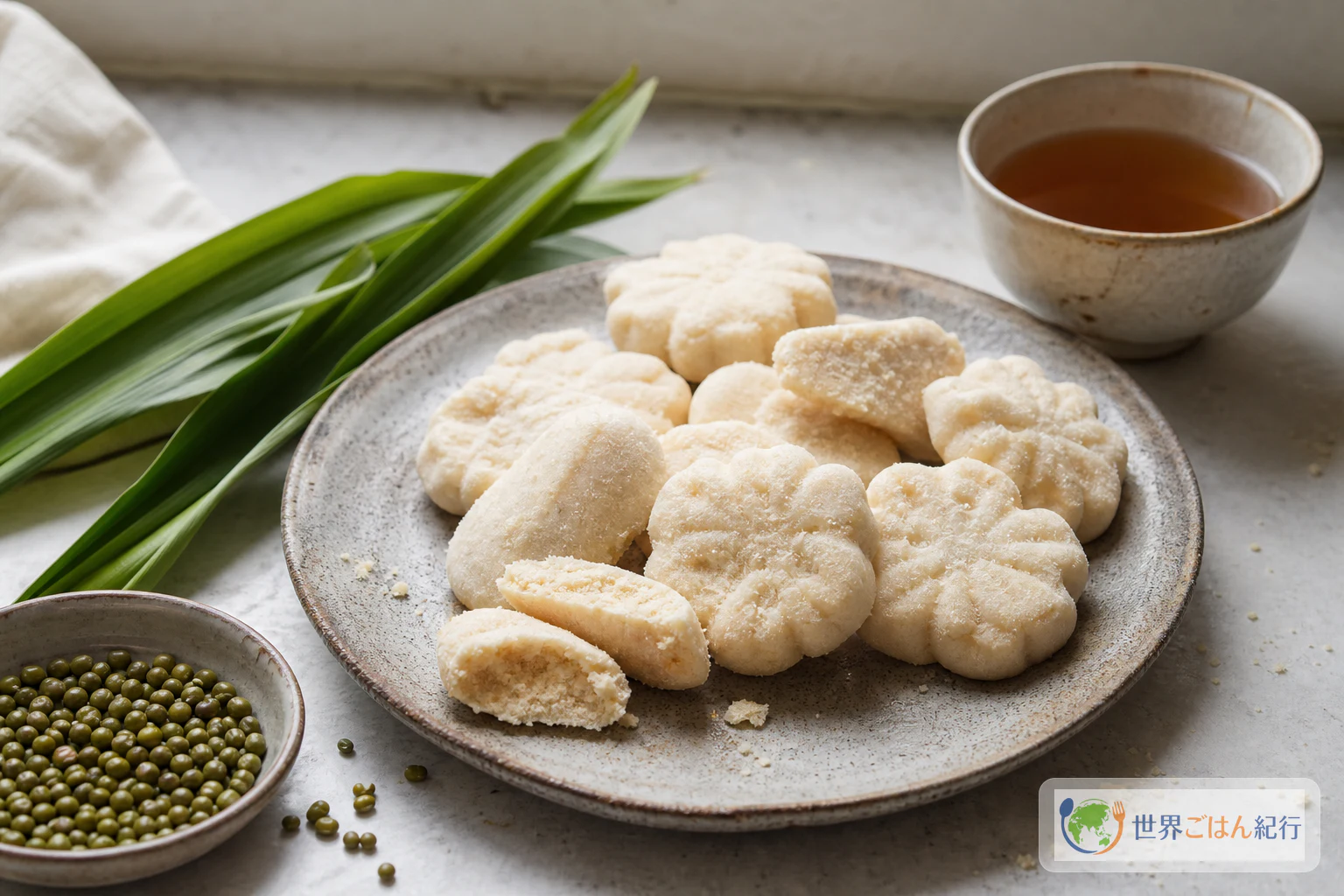
Ingredients
Dough
| Ingredient | Amount | Substitutes & notes |
|---|---|---|
| Hulled mung beans | 10.5 oz (300 g) | Moong dal. With whole-skin mung beans, roughly remove the skins after dry-roasting |
| Powdered sugar | 3.75 oz (105 g) | Not granulated sugar. It tends to leave a gritty texture |
| Pandan leaves | 2 leaves | Frozen is fine. If you have none, leave them out and increase the vanilla slightly |
| Vanilla extract | 1/2 tsp | With vanilla oil, 3–4 drops |
| Salt | A pinch (about 1 g) | Gives the sweetness an outline |
| Lukewarm water | 35–55 ml | Coconut milk diluted with an equal amount of water also works |
Steps
1Dry-roast the mung beans
18 min
Heat is medium-low. Put 10.5 oz (300 g) hulled mung beans and 2 pandan leaves in a frying pan and dry-roast for 15–18 minutes with a wooden spatula, using no oil. Stop when the surface of the beans turns a slightly deeper yellow, the green bean smell is gone and a toasty aroma rises. High heat that scorches them brings bitterness, so if the beans start jumping on the bottom of the pan, lower the heat.
2Cool and grind fine
20 min
No heat is used. Spread the dry-roasted mung beans on a tray and cool for 10 minutes. Grinding them warm traps moisture and makes the flour heavy. Once the heat has gone, run them through the food processor 30 seconds at a time to make a coarse flour. Then grind in small batches in a spice mill and pass through a fine-mesh sieve. Grind again the coarse bits left in the sieve, until the flour is fine enough to feel smooth between your fingers.
3Combine the powdered sugar and the moisture
8 min
No heat is used. Weigh out 9 oz (260 g) mung bean flour and add 3.75 oz (105 g) powdered sugar, a pinch of salt and 1/2 tsp vanilla extract. Drizzle in just 2 tbsp (30 ml) lukewarm water first and mix by rubbing between your fingertips. Aim for the state of damp sand: it holds together when squeezed and breaks softly when pressed with a finger. If the flour pours out loosely, add water 1 tsp at a time; if it is heavy like clay, return mung bean flour 1 tbsp at a time.
4Pack into molds and unmold
15 min
No heat is used. Lightly spoon the flour into small sweet molds and press gently with the pads of your fingers. Press more lightly than you would when shaping rice into an onigiri. Level the surface with a scraper or a small spatula, tap the side of the mold lightly and release. If it cracks, it lacks moisture, so return it to the bowl and add 1 tsp water. If it won't release, you pressed too hard or there is too much water, so put a little less in the mold for the next ones.
5Dry-bake at low temperature
25 min
Preheat the oven to 275°F (130°C). Arrange the shaped dough on parchment paper and bake at 275°F (130°C) for 18–22 minutes. The heat is low-temperature drying. The goal is not browning, but a surface that is dry and smooth and a shape that holds when pressed gently with a finger. If the edges start to turn brown, the temperature is too high, so lower it to 250°F (120°C). The baked pieces are still fragile, so don't touch them while hot.
6Cool and seal
30 min
No heat is used. Leave on the baking sheet for 10 minutes, and once the shape has settled, move to a rack and cool for another 20 minutes. Put in a storage container only when cooled through to the center. If you close the lid while warm, droplets form and they turn moist by the next day. A fully cooled kue satu should hold when picked up and dissolve into a fine powder when bitten.