Ingredients and steps on one page. Print it, or choose “Save as PDF” in the print dialog.
Sekai Gohan
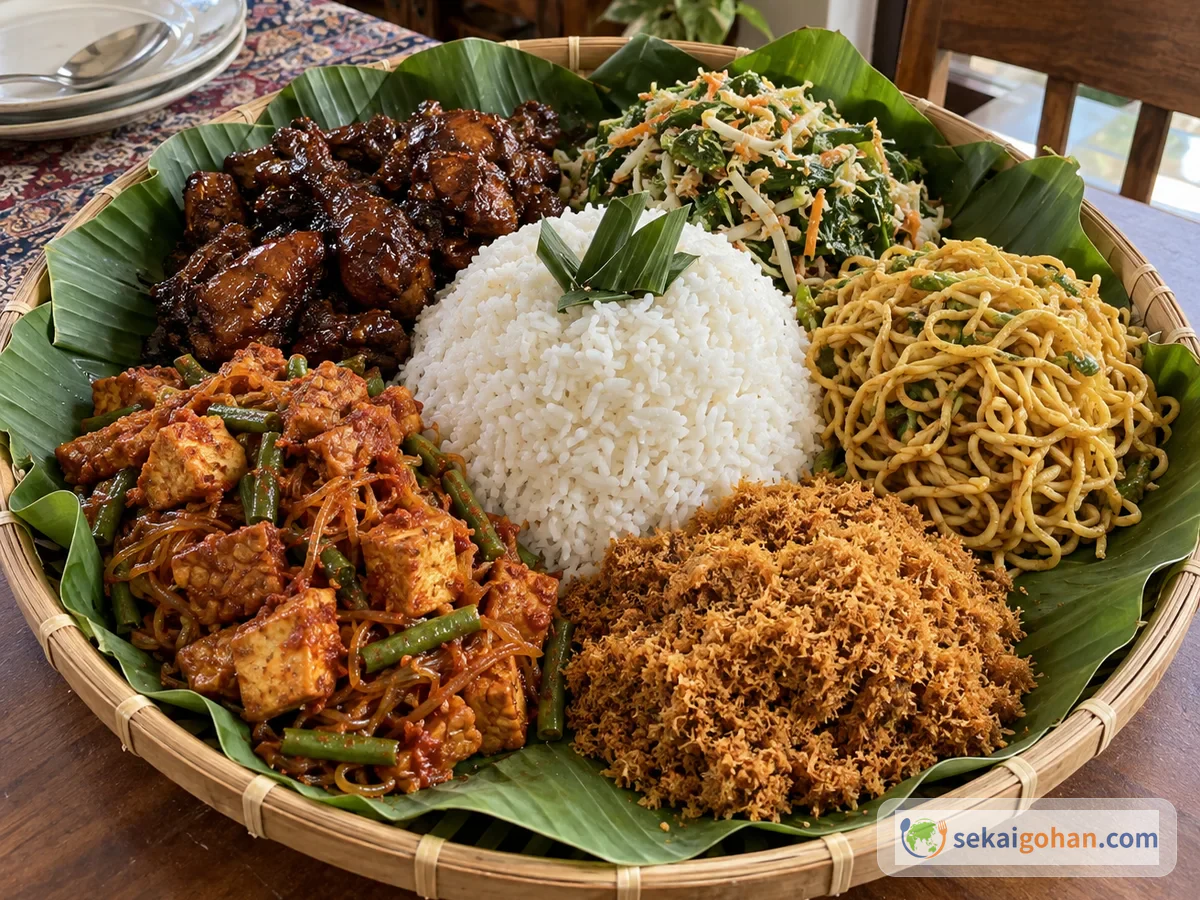
Nasi Ambeng: Javanese Shared-Tray Rice with Chicken, Sambal Goreng and Serunding
Steps
1Make the serunding aromatics
Grind 2 oz (60 g) shallots, 10 g garlic, 15 g rehydrated dried shrimp, and the coriander, fennel, cumin and turmeric into a coarse paste. Put 1 tbsp (15 ml) oil and the paste in a frying pan and fry over medium-low heat for 3–4 minutes until fragrant.
Add 5.5 oz (150 g) unsweetened shredded coconut, 3 g sugar and 3 g salt, and over low heat for 12–15 minutes drive off the moisture, turning the bottom with a wooden spatula. The sign of doneness is a dryness where no moisture seeps out, so that pinching it with your fingers leaves no dampness, and a pale fox-brown color where it comes apart. Do not leave it as a damp floss. A burnt bitterness cannot be undone, so lower the heat and rest the bottom of the pan. Do not stir the blackened parts back in.
2Make the kicap-braised chicken
Finely crush 2 oz (60 g) shallots, 20 g garlic, 1 oz (30 g) ginger, the dried chilies, and the coriander, fennel and cumin. Put 1 tbsp (15 ml) oil in a pot and, over medium heat for 5–7 minutes, fry the aromatics until the oil rises; cook until the moisture has reduced and just before the oil separates.
Add 1.5 lb (700 g) chicken thighs, ¾ cup (200 ml) coconut milk, 1 cup (250 ml) water, ¼ cup (80 ml) kecap manis, the salam leaf, cinnamon, cardamom, star anise and salt. Once it boils, reduce to low and simmer with the lid slightly ajar for 25–30 minutes. The trick is to stop with a little braising liquid left, aiming for a thickness that clings to the chicken while a little remains at the bottom of the pot.
Check the center of the thickest piece with a thermometer, and cook it at 167°F (75°C) or above for at least 1 minute. Without a thermometer, break open a thick piece and confirm that no redness or raw juices remain.
NoteCook chicken to 167°F (75°C) or above at the center for at least 1 minute. Do not return plates, knives, cutting boards and tongs that held raw chicken to the cooked chicken or vegetables. When taking the temperature, insert the tip of the thermometer into the middle of the thick part, and wash and sanitize it after measuring.
3Cook the rice and let it steam
Lightly rinse 1 lb (450 g) jasmine rice until the water is almost clear, and drain in a sieve for 10 minutes. Put the rice, 2¼ cups (540 ml) water, 4 g salt and the knotted pandan leaf in a heavy pot and bring to a boil over medium heat. When it boils, lower to low heat and, without opening the lid, cook for 12–15 minutes, on low heat until the sound of water disappears. Small holes forming on the surface are the sign.
When you turn off the heat, let it steam for 10 minutes so the grains stand up. Turn it from the bottom with a rice paddle, without making it soft and pasty, leaving the grains in clumps that can be heaped in the center of the tray. If water remains, remove the lid and add just 2–3 more minutes over low heat. If the bottom is about to scorch, do not stir; move it to another container to steam.
4Simmer the sambal goreng
Cut 5.5 oz (150 g) tempeh, 5.5 oz (150 g) firm tofu and 6.5 oz (180 g) potatoes into 1 inch (2 cm) cubes, brown the surfaces with a suitable amount of the 2 tbsp (30 ml) oil and remove. In the same pot, fry 2 oz (60 g) shallots, 15 g garlic, the red chilies, 15 g rehydrated dried shrimp and 15 g chili paste over medium heat for 4–5 minutes.
Add ½ cup (150 ml) coconut milk, ½ cup (100 ml) water and 2 tbsp (30 ml) kecap manis, and return the browned ingredients, 3.5 oz (100 g) green beans and 1 oz (30 g) rehydrated glass noodles. Over low heat for 8–10 minutes, cook until the glass noodles have absorbed the liquid and a reddish-brown sauce thinly coats the beans and tofu. Turn off the heat before the liquid disappears completely. If the bottom of the pot is drying, add water 1 tbsp at a time and do not stir in anything that has scorched.
5Blanch and dress the urap vegetables
Cut 5.5 oz (150 g) cabbage 1 inch (2 cm) wide and 3.5 oz (100 g) green beans into 1 inch (3 cm) lengths, leave 3.5 oz (100 g) bean sprouts whole, and blanch them in boiling water in turn. The guideline is 2 minutes for the beans, 1 minute for the cabbage and 30 seconds for the bean sprouts. Drain in a sieve and cool briefly, then without squeezing hard by hand, wrap them in paper towels and press out the water. This is the preparation that keeps water from coming out of the vegetables.
Put 2.75 oz (80 g) shredded coconut, the red chili, 1 oz (30 g) shallots and 1 garlic clove in a frying pan over low heat, and add 2 tsp (10 ml) lime juice, 3 g sugar and 3 g salt. Toss the vegetables with the seasoned coconut once it has cooled slightly, and when the coconut coats all the vegetables evenly, keep it in a separate container until just before eating. Dressed while hot, the vegetables release water. Stop at the point where the vegetables keep their green color and crunch, with a little resistance at the center when you bite.
6Stir-fry the noodles last
Put 1 tbsp (15 ml) oil in the frying pan and fry 1 oz (30 g) shallots, 1 garlic clove, 10 g rehydrated dried shrimp and 10 g chili paste over medium heat for 2–3 minutes. Add 3.5 oz (100 g) mustard greens or komatsuna, 3.5 oz (100 g) firm tofu and 9 oz (250 g) steamed Chinese noodles, and spend 3–4 minutes loosening the noodles over strong heat for a short time, without breaking them.
Add 2 tbsp (30 ml) kecap manis from the side of the pan, and turn off the heat just before all the noodles turn light brown and the leafy greens wilt. Instead of adding water and simmering, loosen clumping noodles with a little oil. Noodles that have become too soft do not fully recover. Served hot onto the tray, they transfer moisture, so let the steam escape for 2–3 minutes before plating.