Ingredients and steps on one page. Print it, or choose “Save as PDF” in the print dialog.
Sekai Gohan
Pempek: Palembang Fish Cakes with Sweet-Sour Cuko Sauce
Ingredients
Fish cake dough
| Ingredient | Amount | Substitutes, notes |
|---|---|---|
| White fish fillet or frozen surimi | 1 lb (450 g) | Fresh cod, pollock, swordfish. Remove skin and bones |
| Ice water | ½ cup (120 ml) | Cold water tightens the dough |
| Salt | 1 1/4 tsp | Develops the fish's stickiness |
| Light brown sugar | 1 tsp | Rounds off the fish's sharp edges |
| Garlic | 1 clove | Grated. Don't overdo it |
| White pepper | 1/3 tsp | Black pepper also works |
| Egg white | 1 | Binds the dough. Don't use the yolk in the cuko |
| Tapioca starch | 8 oz (220 g) | Same amount of sago flour if you have it. Don't overdo it |
| Neutral oil | 2 tsp | For the hands. Not mixed into the dough |
For kapal selam
| Ingredient | Amount | Substitutes, notes |
|---|---|---|
| Eggs | 2 | Beat well; use about 2 tbsp per piece |
| Salt | a pinch | Mixed into the egg |
Cuko
| Ingredient | Amount | Substitutes, notes |
|---|---|---|
| Dark brown sugar or palm sugar | 4 oz (120 g) | Chop finely |
| Water | 1½ cups (350 ml) | If it reduces too far, add 2 tbsp at a time |
| Tamarind paste | 2 tbsp | Pickled plum as a stand-in changes the flavor; a last resort |
| Rice vinegar | 2 tbsp | Raises the acidity. Some local versions also use vinegar |
| Garlic | 3 cloves | Crush, then chop |
| Red chili | 1 | Remove seeds for less heat |
| Salt | 1/2 tsp | Adjust at the end |
Boiling, frying and serving
| Ingredient | Amount | Substitutes, notes |
|---|---|---|
| Boiling water | 2 quarts (2 L) | With 1 tsp salt |
| Frying oil | about 3 cups (700 ml) | 1 inch (3 cm) from the bottom of the pot |
| Cucumber | 1 | 0.5 inches (1 cm) cubes. Chill them |
| Chinese egg noodles or stir-fry noodles | 1 portion | Boil and drain. Optional |
| Dried shrimp powder | 2 tsp | A small amount if no shellfish allergy |
Steps
1Grind the fish cold into a paste
8 min
No heat is used. Pat 1 lb (450 g) white fish dry and cut it into 1 inch (2 cm) cubes. Put the fish, ¼ cup (80 ml) of the ½ cup (120 ml) ice water, the salt, brown sugar, garlic and white pepper in a food processor and run it for 2 minutes, stopping every 30 seconds. Scrape the sides with a spatula partway, add the egg white and run another 30 seconds. It is enough when the dough is a cold white paste that clings slightly to your finger. If it warms and slumps, rest the whole bowl in the refrigerator for 10 minutes.
2Fold in the tapioca starch
7 min
No heat is used. Move the fish paste to a large bowl and add 8 oz (220 g) tapioca starch in three portions. Mix by cutting with a spatula, and once no starch is visible, add the remaining ice water 1 tbsp at a time. The guide is a firmness you can lift when your hands are lightly oiled, with the surface still slightly uneven. Kneading hard to make it smooth makes it tough, so stop when the powderiness is gone.
3Shape lenjer and kapal selam
18 min
No heat is used. With lightly oiled hands, roll 70 percent of the dough into sticks about 1 inch (3 cm) across and 4.5 inches (12 cm) long. Divide the rest in two, flatten each into a bowl shape on the palm, put in 2 tbsp of beaten egg, and close the opening. Too much egg splits them in the water, so don't fill them to the brim. Pinch the seam closed and smooth the part where the white dough overlaps by about 0.5 inches (1 cm). A stick should lift without breaking and spring back softly when pressed; an egg-filled piece should not seep egg when tilted. Small cracks widen in the water, so smooth them away with an oiled finger.
4Boil in barely bubbling water
14 min
Bring 2 quarts (2 L) of water to a boil in a pot and add 1 tsp salt. The heat is medium to low-medium. Lower it until the surface just shivers, then add the 1 inch (3 cm) by 4.5 inches (12 cm) sticks and the egg-filled pieces about 1 inch (2 cm) thick. A hard boil splits the egg-filled ones. Boil the long ones 3 minutes after they float, and the egg-filled ones 5 minutes after they float. They are done when white and firm to the center and springy when pressed. Lift into a colander and drain the surface for 10 minutes.
5Simmer the cuko
12 min
Put the dark brown sugar, water, tamarind paste, rice vinegar, garlic, chili and salt in a small pot. Dissolve the sugar over medium heat, then once it boils, reduce to low and simmer 8 minutes. The heat is right when small bubbles rise at the edge of the pot. Stop when the raw garlic smell is gone and it drops freely from a spoon. Reduced to a paste, it won't soak into the pempek and becomes heavy. Once it has cooled slightly, strain through a sieve if you like.
6Fry at about 350°F (170°C)
8 min
Put oil 1 inch (3 cm) deep in a pot and heat to 350°F (170°C) over medium heat. Add the drained pempek and fry the long ones for 3 minutes and the egg-filled ones for 4 minutes. Hold the oil at 165 to 175°C. Remove when the surface is a light golden brown, the small bubbles have calmed and the outside feels slightly firm when held with chopsticks. A dark brown at high heat puts char ahead of the chewy inside.
7Slice and pour on the cuko
5 min
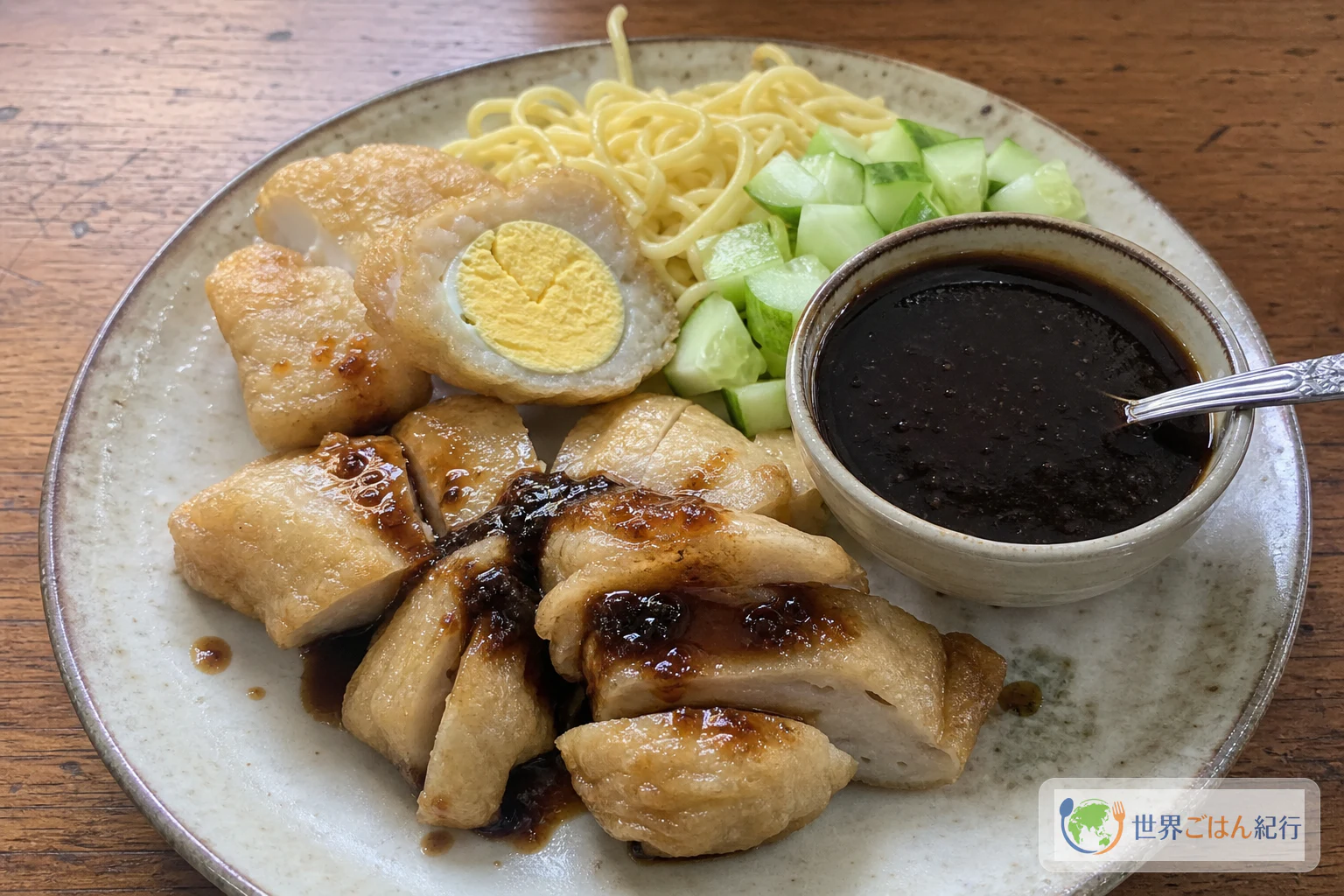
No heat is used. Rest the fried pempek for 2 minutes, then cut the sticks into 0.5 inches (1.5 cm) slices on the diagonal and the egg-filled pieces into four. Set cucumber and boiled yellow noodles on a plate and put the pempek on top. Don't pour all the cuko on at once: spoon about 3 tbsp over just before eating and serve the rest in a small bowl. If using dried shrimp powder, sprinkle a little over after the cuko. If the acidity seems strong, eating cucumber and noodles together rounds it off.