Ingredients and steps on one page. Print it, or choose “Save as PDF” in the print dialog.
Sekai Gohan
How to Make Serabi: Javanese Rice Flour and Coconut Pancakes
Ingredients
Batter
| Ingredient | Amount | Substitutes and notes |
|---|---|---|
| Rice flour (finely milled, for baking) | 6.5 oz (180 g) | Regular long-grain rice flour also works. Glutinous rice flour alone makes it heavy |
| Tapioca starch | 20 g | Cornstarch or potato starch, 15 g, also works. The edge is a little less light |
| Raw cane sugar (light brown or turbinado) | 12 g | For the batter. Helps fermentation and browning |
| Dry yeast | 2 g | Instant type |
| Salt | 2 g | Just under 1/3 tsp |
| Coconut milk | 1 cup (250 ml) | Shake the can well before measuring |
| Lukewarm water | ½ cup (110 ml) | 35–38 degrees C |
| Rice bran oil | 2 tbsp | Used for baking. Neutral vegetable oil also works |
| Pandan leaf | 1 | For aroma. Can be omitted |
Kinca and finishing
| Ingredient | Amount | Substitutes and notes |
|---|---|---|
| Coconut milk | ½ cup (150 ml) | For the kinca |
| Palm sugar | 2.75 oz (80 g) | If you cannot find it, use 2 oz (60 g) dark brown sugar and 20 g raw cane sugar |
| Water | 3.5 tbsp (50 ml) | Used at the start of the simmer |
| Salt | 1 g | Tightens the sweetness |
| Pandan leaf | 1/2 | Can be omitted |
| Desiccated coconut | 20 g | For finishing. Optional |
| Banana | 1 | Thinly sliced, if you serve it alongside |
Steps
1Mix the flour and liquid
7 min
Heat: warm the liquids to 35–38 degrees C in a 600 W microwave for 40 seconds.
Put 1 cup (250 ml) coconut milk and ½ cup (110 ml) lukewarm water in a heatproof container and microwave at 600 W for 40 seconds. It should not feel hot to the touch, only a little warmer than body temperature, 35–38 degrees C. In a bowl, put 6.5 oz (180 g) rice flour, 20 g tapioca starch, 12 g raw cane sugar, 2 g dry yeast, and 2 g salt, and mix for 30 seconds. Pour in the liquid in 3 additions and whisk for 2 minutes. Aim for a batter with no white lumps of flour left, one that falls from the whisk in a thin, slow stream.
2Rest the batter
30 min
Heat: no heat. Let it rest at room temperature, 25–28 degrees C.
Cover the bowl with plastic wrap or a damp cloth and leave it for 30 minutes at a room temperature of 25–28 degrees C. If the room is about 20 degrees C, give it 40 minutes; on a hot day, check at 25 minutes. It is enough when small bubbles increase on the surface and you can see traces of fine bubbles at the edge of the bowl. It does not need to rise much. Just before baking, stir only 5 times from the bottom to bring back any flour that has settled. The consistency should fall slowly from the whisk, with no white lumps at the bottom. If you stir too hard, the bubbles escape and the center turns heavy.
3Simmer the kinca
9 min
Heat: medium-low, 6–7 minutes, keeping a gentle simmer.
Put 2.75 oz (80 g) palm sugar, 3.5 tbsp (50 ml) water, 1 g salt, and the pandan leaf in a small pan over medium-low heat. When the sugar dissolves, add ½ cup (150 ml) coconut milk and simmer for 6–7 minutes, stirring with a wooden spatula. The guide is fine bubbles that keep rising along the edge of the pan, and a thin film left on the spatula when you lift it. If you use a thermometer, stop at about 103 degrees C. If you reduce it too far, it hardens like candy as it cools, so take it off the heat while it is still a bit loose.
4Heat the pan and lightly oil it
5 min
Heat: preheat over medium-low for 3–4 minutes.
Set a small frying pan, a mini egg pan, or a cast-iron pan with hollows over medium-low heat and warm it for 3–4 minutes. Add a scant 1 tsp rice bran oil and spread it thinly and evenly over the bottom and sides. You are ready to bake when the oil moves freely, shines evenly, and a drop of batter touched to it immediately foams in small bubbles. If it is hot enough to smoke, lower to low heat and wait 30 seconds. If you pour the batter into a pan that is not preheated enough, the edge sets white and wet.
5Cover and bake
12 min
Heat: medium-low for 2 minutes, covered over low heat for 5–6 minutes, then uncovered over medium-low for the last 2 minutes.
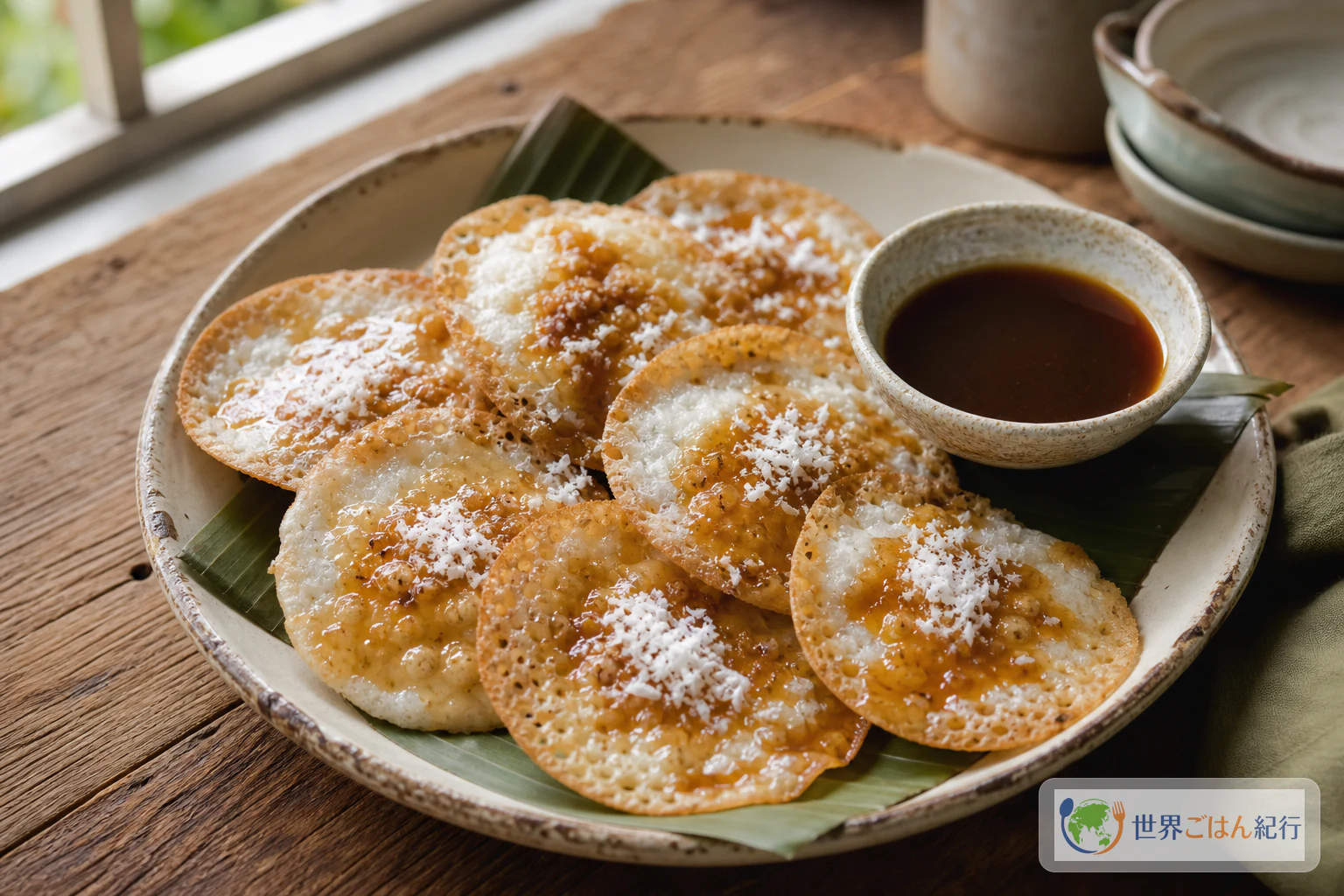
Pour in about ¼ cup (70 ml) of batter with a ladle and let it spread naturally to 10–12 cm across. For the first 2 minutes, use medium-low heat and build fine bubbles at the edge. Cover, lower the heat to low, and steam-bake for 5–6 minutes. When the center sets white, small holes remain on the surface, and the edge turns golden, remove the lid. Go back to medium-low for the last 2 minutes or so to drive off moisture. It is done when you slip a spatula under the edge and the bottom moves as one piece.
6Lift out and serve with kinca
6 min
Heat: 1 minute over low heat before lifting, to dry the bottom.
Lower the heat to low and run a spatula once around the edge. Do not pull it off by force; lift from where it comes up naturally. If the bottom is damp, leave it just 1 more minute at the same heat. Put the baked serabi on a plate or a banana leaf, with the kinca served on the side. Spoon on kinca just before eating and scatter about 1 tsp desiccated coconut. If you pour on too much first, the light edge goes soft early.