Ingredients and steps on one page. Print it, or choose “Save as PDF” in the print dialog.
Sekai Gohan
Soto Padang: West Sumatran Clear Beef Soup with Crisp Fried Beef
Ingredients
| Ingredient | Amount | Role |
|---|---|---|
| Bone-in beef shank, in large pieces | 2¼ lb (1 kg) | Gives the broth and the fried beef topping |
| Water, cold | 2 quarts (2 L) | The broth |
| Lemongrass (serai), white part, bruised | 2 stalks | Citrus aroma |
| Galangal (lengkuas), bruised | 1 piece, 1 inch (2.5 cm) | Earthy, warm aroma |
| Salam leaves (daun salam) | 2 | Woody, herbal note |
| Makrut lime leaves (daun jeruk), center rib removed | 4 | Bright citrus |
| Star anise (bunga lawang), dry-toasted | 1 | Sweet, anise warmth |
| Cloves (cengkeh), dry-toasted | 2 | Sweet, sharp spice |
| Cardamom pods (kapulaga), lightly crushed and dry-toasted | 2 | Sweet, floral lift |
| Cinnamon stick (kayu manis) | 1½ inches (4 cm) | Sweet, woody depth |
| Shallots (bawang merah), roughly chopped | 3½ oz (100 g) | Body of the spice paste |
| Garlic (bawang putih) | 10 cloves (4 for the pot, 6 for the paste) | Broth aroma and paste |
| Ginger (jahe), sliced | 1-inch (2.5 cm) piece, 25 g | Warmth, cuts the beefy smell |
| Candlenuts (kemiri), raw | 4 | Rich, rounded paste |
| Ground turmeric | ½ tsp | Golden color, warmth |
| Coriander seeds, dry-toasted and ground | 2 tsp | Nutty aroma in the broth |
| Nutmeg (pala), freshly grated | ½ tsp | Sweet, rounded spice |
| White pepper (merica putih), freshly ground | 2 tsp (½ tsp pot, ½ tsp potato cakes, 1 tsp paste) | Peppery heat |
| Salt | 3 tsp (1½ tsp pot, ½ tsp potato cakes, 1 tsp broth) | Seasoning |
| Sugar, palm sugar (gula aren) if you have it | 1 tsp | Rounds the broth |
| Neutral oil | 3 tbsp (45 ml) potato cakes, 3 tbsp (45 ml) paste, ¼ cup (60 ml) beef | Shallow frying |
| Dried rice vermicelli (bihun) | 5 oz (150 g) | The noodles in each bowl |
| Potatoes, peeled | 1 lb (500 g) | Six potato cakes (perkedel kentang) |
| Scallions (daun bawang), finely sliced | 2 | Fresh garnish |
| Celery (seledri), finely chopped | 2 stalks | Fresh, clean garnish |
| Fried shallots (bawang goreng) | 4 tbsp | Crunchy, sweet topping |
| Limes (jeruk nipis), in wedges | 2 | Sourness at the table |
| Sambal (sambal lado) | 3 tbsp | Heat at the table |
| Sweet soy sauce (kecap manis), optional | 2 tbsp | Sweetness at the table |
Steps
1Toast the spices and bring the beef to a boil
Dry-toast the coriander seeds in a small pan for about 1 minute, until they smell nutty, then grind them to a powder. In the same pan, toast the star anise, cloves and crushed cardamom pods briefly and set them aside for step 8. Put the beef shank, cold water, 4 lightly crushed garlic cloves, ground coriander, 1½ tsp salt and ½ tsp white pepper into the stockpot and bring it to a boil over high heat. For the first 8 to 10 minutes, skim off the grey-white foam as it rises. Move on when hardly any new foam comes up and the liquid around the bones looks clear.
Clarity is decided nowSoto Padang has no coconut milk to hide a muddy broth, so how clear it ends up is settled in these first minutes. Foam you leave on the surface gets churned back into the liquid by the boil, and you can't strain it out afterwards.
2Simmer until the beef is fork-tender
Turn the heat down as low as it will go and set the lid half on. The surface should barely move, with a bubble breaking only now and then. A hard boil now clouds the broth you just skimmed clear. Simmer for about 2 hours, and start the potatoes in step 4 while it cooks. It is done when a fork slides into the thickest piece of meat with no resistance.
3Lift out the beef and strain the broth
Lift the beef onto a cutting board and let it cool for about 15 minutes, until you can handle it. Pour the broth through the fine-mesh sieve into a large bowl. Discard what stays in the sieve, rinse the pot and pour only the clear liquid back in. The broth should look pale gold, with nothing floating in it.
4Boil, mash and shape the potatoes
Boil the peeled potatoes for about 20 minutes, until a skewer passes through with no resistance. Drain them well and mash them smooth while still hot, with ½ tsp salt and ½ tsp white pepper. Divide the mash into six portions and shape each into a low round about ⅝ inch (1.5 cm) thick. The cakes are ready when the mash is free of lumps and the edges hold without cracking.
5Shallow-fry the potato cakes
Heat 3 tbsp (45 ml) oil in the wide skillet over medium-high heat. Lay in the potato cakes and fry for about 3 minutes, then turn them once with a spatula and fry the second side for about 3 minutes more. A thin layer of oil cooks them through and keeps their flat shape. They are done when both faces are deep golden. Drain on the rack.
Hot oilLay each cake and each beef slice into the pan away from you, and keep the handle turned in from the edge of the stove. Water on the surface makes hot oil spit.
6Grind the spice paste
Put the shallots, the remaining 6 garlic cloves, ginger, candlenuts, turmeric, nutmeg and 1 tsp white pepper into the mortar or a small food processor. Pound or pulse, scraping down the sides, until you have a damp, smooth paste. A fine paste fries evenly and gives its aroma to the oil. Stop when no pieces of candlenut or shallot are left and the paste holds together in a moist mass.
7Fry the paste until the oil separates
Wipe out the skillet and heat the next 3 tbsp (45 ml) oil over medium-high heat. Add the paste and fry for about 5 minutes, stirring the whole time so it doesn't catch. The raw, sharp smell of shallot fades and the color turns deeper orange-brown. It is ready when the oil pulls away from the paste and pools at the edges of the pan.
8Infuse the broth with the whole aromatics
Scrape the fried paste into the pot of clear broth. Add the lemongrass, galangal, salam leaves, makrut lime leaves, toasted star anise, cloves and cardamom, the cinnamon, sugar and the last 1 tsp salt. Bring it back to a gentle simmer and let the aromatics steep for 15 minutes. Then turn the heat to its lowest setting and keep the broth hot. It is ready when it smells of citrus and warm spice and still looks clear gold.
9Slice and fry the beef
Slice the cooled beef across the grain, ⅛ inch (3 to 4 mm) thick. The two-hour simmer has already cooked it all the way through. The frying only gives it a crust. Heat the last ¼ cup (60 ml) oil over medium-high until a slice sizzles sharply as it goes in. Fry in a single layer, in batches, for 3 to 5 minutes per batch, turning once. Lift each slice onto the rack when both sides are colored and the edges are crisp.
Thin, across the grain, one layerSimmered beef falls apart easily. Thin slices cut across the grain hold together in the pan and stay tender in the bowl. A single layer in hot oil crisps the edges before the middle dries out.
10Soften the rice vermicelli
Put the rice vermicelli in a heatproof bowl and pour over enough boiling water to cover it. Leave it until the strands turn translucent white all the way through. Drain it right away, rinse it under cold water to stop the softening, and shake the colander hard to get rid of the water. The strands should be limp but still springy when you pinch one.
11Assemble and pour the broth
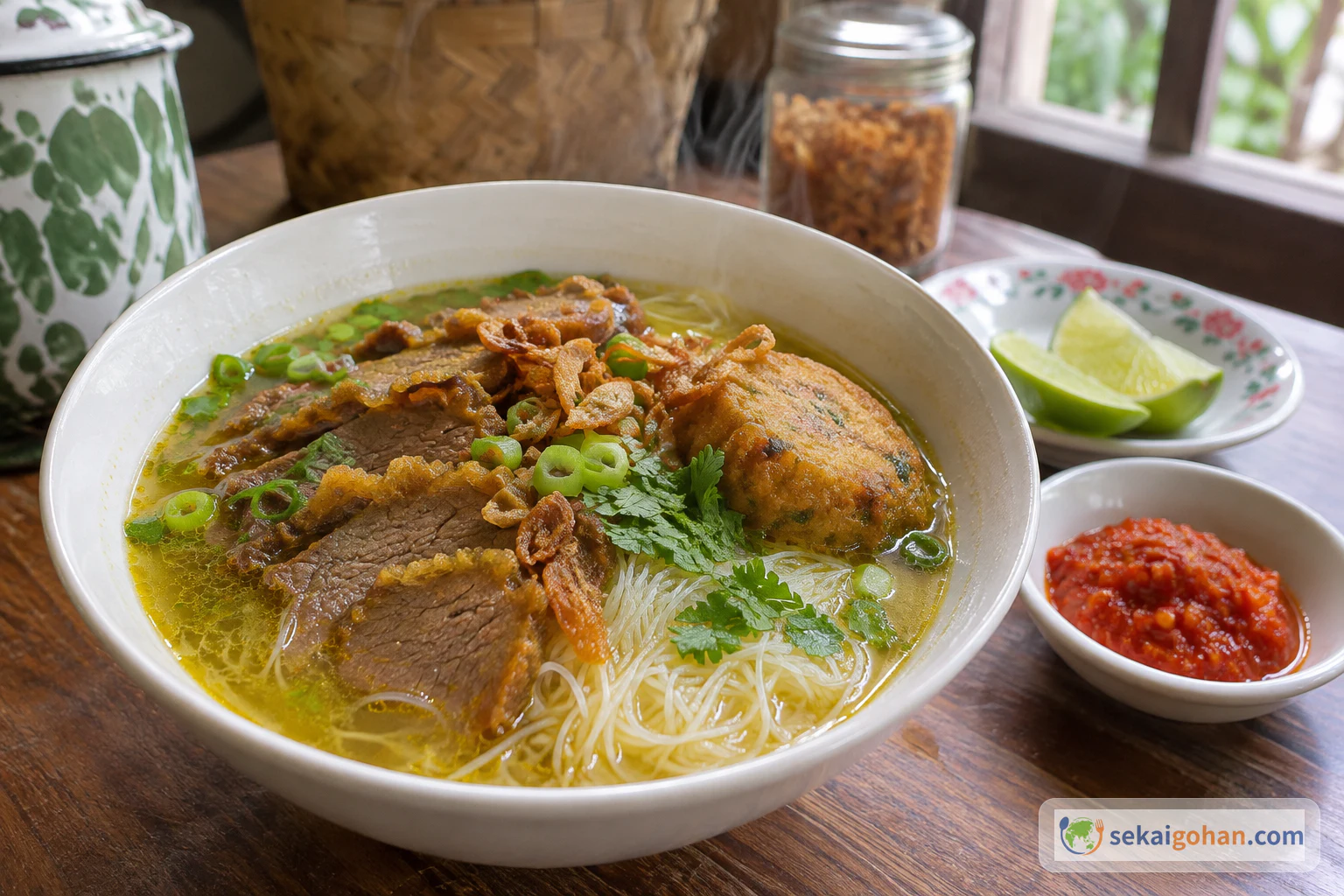
Bring the broth back to a boil. Divide the vermicelli among six bowls, then top each with fried beef slices and one potato cake. Ladle the boiling broth over the top, leaving the whole spices behind in the pot and stopping before the bowl is full. Scatter the scallions, celery and fried shallots on top, and set the lime, sambal and kecap manis on the table. It is ready when the broth covers the noodles and the garnish floats on top.