Ingredients and steps on one page. Print it, or choose “Save as PDF” in the print dialog.
Sekai Gohan
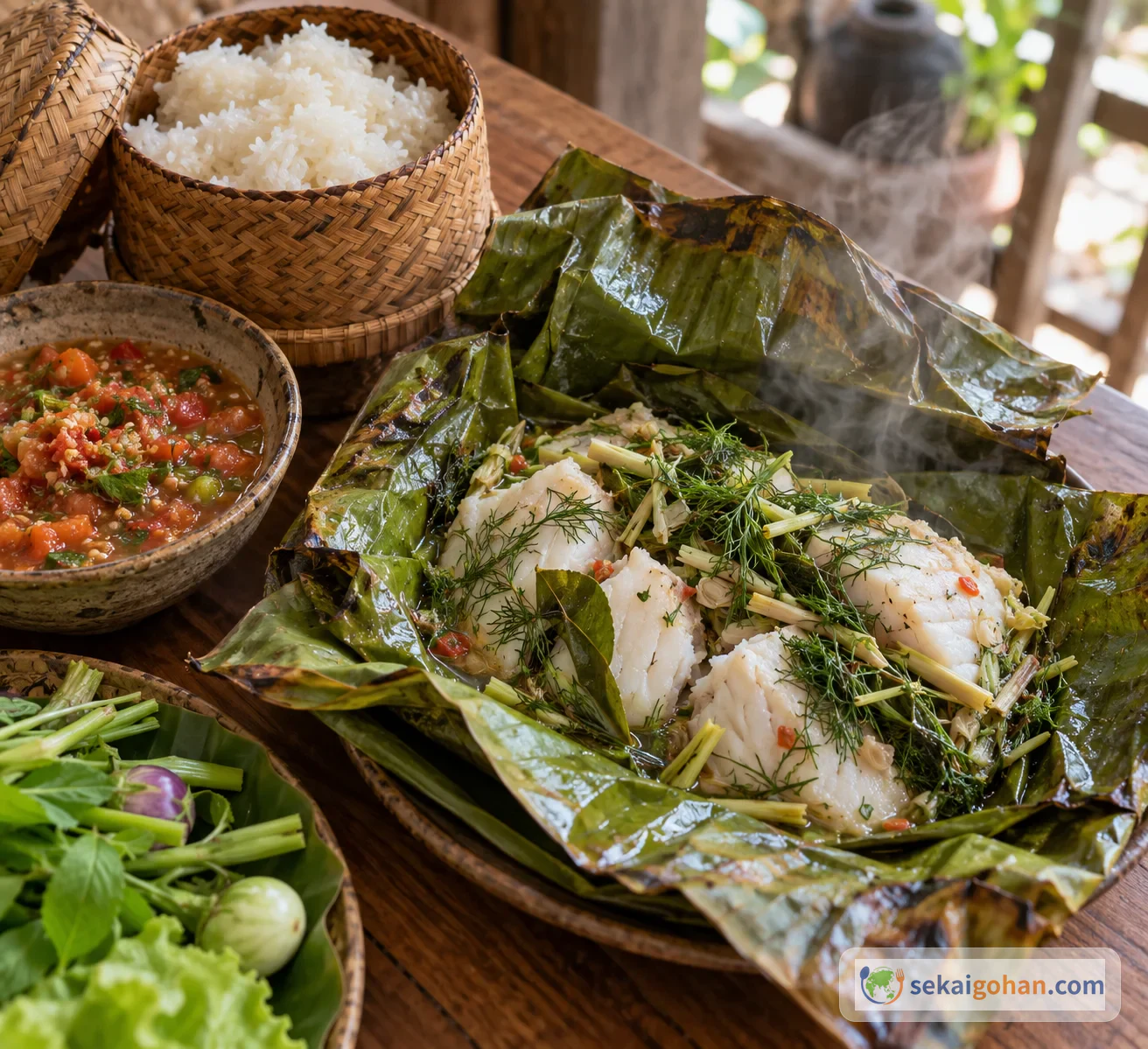
Mok Pa: Lao Herb-Steamed Fish in Banana Leaves
Ingredients
Fish and aromatics
| Ingredient | Amount | Substitutes & notes |
|---|---|---|
| White fish (skinless, boneless) | 600 g | About 1.3 lb. Cut into 3 cm (1 1/4 in) cubes. Lean fish such as tilapia, catfish or cod. Pat very dry with paper towels |
| Lemongrass | 2 stalks | Slice the tender lower part 2 mm thick. If frozen, thaw and pat dry |
| Galangal | 3 thin slices (about 10 g) | 10 g ginger can stand in; the aroma will be milder |
| Shallots | 4 | Peel and halve. 1/2 small onion also works |
| Garlic | 4 cloves | Roughly chopped |
| Red chiles | 3 | Leaving the seeds in makes it hotter. Use 1 for less heat |
| Salt | 1 tsp | The first salt for pounding the aromatics. Don't adjust it later based on the fish sauce |
| Fish sauce | 2 tbsp | Can be swapped for 1 tbsp padaek + 1 tbsp fish sauce, but the aroma gets stronger |
| Sticky (glutinous) rice, uncooked | 2 tbsp (about 25 g) | Dry-toast and crush coarsely. With store-bought glutinous rice flour, use about 1 tbsp |
| Egg | 1 | Beaten. Without the egg the filling releases more liquid, so don't make the parcels thick |
| Dill | 1 cup (about 30 g) | Remove the tough stems and chop roughly. It's the heart of the aroma here, so don't skip it |
| Scallions | 4 | Cut into 3 cm (1 1/4 in) lengths |
| Makrut lime leaves | 3 | Remove the tough center vein and slice into very fine threads. If frozen, thaw and pat dry |
| Thai basil | A handful (optional) | Adds aroma. Leave out if you don't have it |
Wrapping and accompaniments
| Ingredient | Amount | Substitutes & notes |
|---|---|---|
| Banana leaves | 8 pieces, 10 inches (25 cm) square | About 10 in square. 2 per parcel × 4. Frozen leaves tear easily, so soften them in hot water and back with parchment paper if needed |
| Sticky rice | 10.5 oz (300 g) | Soak 6–12 hours and steam separately. Roll the cooked rice into balls to scoop up the fish |
| Tomatoes | 2 medium (about 10.5 oz (300 g)) | For the spicy tomato dip. A side based on how it's served locally; don't mix into the fish parcels |
| Garlic | 1 clove | For the tomato dip |
| Red chile | 1 | For the tomato dip. Adjust the heat |
| Lime juice | 1 tbsp | Lemon juice works; the aroma changes |
| Fish sauce | 1 tsp | For the tomato dip. For fish allergies, change the side as well |
| Bamboo skewers or wooden picks | 4–8 | To secure the top of the leaves. Don't use metal staples |
Steps
1Soak and steam the sticky rice
6–12 hours soaking + 25–30 min steaming
Rinse 10.5 oz (300 g) sticky rice three times and soak it in cold water for 6–12 hours. In a hurry, you can soak it in warm water for 1 hour instead. Line a steamer with a damp cotton cloth or steaming cloth, spread the drained rice on it, and steam over medium heat with a steady flow of steam for 25–30 minutes. It's done when there's no hard core in the center of the grains and it turns sticky when pressed between your fingers. Transfer it to a covered container so it doesn't dry out, and keep it warm until the fish is wrapped. Use separate tools from those for the raw fish, and don't let any fish juices drip onto the rice.
2Pound the aromatics into a coarse paste
5 min
Add the lemongrass, galangal, shallots, garlic, chiles and salt to a mortar in that order and pound. Adding the salt first is the key: the grains help break down the fibers. Pound with the pestle for about 5 minutes and stop at a coarse paste where the lemongrass fibers are still visible. Don't turn it into a watery purée. If using a food processor, pulse a few times for 1–2 seconds each, scraping down the sides and keeping some texture. Remove the center vein from the makrut lime leaves and slice them into very fine threads; don't pound them in this step, but add them straight to the fish in the next. Even if the paste is too dry to move around, don't add water. The fish sauce goes in at the next step.
TipIf you pound it too smooth, the texture of the lemongrass fibers disappears. It also blends with the liquid from the fish into one mass, which tends to make the inside of the parcel loose. Stop when no liquid pools at the bottom of the mortar and a pinch holds together like moist minced aromatics. If you used a machine, check the coarseness by eye before adding it to the fish.
3Mix the fish with the herbs and chill
10 min + 10 min resting
Cut 1.25 lb (600 g) white fish into 1 inch (3 cm) cubes, pat the surfaces very dry with paper towels and put them in a bowl. Add the aromatic paste, 2 tbsp fish sauce, 2 tbsp dry-toasted and coarsely crushed sticky rice and 1 beaten egg, and fold from the bottom so the edges of the fish don't break apart. Add the dill, scallions, finely sliced makrut lime leaves and Thai basil, if using, last, mixing only lightly so the leaves don't wilt too much.
What you want is for no liquid to run to the bottom when you scoop up the mixture, and for the fish to have a thin coating on its surface. If liquid pools, pat the fish dry again and chill before moving on. Cover with plastic wrap and rest in the refrigerator for 10 minutes so the aromatics meld. Don't taste the raw fish. Saltiness varies with the brand of fish sauce, so adjust it with the sides before serving.
4Soften the leaves and wrap
10 min
Wash the 10 inches (25 cm) square banana leaves, wipe them dry, and dip them in boiling water for 10–15 seconds or hold them over steam. They're ready when the color deepens, they turn glossy and bend supplely. Stack 2 leaves crosswise so one set of veins runs horizontally and the other vertically, and place 1/4 of the filling (about 7 oz (200 g)) in the center. Fold the bottom edge up, tuck the left and right sides in, overlap the top edge to make a rectangle, and secure the top with a bamboo skewer or wooden pick.
If frozen leaves split, keep the two-leaf stack intact and turn the torn side to the outside. If needed, reinforce the bottom with a strip of leaf. Make all the parcels the same thickness and set them in the steamer seam side up. Leave no gaps for juices to leak, but don't squash the fish.
TipIf white lines appear when you bend a leaf and it looks ready to crack, give it a few more seconds in boiling water or steam. Place the filling before the leaf surface dries, and cross the veins so that a tear in one direction is less likely to run through the whole parcel. If a parcel is too big, split the filling into two. Avoid making it thicker and lengthening the steaming time.
5Steam until cooked through to the center
30 min
Bring the steamer water to a boil first, then lower to medium heat so it keeps simmering steadily. Arrange the parcels with room between them for steam to pass, cover and steam for 30 minutes. The time varies with frozen or fresh leaves, parcel thickness and the size of the fish pieces, though, so don't treat time alone as the sign it's done. Look for the leaves to have changed from bright green to a darker color, the filling to feel firm when you press the parcel, and the center of the fish to be opaque.
Insert a thermometer into the center of the thickest parcel and confirm at least 63°C (145°F). Without a thermometer, check that the flesh separates with a fork. If it isn't opaque, steam another 3–5 minutes. After turning off the heat, let it stand for 3 minutes, and keep your face back when you lift the lid. Serve hot with sticky rice, the spicy tomato dip and steamed vegetables.
How to tell when it's doneLook at three things together: the color of the leaves, the state of the fish and the temperature. Leaf color helps, but the safety check is whether the center of the fish has reached 63°C (145°F), or whether it's opaque and flakes apart. If the center is still translucent, put the parcel back in the steamer without opening it further and check every 3–5 minutes. If the outside has set but the center is raw, check that the parcel is an even thickness next time.