Ingredients and steps on one page. Print it, or choose “Save as PDF” in the print dialog.
Sekai Gohan
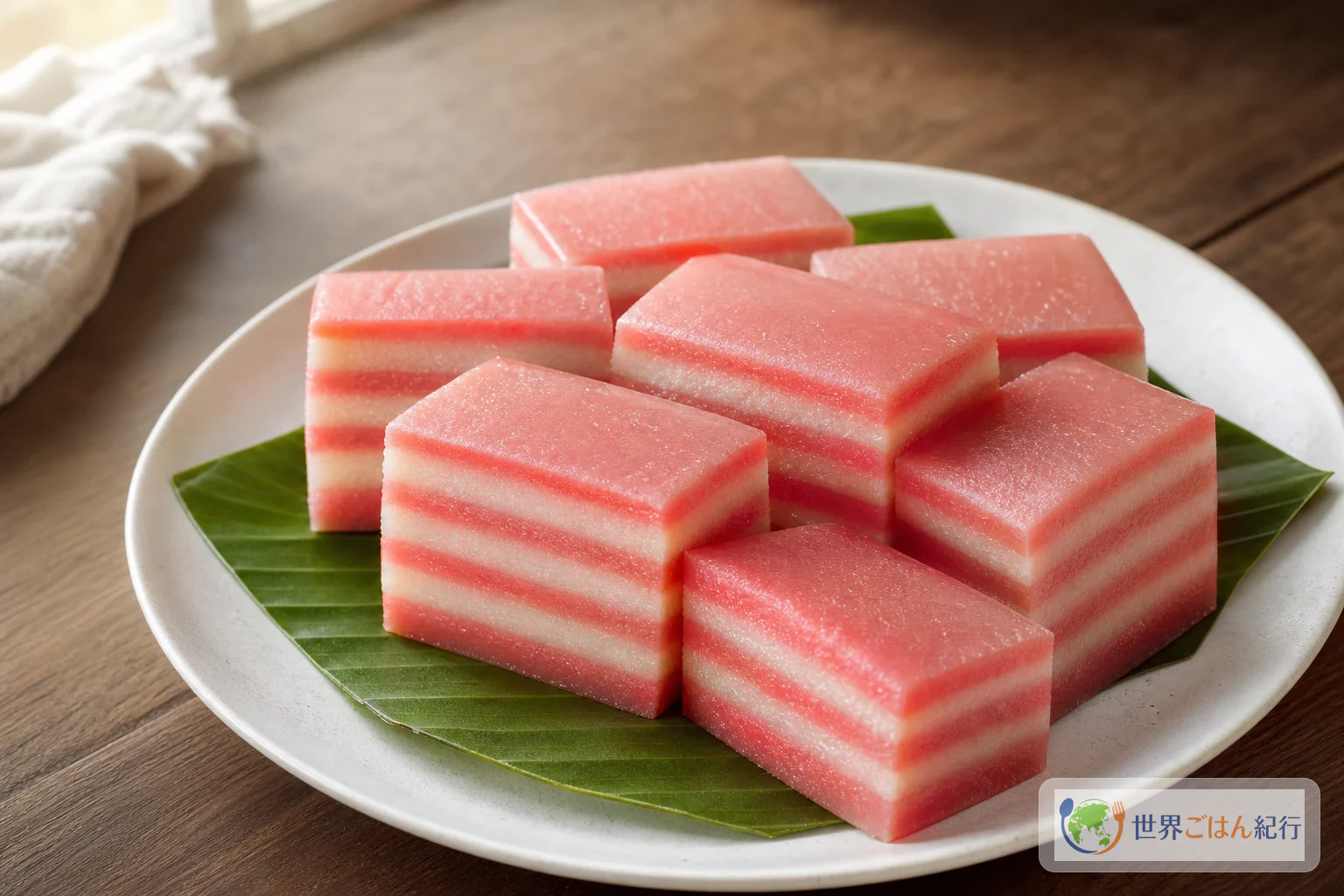
Kuih Lapis: Malaysian Steamed Layer Cake
Ingredients
| Ingredient | Amount | Role and how to choose |
|---|---|---|
| Rice flour (non-glutinous) | 60 g | The structure of the batter. Fine rice flour for baking is fine, but don't swap in glutinous rice flour |
| Tapioca starch | 165 g | Supple bounce and the stickiness that binds the layers. Replace no more than 30 g with potato starch |
| Unsweetened coconut milk | 320 ml | About 1 1/3 cups. Aroma and fat. Use canned cooking coconut milk, not sweetened products or coconut drinks |
| Water | 200 ml | Draws out the pandan aroma and thins the syrup |
| Granulated sugar | 175 g | Sweetness and a moist steamed texture |
| Salt | 1/2 tsp | Sharpens the sweet coconut aroma |
| Pandan leaves | 3 | Tie all 3 together. Frozen is fine; leave them out if you can't find them |
| Food coloring | A little red or pink | Added to half of the batter. You can make it all white without it |
| Vegetable oil | 1 tsp | For lightly greasing the pan |
Steps
1Make the pandan syrup
Tie the 3 pandan leaves together and put them in a small pot with ¾ cup (200 ml) water, 6 oz (175 g) granulated sugar and 1/2 tsp salt. Warm over medium heat for 5 minutes, stirring the bottom now and then, until the sugar crystals disappear and steam rises. Don't let it keep boiling; turn off the heat once the green aroma of the leaves comes out. Let the syrup cool to room temperature for 15 minutes.
2Combine the flours and coconut milk, then strain
Put the 2 oz (60 g) rice flour and 6 oz (165 g) tapioca starch in a bowl, and whisk in the cooled syrup a little at a time. Add the 1¼ cups (320 ml) unsweetened coconut milk and whisk for 3 minutes until there are no lumps. You're looking for a smooth batter that falls from the lifted whisk in a thin ribbon, with the trail disappearing in about 2 seconds. Strain it once through a fine sieve, pressing any starch that settles at the bottom through with a silicone spatula. Rest the batter for 15 minutes, and prepare the pan and steamer meanwhile.
3Warm the pan and steam the first layer
Lightly oil the bottom and sides of a 7-inch (18 cm) square metal pan. Bring the steamer water to a boil over high heat, and once the steam is steady, lower it to medium. Put the pan in and warm it for 5 minutes, so you never pour batter into a cold pan. Divide the batter into 8 bowls of about 4 oz (115 g) each, and add just a little food coloring to 4 of them (the pink layers). When the color is even with no large bubbles left, the coloring is done.
If the steamer water touches the bottom of the pan, the bottom layer turns watery. On the other hand, too little water and the steam cuts out partway through, so check the water level in the pot before you start.
Stir the white batter from the bottom and pour about 4 oz (115 g) into the center of the pan. Tilt the pan to spread it into the corners, cover, and steam over medium heat for 4 to 5 minutes. When there are fewer water droplets on the surface and lightly touching it with the back of a spoon leaves almost no mark, move on. If it's still liquid and moves, add 1 minute at a time.
4Alternate white and pink layers
Gently stir the pink batter from the bottom until it flows easily with only fine bubbles, then pour about 4 oz (115 g) over the first layer. Steam over medium heat for 4 to 5 minutes, and when the surface changes from translucent to matte, switch to the white batter. Repeat through the 7th layer, always stirring the bottom of the bowl before each pour. If large bubbles appear, run the tip of a bamboo skewer over the surface just 2 or 3 times before pouring the next layer.
Dropping the batter from high up punches holes in the layer below. Pour from about 1 inch (2 cm) above the surface, letting it run down the side of the pan. If the steam weakens, add a little boiling water at the edge of the pot and bring it back to medium.
5Steam the last layer for 8 minutes and let it settle at room temperature
After pouring the 8th layer, steam over medium heat for 8 minutes. You want a smooth surface that doesn't ripple when you gently shake the pan, and a center that springs back slowly when pressed with the back of a spoon. Turn off the heat, leave it covered for 3 minutes, then take it out. Let it cool in the pan at room temperature for 45 minutes, and lightly blot the water droplets on the surface with paper towels.
Oversteam it and it tightens like rubber; understeam it and the layers run when you cut it. Wait until the next step to cut, and let it cool in its 7-inch (18 cm) square shape. Don't shorten the final 8 minutes, and check that the steam stays steady.
6Chill, then cut into 1 inch (3 cm) squares
Once it has cooled, cover the pan with plastic wrap and refrigerate for 1 hour. Run a thin spatula around the sides of the pan, place a plate on top and flip it out. Wet a knife with vegetable oil, cut into strips 1 inch (2.5 to 3 cm) wide, then into 1 inch (3 cm) squares. Wipe the blade and re-oil it after each cut so the white layers don't drag on the knife. Letting it sit at room temperature for 20 minutes before eating brings back more bounce than serving it straight from the refrigerator.