Ingredients and steps on one page. Print it, or choose “Save as PDF” in the print dialog.
Sekai Gohan
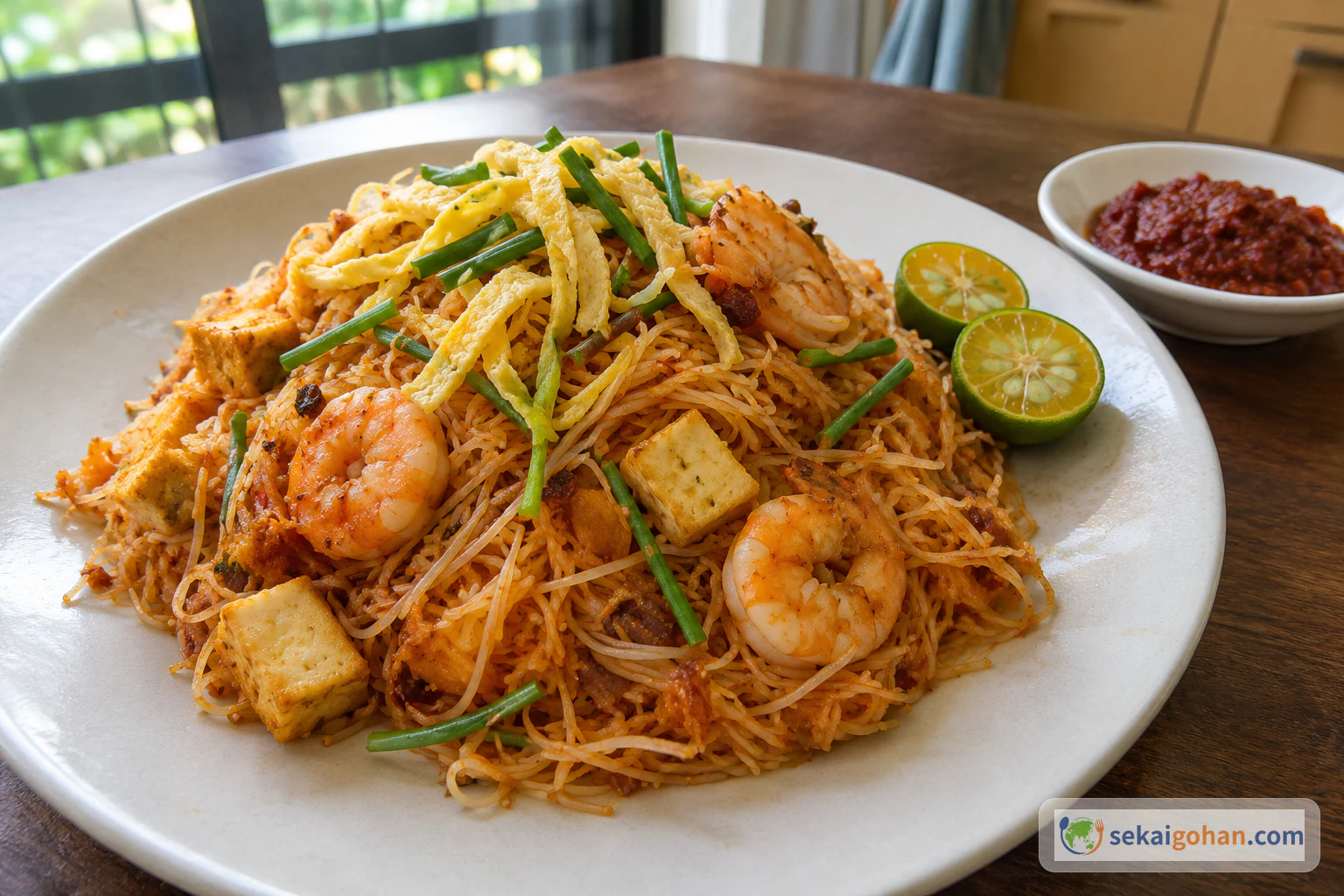
Mee Siam: Malaysian Dry Rice Noodles with Tamarind and Taucheo
Ingredients
| Ingredient | Amount | Role |
|---|---|---|
| Dried thin rice vermicelli (bee hoon) | 10½ oz (300 g) | The noodles |
| Room-temperature water, about 77°F (25°C) | as needed | Soaking the noodles |
| Firm tofu (tau kwa) | 7 oz (200 g) | Fried cubes with a chewy bite |
| Vegetable oil | ½ cup (125 ml) | Frying the tofu, then 1 tbsp for the omelettes, the rest for the paste |
| Prawns, peeled | 7 oz (200 g) | Sweetness and bite |
| Bean sprouts (optional) | 3½ oz (100 g) | Crunch |
| Garlic chives (kucai) | 2 oz (60 g) | Fresh, oniony topping |
| Calamansi | 8 (or 2 regular limes) | 4 squeezed in at the end, the rest served alongside |
| Eggs | 3 | Thin omelette strips |
| Salt (for the eggs) | ⅛ tsp | Seasons the omelettes |
| Dried red chillies | 10 | Heat and red colour in the paste |
| Dried shrimp (udang kering) | 2 oz (60 g) | Savoury depth in the paste |
| Just-boiled water (for the chillies) | as needed | Softening the chillies |
| Just-boiled water (for the dried shrimp) | about ½ cup (120 ml) | Softening the shrimp; becomes the soaking liquid |
| Onion, medium | 1, about 4 oz (120 g) peeled | Sweetness and body in the paste |
| Garlic | 4 cloves, about 1 oz (25 g) | Aroma in the paste |
| Tamarind pulp (asam jawa) | 2 heaped tbsp (or 3 tbsp tamarind paste) | Sourness |
| Hot water (for the tamarind) | ½ cup (125 ml) | Loosening the tamarind |
| Taucheo (salted fermented soybeans) | 2 heaped tbsp | Salt and fermented depth |
| Tomato paste | 1 level tbsp | Sweetness and colour |
| White sugar | 1 tbsp | Sweetness |
| Salt (for the sauce) | ½ tsp | Seasoning |
| Dried shrimp soaking liquid | 4 tbsp, plus extra as needed | Savoury liquid for the sauce and the final toss |
| Sambal | to serve | Extra heat at the table |
Steps
1Soak the noodles in room-temperature water
Put the dried rice vermicelli in a large bowl and cover it completely with room-temperature water, about 77°F (25°C). Leave it for 1 hour. Use no hot water here: noodles softened in hot water snap and turn mushy once they hit the wok. The noodles are ready when they are white and pliable and a long strand lifts out whole.
2Soak the chillies and dried shrimp
Snip each dried chilli into 2 or 3 pieces with kitchen scissors, put them in a bowl and cover with just-boiled water for at least 20 minutes. Rinse the dried shrimp briefly and soak them in about ½ cup (120 ml) just-boiled water for at least 15 minutes. Keep the shrimp soaking liquid; it goes into the paste, the sauce and the final toss. Both are ready when the chilli skins feel soft and the shrimp have plumped in water that has turned faintly orange.
3Make the tamarind water
Pour ½ cup (125 ml) hot water over the tamarind pulp and leave it for 10 minutes. Squeeze and rub the pulp between your fingers until it loosens into the water. Pick out the fibres and pieces of shell by hand, and leave the liquid unstrained, since straining takes flavour away. It is ready when it is thick, brown and muddy with no hard lumps left.
4Fry the tofu
Cut the tofu into 1-inch (2.5 cm) cubes and pat them dry with kitchen paper. Heat the ½ cup (125 ml) oil in the wok over medium heat and fry the cubes for about 1 minute on each side. Drain them on kitchen paper and keep the oil in the wok. The cubes are done when every side has turned light golden and holds its shape when turned.
5Cook the omelettes and cut them into strips
Beat the eggs lightly with ⅛ tsp salt. Heat 1 tbsp of the frying oil from the wok in an 8-inch (20 cm) pan and cook two thin omelettes, one after the other. Let them cool, roll each one up and slice it into thin strips, then cover the strips so they do not dry out. Each omelette is done when the top is set with no wet egg left.
6Blend the rempah
Drain the chillies, and shake out the loose seeds if you want less heat. Put them in the blender with the drained dried shrimp, the onion and the garlic. Blend until smooth, adding a little shrimp soaking liquid if the blades spin without catching. The paste is ready when it is an even, deep red-orange with no visible flecks of shrimp.
7Mix the seasoning sauce
Put the taucheo in a bowl and crush it lightly with a fork, leaving some beans whole. Stir in the tamarind water, tomato paste, sugar, ½ tsp salt and 4 tbsp of the shrimp soaking liquid. Set the rest of the soaking liquid next to the stove. The sauce is ready when the tomato paste has dissolved into a loose brown liquid with whole beans still floating in it.
8Fry the paste until the oil separates
Heat the oil left in the wok over medium heat and add the paste. After about 3 minutes, lower the heat to medium-low and keep frying for at least 10 minutes, ideally 15 in total. Turn the heat down further if the paste starts to catch, and stir almost constantly for the last 5 minutes. It is ready when the paste has darkened to brick red, red oil pools around its edges and the raw smell is gone.
9Add the sauce, then the prawns
Pour the seasoning sauce into the wok and cook it with the paste for 1 minute over medium heat. Add the prawns and bean sprouts and cook for about 2 minutes, stirring. The prawns only need to be almost cooked at this point; a little translucency in the centre is fine now, because they keep cooking with the noodles. Move on when they are pink on the outside and mostly opaque.
10Toss in the noodles
Drain the noodles well and add them to the wok. Lift and turn them with two spatulas or long chopsticks for 5 minutes, working the paste and sauce through every strand. Keep the movement under and up rather than around the pan. The noodles are ready when they are evenly red-orange with no pale clumps and no liquid pooling at the bottom.
11Return the tofu and taste
Add the fried tofu and toss for 2 minutes to heat it through. Taste a few strands and adjust with salt or a splash of the shrimp soaking liquid. The noodles should have a little bite, like al dente pasta; if they are still firm, add 2 to 3 tbsp of soaking liquid and toss for another 3 to 5 minutes. Move on only when the noodles are tender with a slight bite and a prawn cut in half is opaque all the way through.
12Finish with calamansi and garnish
Squeeze 4 calamansi (or 1 lime) over the noodles, toss once and let it sit for 5 minutes. Cut the garlic chives into 2-inch (5 cm) lengths. Pile the noodles onto a platter, lay the omelette strips over the top and scatter the chives over them. Serve with the remaining calamansi and sambal while the chives are still bright green and crisp.