Ingredients and steps on one page. Print it, or choose “Save as PDF” in the print dialog.
Sekai Gohan
Nasi Kerabu: Malaysia's Blue Herb Rice from the East Coast
Ingredients
| Ingredient | Amount | Substitutes & notes |
|---|---|---|
| Jasmine rice or long-grain rice | 10.5 oz (300g) | Short-grain rice also works. Adjust the water difference with the draining time after washing |
| Dried butterfly pea flowers | 8g | If you skip the blue, omit it and make yellow rice with 2 g turmeric |
| Boiling water | 1 cup (220ml) | Used for the flower infusion |
| Water | ½ cup (140ml) | Combine with the infusion for a total cooking liquid of 1½ cups (360 ml) |
| Pandan leaf | 1 | Omit if unavailable |
| Lemongrass | 2 stalks | 1 for the rice, 1 for the sambal |
| Makrut lime leaves | 2 | Dried is fine. Omit if unavailable |
| Mackerel fillet | 12.5 oz (350g) | 9 oz (250 g) for grilled fish, 3.5 oz (100 g) for the coconut sambal |
| Grated coconut | 3.5 oz (100g) | Unsweetened coconut flakes also work |
| Shallot or red onion | 2 oz (60g) | 1 oz (30 g) each, split between the sambal and the sauce |
| Ginger | 20g | 10 g each, split between the sambal and the sauce |
| Dried red chiles | 8g | Reduce the seeds to lower the heat |
| Coconut milk | ¾ cup (200ml) | Unsweetened, carton or can |
| Tamarind paste | 10g | Substitute 5 g umeboshi flesh and 1 tsp (5 ml) lime juice |
| Palm sugar | 20g | Raw cane sugar also works |
| Fish sauce or budu | 2 tbsp (30ml) | Budu is a fermented fish sauce. Fish sauce is the substitute for cooking outside Malaysia |
| Vegetable oil | 1 tbsp (15ml) | For frying the sauce |
| Cucumber | 5.5 oz (150g) | Cut into 2–3 mm strips |
| Green beans | 2.75 oz (80g) | Fresh enough to eat raw, thinly sliced |
| Cabbage | 3.5 oz (100g) | Napa cabbage also works, but pat dry before using |
| Mint or Vietnamese coriander | 20g | 1 oz (30 g) myoga ginger can stand in for the aroma |
| Lime | 1 | For finishing |
| Salted eggs | 2 | Ordinary boiled eggs also work |
| Fish crackers | 1.5 oz (40g) | Shrimp crackers also work. Check the ingredient label |
Steps
1Make the butterfly pea flower infusion
10 min
Pour 1 cup (220 ml) of boiling water over 8 g of dried butterfly pea flowers and let stand for 10 minutes. When the liquid is a deep indigo, strain it through a tea strainer, taking the flowers out without crushing them. If the color is pale, rather than adding more boiling water, spread the flowers out in the strainer so they do not overlap and extend the steeping time by 5 minutes. Adding lemon or lime first changes the color, so wait to add the acidity until serving.
2Cook the rice with the aromatics
35 min
Wash 10.5 oz (300 g) of rice and drain it in a colander for 10 minutes. Put the rice, 1 cup (220 ml) of butterfly pea infusion and ½ cup (140 ml) of water in the rice cooker, for a total of 1½ cups (360 ml). Lay on 1 bruised stalk of lemongrass, a knotted pandan leaf and 2 makrut lime leaves, and cook on the normal setting. When done, let it steam for 10 minutes, remove the aromatics and fold the rice from the bottom with a paddle. The signs of success are grains dyed an even blue, plump, with no water left at the bottom, and grains that loosen lightly when the paddle goes in.
3Make the coconut sambal
12 min
Heat a skillet over low heat and dry-toast 3.5 oz (100 g) of grated coconut for 6–8 minutes. When it is a pale golden brown and gives off a sweet smell, turn off the heat, spread it on a plate and cool. In a separate skillet, cook 3.5 oz (100 g) of mackerel over medium heat, skin side down for 4–5 minutes, then flip and cook for 3–4 minutes, and flake the flesh. In a stone mortar, put the mackerel, 1 oz (30 g) of shallot, 10 g of ginger, the tender center of the lemongrass, 10 g of palm sugar and 1 g of salt. Make a coarse paste with some grains remaining, and mix with the toasted coconut. Toasting the coconut to a dark brown makes it bitter, so stop at a pale golden brown.
4Simmer the fish sauce dressing
15 min
Soak 8 g of dried red chiles in warm water for 10 minutes and grind finely with 1 oz (30 g) of shallot, 10 g of ginger, 10 g of tamarind and 10 g of palm sugar. Put 1 tbsp (15 ml) of oil in a pot over medium-low heat and fry the paste for 8–10 minutes. When red oil floats at the edge of the pot, the raw onion smell has gone and it forms a paste, add ¾ cup (200 ml) of coconut milk, ½ cup (100 ml) of water and 1 stalk of lemongrass. Keep it at a temperature where the surface does not boil hard, over low heat for 10 minutes. Turn off the heat and add 2 tbsp (30 ml) of fish sauce, making a smooth sauce with a few coarse grains left, and stop at a thickness that leaves a thin coat on the back of a spoon. If it is not sour enough, add lime juice 1 tsp (5 ml) at a time; if too salty, add water 2 tsp (10 ml) at a time.
5Cook the fish and the garnishes
15 min
Sprinkle 9 oz (250 g) of mackerel fillet with 2 g of salt and cook it in a fish grill or a 400°F (200°C) oven for 10–12 minutes. Check that the thickest part of the flesh has turned opaque and flakes when pressed with chopsticks. If you have a thermometer, aim for 145°F (63°C) at the center, and cook egg dishes to 160°F (71°C) at the center. Heat the fish crackers as the package says, and peel and halve the salted eggs. For raw green beans, remove the strings and cut 2–3 mm wide.
6Shred the herbs and build the plate
8 min
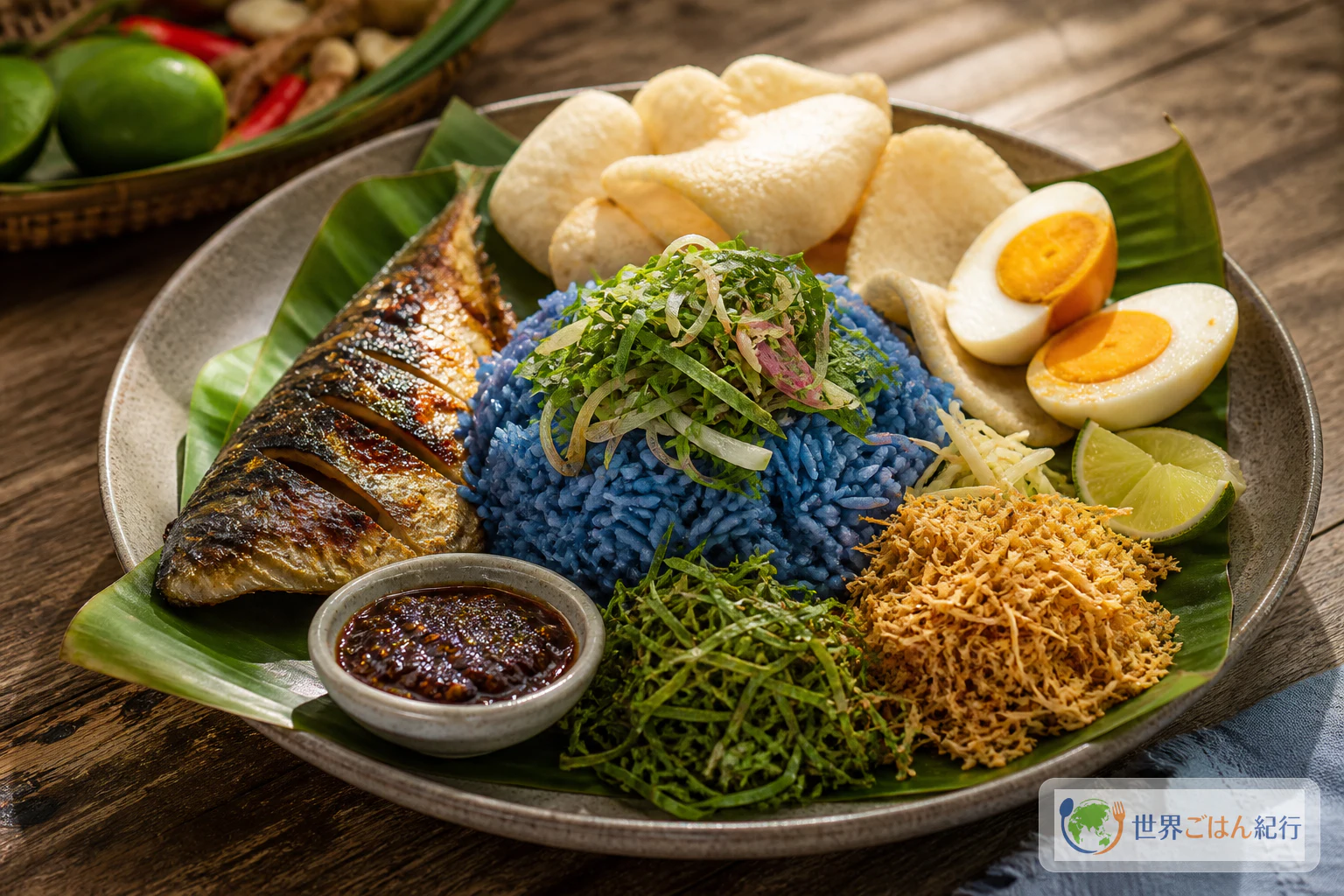
Cut the cucumber, green beans, cabbage, mint or Vietnamese coriander, and myoga into 2–3 mm (up to 0.125 inch) widths. Pat the watery vegetables with paper towels and do not mix them until right before eating. With the heat off, check that the already cooked components are cooked through to the center. Mound the blue rice in the middle of the plate and set the herbs, grilled fish, coconut sambal, fish sauce dressing, salted egg and fish crackers around it. Serve with lime; first taste the components separately, then mix just one bite's worth, and you will notice the difference between the bitterness of the herbs and the sweet-sour of the sauce.