Ingredients and steps on one page. Print it, or choose “Save as PDF” in the print dialog.
Sekai Gohan
Solok Ikan: Malaysian Whole Mackerel Stuffed and Fried
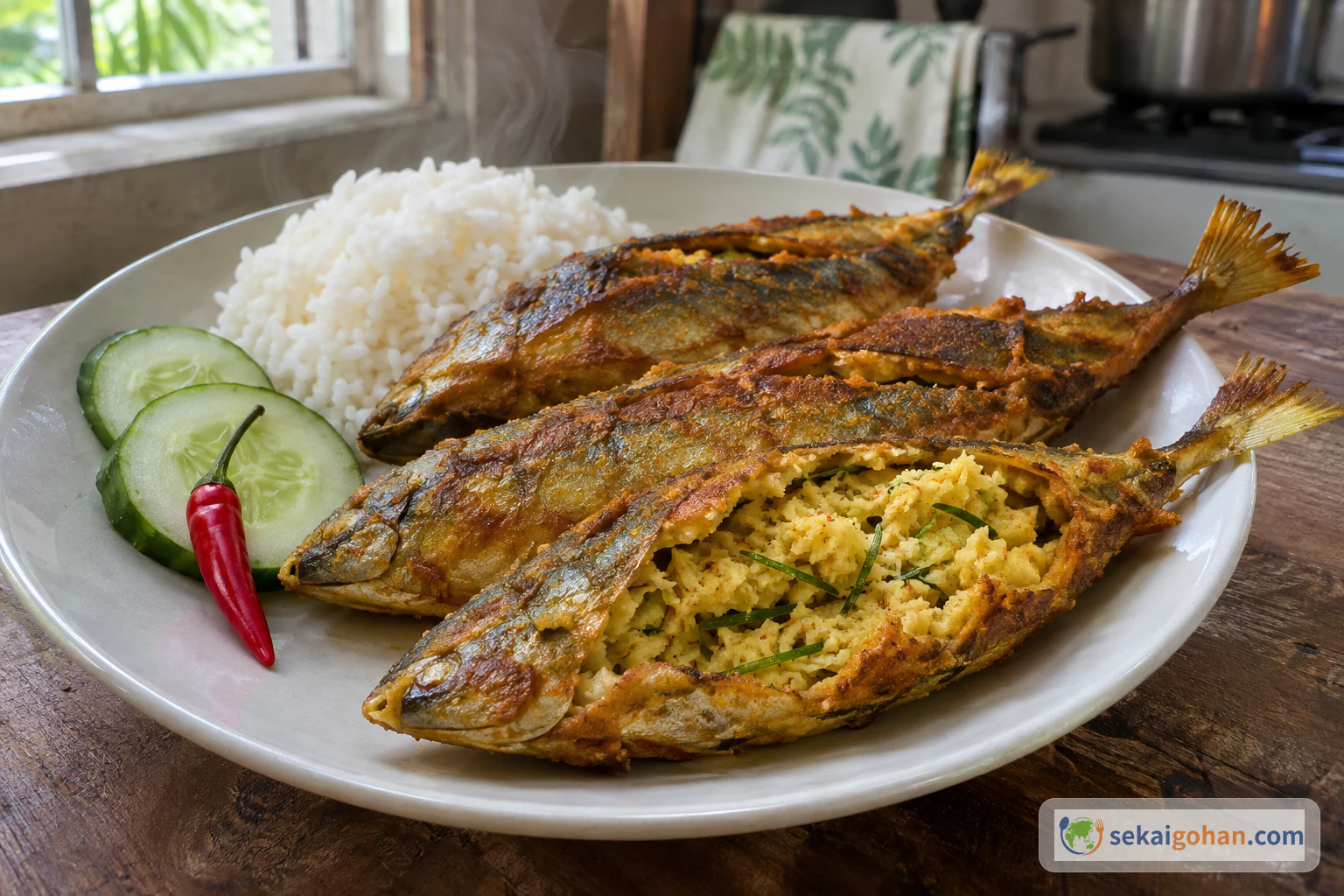
Ingredients
| Ingredient | Amount | Role |
|---|---|---|
| Indian mackerel (ikan kembong), large and very fresh | 4 whole fish | The skin is the casing; the flesh is the base of the filling |
| Lemongrass (serai) | 2 stalks | The main citrusy aroma of the filling |
| Shallots (bawang merah) | 3 | Sweetness and depth |
| White grated coconut (kelapa parut putih) | 1 handful | Body, moisture and gentle sweetness |
| Black pepper (lada hitam) | ½ tsp, as a starting amount | Warmth that sharpens the coconut |
| Laksa leaves (daun kesom) | a few leaves | The green, peppery-minty top note |
| Salt | to taste | Seasons the filling, which cannot be salted after frying |
| Fresh red chili, sliced (cili hiris), optional | to taste | Heat |
| Seasoning powder, optional | to taste | Rounds out the savoury flavour |
| Sugar, optional | a little | Softens the salt |
| Cooking oil | as needed | For shallow frying |
Steps
1Clean the fish and open the back
Rinse the fish and pat them dry inside and out with kitchen paper. Lay one on the board with its back towards you. Draw the knife along the back from just behind the head to just before the tail, cutting down beside the backbone. Keep the head, tail and belly whole. The fish should open along the back like a pouch, with the belly still joining both sides.
2Lift out the backbone and scrape the flesh
Break the backbone at the head and tail and lift it out. Pull out and discard the innards if they are still in the fish. Scrape all the flesh away from the inside of the skin with a spoon or the back of the knife, and pick out every rib bone and pin bone you can feel. Put the flesh in a bowl and the empty skins on a plate. Work slowly near the belly, where the skin is thinnest. You are done when the skin is an empty, unbroken pocket and the flesh in the bowl has no bones left in it.
Knife handlingCut away from the hand holding the fish and keep the blade shallow along the back. A slip near the belly tears the skin and can cut you.
3Pound the aromatics and coconut
Slice the lemongrass and peel the shallots. Pound them with the black pepper in the mortar until they turn into a damp, fragrant paste. Add the grated coconut and pound briefly so it softens and takes up the oils. The paste should smell strongly of lemongrass and look moist.
4Mix the filling
Pound or mash the fish flesh roughly, keeping some small pieces for texture. Combine it with the aromatic coconut paste in the bowl. Slice the laksa leaves very finely and fold them in with the sliced chili, if you use it. The filling is ready when it holds together loosely and looks pale yellow with green flecks, coarse rather than sticky.
Pound, do not blend smoothThe mortar crushes the lemongrass and shallot and draws out their oils, which then soak into the coconut. If you use a food processor, pulse in short bursts, because a smooth paste turns the filling dense and rubbery.
5Season and taste
Add salt, and the seasoning powder and a little sugar if you like. Fry a small spoonful of the filling in a dry pan until it is cooked all the way through, then taste it. Adjust the salt now. This is the last chance to season. Stop when the cooked spoonful tastes well salted and fragrant.
6Stuff the skins and reshape
Spoon the filling back into each skin and pack it in gently. Fill to about four-fifths full, leaving a little room so the skin does not burst in the oil. Press the edges of the back together and smooth the shape into a whole fish. Pin the seam with a toothpick if it gapes. Each fish should look plump and closed, with no filling pushing out.
7Heat the oil and lay in the fish
Pour oil into the saucepan or frying pan so it comes about halfway up the fish. Heat it over medium heat until it shimmers and a pinch of filling sizzles steadily. Pat the outside of each fish dry again, then lay it in the oil away from you. The fish should sizzle at once without violent spitting.
Hot oilWater on the skin makes oil spit, so dry the fish just before frying. Lower the fish in with a turner, never drop it, and keep the handle of the pan turned in.
8Fry both sides slowly
Fry over medium to medium-low heat without moving the fish until the underside is deep golden brown. Turn it carefully with the slotted turner and fry the other side the same way. If the skin browns fast, lower the heat so the filling has time to cook. Lift each fish onto kitchen paper when both sides are crisp and evenly golden.
9Check the centre
Open one fish along the back seam with a fork and knife. The filling must be opaque all the way through and steaming, with no translucent raw fish left at the centre. If you see any raw part, close it, return all the fish to the oil and fry on lower heat until the centre is done. Serve when every centre is cooked and opaque.
Cook the filling throughThe filling is made from raw fish. Cook it right to the centre, and serve it only when no translucent raw part remains.