Ingredients and steps on one page. Print it, or choose “Save as PDF” in the print dialog.
Sekai Gohan
Susu Kacang Soya: Malaysian Pandan Soy Milk with Palm Sugar Syrup
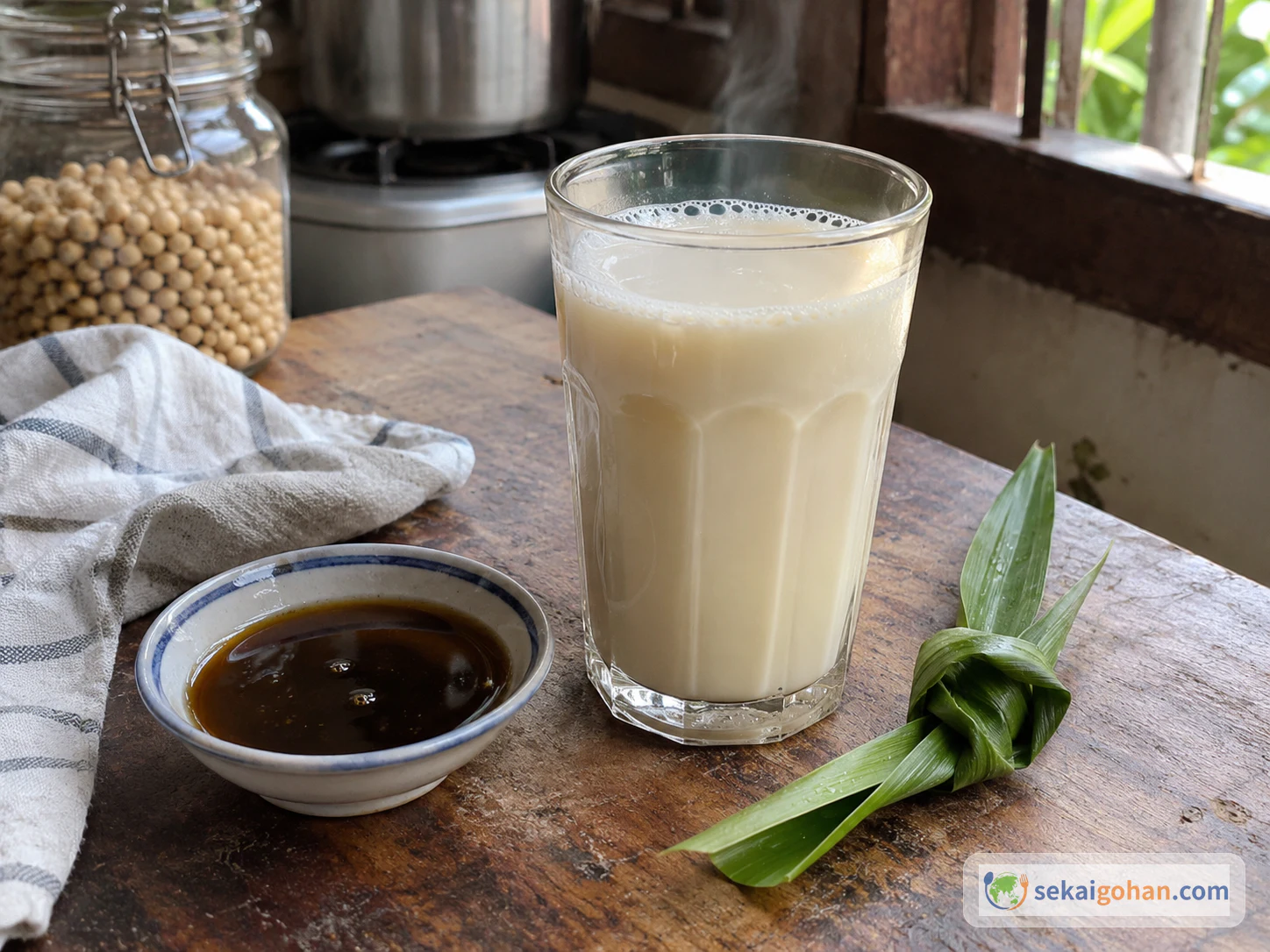
Ingredients
| Ingredient | Amount | Role |
|---|---|---|
| Dried yellow soybeans (kacang soya) | 10¾ oz (300 g) | The body and flavour of the milk |
| Water, for the soy milk (air) | 10½ cups (2.5 L) | Ground with the beans and pressed out as milk |
| Pandan leaves, for the soy milk (daun pandan) | 2, knotted | The main aroma |
| White sugar, for the ginger syrup (gula) | 9 oz (250 g) | Clean sweetness |
| Water, for the ginger syrup | ⅓ cup (80 ml) | Dissolves the sugar |
| Fresh ginger (halia) | 1 oz (25 g), peeled and lightly bruised | Warm bite in the syrup |
| Palm sugar (gula melaka) | 10¾ oz (300 g), chopped or grated | Dark, deep sweetness |
| Water, for the palm sugar syrup | 1 cup (240 ml) | Melts the palm sugar |
| Pandan leaves, for the palm sugar syrup (daun pandan) | 3, knotted | Aroma in the syrup |
| Grass jelly (cincau), store-bought, optional | As needed | Topping for a cold glass |
| Ice, optional | As needed | For cold serving; use ice made from drinking water |
Steps
1Wash and soak the soybeans
Rinse the soybeans under running water and put them in a large bowl with plenty of fresh water. Cover and refrigerate for 8 to 12 hours, aiming for the full 12 hours, and keep the soak in the fridge rather than on the counter. Before using them, pick out any beans that float or look discoloured. The beans are ready when they have nearly doubled in size and split cleanly under a fingernail.
2Make the ginger syrup
Put the white sugar, the ⅓ cup (80 ml) water and the bruised ginger in a small saucepan. Bring it to a boil, stirring until the sugar dissolves, then let it bubble for a few minutes to reduce. Strain out the ginger and pour the syrup into a clean jug. It looks thin while hot and thickens as it cools; stop before it turns heavy in the pan, because overcooked syrup sets hard once cold.
3Make the palm sugar syrup
Chop or grate the gula melaka so it melts evenly. Put it in the second saucepan with the 1 cup (240 ml) water and the three knotted pandan leaves, and set it over medium heat. Stir until the sugar has melted, then simmer until the syrup takes on a little body. Strain out the pandan once the syrup has a little body; it thickens further as it cools.
4Blend the soaked beans
Drain the beans and set aside a little of the measured water for the second press. Blend the beans in two batches, each with about half of the remaining water, on high for about 1 minute. Stop while the purée still has a fine grit rather than running smooth and liquid. You want a thick, pale purée that looks grainy against the side of the jar.
Stop blending earlyBlending past the grainy stage grinds the pulp so fine that it slips through the cloth and clogs it, and the milk ends up gritty. One minute on high per batch is enough.
5Press the milk through cloth
Line a sieve or colander with cheesecloth or a nut-milk bag and set it over a large pot. Pour in the purée a portion at a time, gather the cloth and twist it hard so the milk runs out below. Keep twisting and squeezing until the pulp in the cloth gives almost no liquid when you clench it in your fist.
6Press a second time and strain again
Put the pulp (okara) back in the blender with the water you set aside and blend it again. Squeeze it through the cloth a second time; this pulls out milk the first press left behind. Then pour all the milk through a clean cloth once more. It is ready when no grains show in the milk and the pulp in the cloth is nearly dry.
7Heat the milk with pandan
Pour the milk into the pot of at least 3¼ quarts (3 L) and drop in the two knotted pandan leaves. Set it over medium heat and stir constantly with a wooden spatula, scraping the bottom so nothing catches. Keep stirring as the steam builds. Move to the next step when foam starts to rise from the edges and the liquid begins to bubble.
8Hold a full boil for 10 minutes
Once it boils, lower the heat to medium-low while keeping the milk at a boil for at least 10 minutes. Skim off the foam as it rises, and look underneath it: the liquid surface itself must be bubbling, and the 10 minutes count only from then. If you smell scorching, lower the heat further. When the raw bean smell is gone and the steam smells sweet, lift out the pandan and turn off the heat.
Foam is not a boilSoy milk foams up long before it truly boils, and that foam is what fools people into stopping early. Skim it and watch the liquid underneath; only a bubbling surface counts toward the 10 minutes.
Boiling soy milkNever drink raw soy milk, and never shorten the 10-minute boil. Raw beans contain a natural lectin that the full soak and a vigorous boil break down; undercooked beans cause vomiting, diarrhoea and stomach pain. The foam boils over fast, so keep a hand on the heat and stay at the stove. If the bottom scorches, the burnt taste stays in the milk; make a fresh batch rather than drinking it.
9Serve warm or over ice
For warm glasses, ladle the milk into mugs or teacups, and keep whatever stays in the pot hot at 140°F (60°C) or above while you serve. For cold glasses, use milk chilled as in the next step, or pour it over ice. If you are adding cincau, put it in the glass first and pour the milk over it. Set the syrups on the table and let each person stir 2 tsp to 2 tbsp into a ⅔- to ⅞-cup (150–200 ml) glass as a starting point, tasting and adding more a spoonful at a time.
Keep the sugar out of the potSweeten each glass, never the pot. Unsweetened milk lets every drinker choose ginger or gula melaka and set the strength, and plain leftovers stay ready for either syrup.
10Cool and refrigerate the rest
Cool what is left right away: bring it down to 68°F (20°C) within 2 hours, then to 39°F (4°C) within the next 4 hours. Pour it into clean containers with lids and refrigerate at 39°F (4°C) or below, and drink it by the next day. Boiling does not kill the spores of the bacteria that grow in soy milk, so never leave it at room temperature or carry it without keeping it cold. To serve leftovers warm, reheat until the milk reaches at least 167°F (75°C); in a microwave, stir once partway to even out the heat.