Ingredients and steps on one page. Print it, or choose “Save as PDF” in the print dialog.
Sekai Gohan
Ulam: Malaysian Raw Vegetables with Sambal Belacan
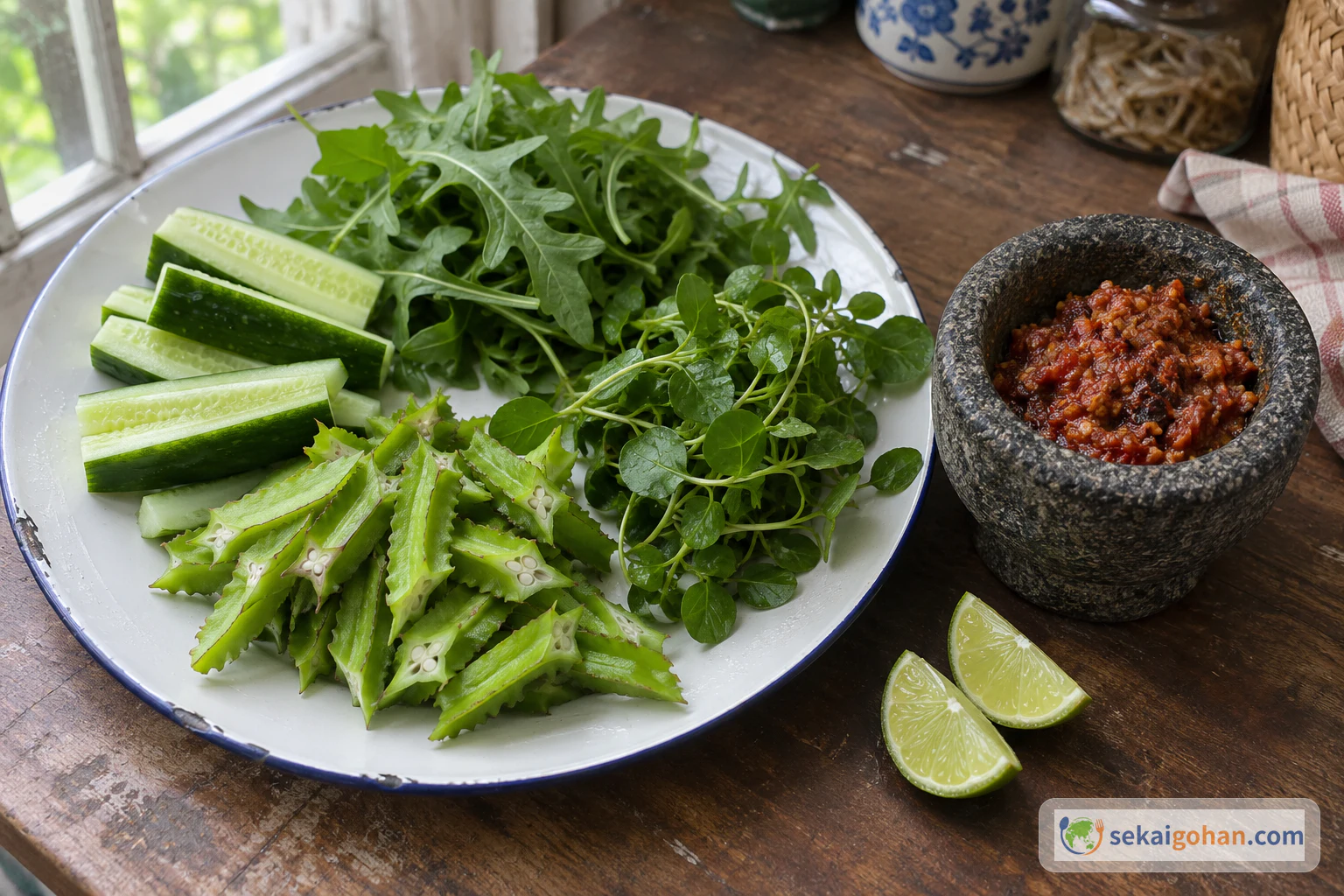
Ingredients
| Ingredient | Amount | Role |
|---|---|---|
| Cucumber (timun) | 1 (about 3½ oz / 100 g) | Water and crunch, the backbone of the plate |
| Winged beans (kacang botol, kacang botor) | 10 pods (about 3½ oz / 100 g) | Crisp pods with a four-cornered cross-section |
| Arugula | 1 bag (about 2 oz / 60 g) | Green bitterness and aroma, standing in for ulam raja |
| Watercress | 1 bunch (about 1¾ oz / 50 g) | Fresh, watery green, standing in for pegaga and daun selom |
| Petai (stink beans), optional | 1 cluster (about 1 oz / 30 g) | Bitterness and a strong aroma; leave out if you cannot find it |
| Lime (limau) | 1 | Half for the sambal, half cut into wedges for the table |
| Large red chillies (cili merah) | 3 | Body and colour of the sambal |
| Bird's eye chillies, small green (cili padi) | 2 | The heat at the centre of the sambal |
| Firm belacan (fermented shrimp paste) | ⅓ oz (10 g) | Savoury depth and almost all the salt |
Steps
1Wash every vegetable under running water
Wash your hands with soap before you touch the vegetables. Rinse the cucumber, winged beans, arugula and watercress under running drinking water in a colander, pulling the leafy sprigs apart and washing them leaf by leaf. Throw out anything bruised or damaged, or anything that smells, looks or tastes wrong. Dry everything well in a salad spinner or pat it dry with a clean cloth. They are ready when the leaves no longer drip and the pods feel dry to the touch.
2Cut the vegetables and dry them again
Use a clean knife and cutting board. Halve the cucumber lengthwise and cut it into sticks about 2 inches (5 cm) long and ⅜ inch (1 cm) thick. Trim the stem ends of the winged beans and slice them thin on the diagonal, at an angle that shows the four-cornered cross-section. Pick the arugula and watercress into pieces that are easy to eat, and pop the petai out of their pods if you are using them. Stack a few pieces on a plate as a test: no water should pool underneath.
3Dry-toast the belacan
Set a small frying pan over medium heat with no oil and put in the 10 g block of belacan. Toast it for about 3 minutes on the first side, until it turns dry and crumbly, then flip it and toast the second side the same way. If the pan starts to smoke, lower the heat at once, because scorched belacan goes bitter. It is done when it crumbles under the spatula and looks powdery and dry.
4Deseed and chop the chillies
Split the 3 large red chillies and the 2 bird's eye chillies lengthwise. Scrape the seeds out with the tip of a paring knife and set them aside. Chop the chillies coarsely, since the mortar will finish the job. The red chillies give the sambal its colour and body, and the bird's eye chillies give it its heat. Move on when every seed cluster is gone and the pieces are rough and roughly even.
5Pound the sambal and stir in the lime
Put the chillies into the mortar, add the toasted belacan, and pound and grind them together with the pestle. Stop at the middle point: no large chunks left, yet not completely smooth. Squeeze in the juice of half the lime, or add 2 tsp (10 ml) calamansi juice, and stir it through with the pestle. The sambal is ready when it is a coarse, glossy red paste and the lime smells sharp over the roasted shrimp.
6Lay out the plate and eat with rice
Spread the vegetables over a platter in separate piles. Spoon the sambal into a small bowl and set it in the middle or at one edge. Cut the remaining half lime into wedges and add them, then bring the plate to the table with steamed rice. Each person dips one or two pieces at a time and eats them with rice. The plate is right when the vegetables stay crisp and dry and the sambal stays in its bowl, never mixed in.