Ingredients and steps on one page. Print it, or choose “Save as PDF” in the print dialog.
Sekai Gohan
Shwe Yin Aye: Myanmar's Iced Coconut Milk Dessert for Thingyan
Ingredients
| Ingredient | Amount | Role |
|---|---|---|
| Rice-flour jelly (mont let saung), made below | about 2 cups (500 ml) | Slippery strands at the bottom of the glass |
| Small sago pearls | about 7¼ oz (204 g) | Small, clear, chewy pearls |
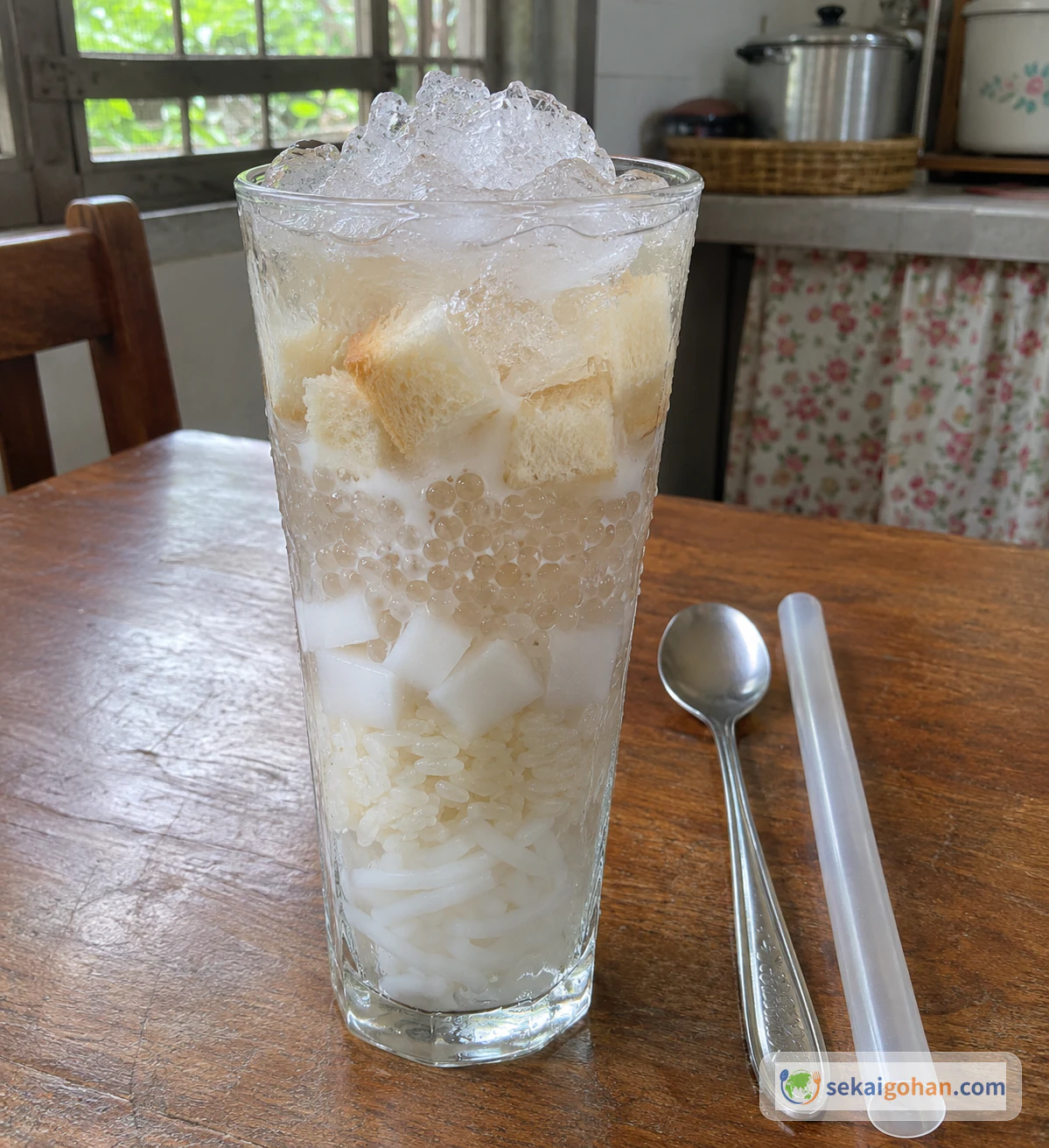
| Glutinous rice (sticky rice), steamed | 1½ cups once steamed | The chewiest layer |
| Plain white sandwich bread | 5 slices | Soft cubes that soak up the coconut milk |
| Coconut jelly | ½ oz (12.5 g), half a 25 g sachet | Bouncy white cubes |
| Coconut milk | 1¼ cups (300 ml) | Binds the whole glass |
| Water, for thinning the coconut milk | 2 cups (500 ml) | Makes the milk light enough to drink through a straw |
| Sugar | 4½ oz (125 g) | The syrup; all the sweetness |
| Water, for the syrup | a little | Melts the sugar |
| Salt | a pinch | Sharpens the coconut |
| Ice, crushed | as needed | Cold, and a slow thinning as it melts |
| Mung bean flour, for the jelly | 1⅓ oz (37.5 g) | Clean set and a slippery surface |
| Rice flour, for the jelly | about 1 oz (30 g) | Body and the ivory colour |
| Tapioca flour, for the jelly | ½ oz (15 g) | Springy chew |
| Water, for the jelly | 2 cups (500 ml), 1¼ cups (300 ml) to mix and about ¾ cup (200 ml) to add while cooking | Dissolves and cooks the flours |
| Pandan juice, for the jelly (optional) | a little | Green colour |
Steps
1Soak and steam the sticky rice
Rinse the glutinous rice in several changes of water until the water runs clear, enough to give 1½ cups once steamed. Cover it with plenty of fresh water and soak for at least 6 hours in the refrigerator, not on the counter. Drain it in a colander, spread it over a damp cloth in the steamer and steam over high heat, turning the rice over now and then so the top and bottom cook evenly. It is done when the grains look glossy and translucent and a pinched grain has no hard core.
2Mix the jelly batter
Put the mung bean flour, rice flour and tapioca flour in a small saucepan. Pour in 1¼ cups (300 ml) of the jelly water a little at a time, whisking in one direction. Keep whisking until every lump has gone and the batter is smooth and milky. Set the remaining water beside the pan.
3Cook the jelly over low heat
Set the pan over low heat and switch to a wooden spatula, still stirring in the same direction. Add the remaining ¾ cup (200 ml) water a little at a time as the batter warms and thickens. Keep stirring as it turns glossy and translucent ivory. Take it off the heat when the mass pulls away from the bottom of the pan and holds a soft ridge behind the spatula. For green jelly, stir in a few drops of pandan juice now.
4Press the jelly into iced water
Set a large bowl of iced water on the counter and hold a perforated ladle or coarse sieve over it. Press the warm jelly through the holes with the spatula, letting short strands fall into the water. They firm up as they hit the cold. Leave the strands in their water and refrigerate them until you assemble. They are ready when a lifted strand is firm, slippery and keeps its shape.
5Boil and rinse the sago
Bring a large pot of water to a full boil and rain in the sago, stirring now and then so the pearls do not stick together. Boil for about 10 to 12 minutes; larger pearls and a gentler flame take longer. Drain in a fine sieve and rinse quickly under cold water to wash off the surface starch, then drain well. The sago is done when the white dot in the centre has vanished and every pearl is translucent all the way through.
6Cut the coconut jelly
Make up half the coconut jelly sachet following its directions, pour it into a shallow tray and chill until firm. Turn it out onto a board and cut it into ⅜-inch (1 cm) cubes. Cut an agar version the same size. Gather the cubes in a small bowl and keep them cold. The cubes are right when the cut faces are clean and they bounce slightly instead of smearing on the knife.
7Thin the coconut milk and make the syrup
Pour the coconut milk into a jug, add the 2 cups (500 ml) thinning water and the pinch of salt, stir and refrigerate; this milk is never heated. In a small saucepan, warm the sugar with a little water, stirring until it dissolves and thickens lightly. Take it off the heat and let it cool completely. The syrup is ready when it falls from a spoon in a thin, clear thread.
8Layer the glasses and pour
Cut the bread into cubes now. Into each tall glass, layer jelly strands, sticky rice, coconut jelly, sago and bread, in that order. Fill with crushed ice until the glass is about four-fifths full, pour in the coconut milk and finish with syrup over the top. Serve at once with a spoon and a straw, and eat within 5 minutes, while the bread still holds its shape and the milk has just reached the bottom layer.