Ingredients and steps on one page. Print it, or choose “Save as PDF” in the print dialog.
Sekai Gohan
Tohu Thoke: Myanmar Chickpea Tofu Salad with Tamarind Dressing
Ingredients
Chickpea tofu
| Ingredient | Amount | Role and substitutes |
|---|---|---|
| Chickpea flour (besan) | 3.5 oz (100 g) | The center of flavor and setting. Also called garbanzo flour |
| Water | 2½ cups (600 ml) | ¾ cup (200 ml) to mix with the flour, 1¾ cups (400 ml) to heat in the pot |
| Salt | 4 g | Brings out the sweetness of the beans. Fish sauce is not added to the tofu |
| Oil | 1 tsp | Brushed thinly on the tray. A mild-flavored one such as light sesame oil |
Vegetables and toppings
| Ingredient | Amount | What to aim for |
|---|---|---|
| Cabbage | 7 oz (200 g) | 0.125 inch (4 mm) wide. Adds crunch to the soft tofu |
| Tomatoes | 2 (about 8.5 oz (240 g)) | 0.5 inches (1 cm) cubes. If there are many seeds, remove some |
| Red onion | 1/2 (about 2.75 oz (80 g)) | 0.125 inch (2 mm) wide. If it is sharp, soak in water for 2 minutes and wipe dry |
| Cilantro | 15 g | 1 inches (2 cm) lengths. If you dislike it, swap for scallion |
| Peanuts | 1.5 oz (40 g) | Unsalted, no oil. Coarsely chopped |
| White sesame seeds | 10 g | Adds toastiness |
| Garlic | 2 cloves | Thinly sliced for fried garlic |
| Oil | 2 tbsp | For frying the garlic |
Tamarind dressing
| Ingredient | Amount | Difference when substituted |
|---|---|---|
| Tamarind paste | 20 g | Fruity sourness with a depth like brown sugar. If you have none, increase the rice vinegar |
| Hot water | 2 tbsp (30 ml) | To loosen the paste and strain out the fibers |
| Rice vinegar | 1 tbsp (15 ml) | The outline of the sourness. Lemon juice brightens the aroma |
| Light brown sugar or palm sugar | 10 g | Rounds off the sourness. Adjust the sweetness last |
| Light soy sauce | 1 tbsp (15 ml) | Savoriness and salt. Choose a light one if you do not want a darker color |
| Fish sauce | 1 tbsp (15 ml) | Fermented fish aroma. For a plant-based version, replace with 2 tsp (10 ml) of soy sauce and 1 g of salt |
| Chili powder | 1 to 2 g | The axis of the heat. You can add it at the table instead |
Steps
1Dissolve the chickpea flour in water
8 min. The stove is not used.
Put 3.5 oz (100 g) of chickpea flour and ¾ cup (200 ml) of water in a bowl and whisk for 1 to 2 minutes. When the flour no longer settles at the bottom, add 4 g of salt and rest for 5 minutes so the flour takes up water. If small lumps remain on the surface, strain through a fine-mesh strainer. If you add all 2½ cups (600 ml) from the start the flour floats on the surface and clumps easily, so first make a paste with a little water, then thin it.
2Cook in the pot and pour into the tray
15 min. Medium to medium-low heat.
Put the remaining 1¾ cups (400 ml) of water in the pot and warm over medium heat until fine bubbles appear at the edge. Do not keep it boiling; lower to medium-low and add the paste from step 1 in 4 portions. Each time, scrape the bottom of the pot with the whisk, and when all of it is in, switch to a wooden spoon and cook for 6 to 8 minutes. Turn off the heat when the batter is a glossy pale yellow and the line drawn across the bottom with the spoon stays for about 2 seconds before slowly closing. Another sign is that the batter falls from the spoon in a thick ribbon and the trace does not vanish right away.
Pour the hot batter in one go into a 7 inches (18 cm) square tray brushed lightly with oil. Smooth the surface with the back of a wet spoon and cool at room temperature for 20 minutes. Even if it is not fully cooled, once the steam on the surface has settled, press plastic wrap against it and chill in the refrigerator for 60 minutes. If you chill for too short a time it will cut, but batter sticks to the knife and the corners fall apart partway through tossing.
3Prepare the dressing and toppings
15 min. Low to medium-low heat.
Dissolve 20 g of tamarind paste in 2 tbsp (30 ml) of hot water and strain through a tea strainer. Mix in 1 tbsp (15 ml) of rice vinegar, 10 g of sugar, 1 tbsp (15 ml) of soy sauce, 1 tbsp (15 ml) of fish sauce, and chili powder, and adjust so that saltiness follows the sourness. The viscosity to aim for is thin: it runs in a fine stream off a spoon and levels out flat again at once when it pools at the bottom of the bowl. Since you are not pouring it on the tofu at the tasting stage, it can be a little strong. If the sourness is sharp, add 1 tsp of water; if the sweetness is short, add 2 g of sugar.
Set a frying pan over low heat and dry-roast the peanuts and white sesame seeds for 2 to 3 minutes. When the sesame pops and the surface of the nuts turns light golden, move them to a plate. In the same pan, put 2 tbsp of oil and the thinly sliced garlic and heat over medium-low heat for 2 to 3 minutes. Take it out as soon as the edges turn light golden. The color continues to deepen from residual heat, so frying it to a dark brown makes it bitter.
4Toss the tofu and vegetables
8 min. Done with ingredients at room temperature.
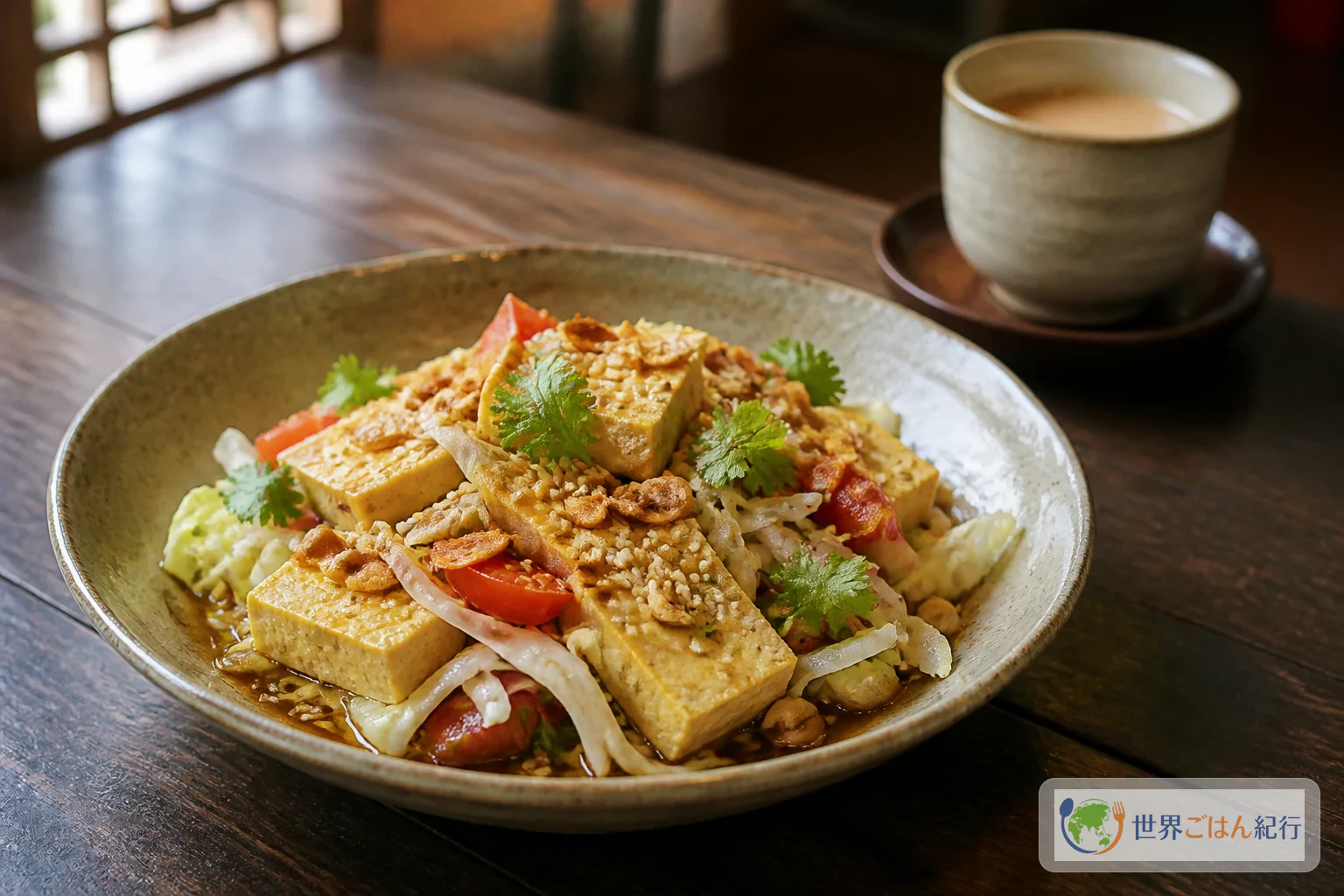
Take the chilled tofu out of the tray and cut into 0.5 inches (1 cm) strips. Put the cabbage, tomatoes, and red onion in a large bowl, add two-thirds of the dressing, and turn 2 to 3 times, lifting from the bottom. Add the tofu, pour the remaining dressing around the edge, and turn twice more. Stop when the dressing coats everything, no seasoning liquid remains at the bottom of the bowl, and the corners of the tofu are still intact. If you mix too much, the corners of the tofu break down and the tomato juice makes everything watery.
Plate it and top with fragrant garlic chips, peanuts, white sesame, and cilantro. Keeping the toppings separate until just before eating preserves the crunch of the garlic and nuts. If you want to vary the heat, do not put all the chili powder in the dressing; add it to each person's plate at the end.