Ingredients and steps on one page. Print it, or choose “Save as PDF” in the print dialog.
Sekai Gohan
Mumu: Papua New Guinea's Earth-Oven Feast of Pork, Sweet Potato, and Coconut Milk
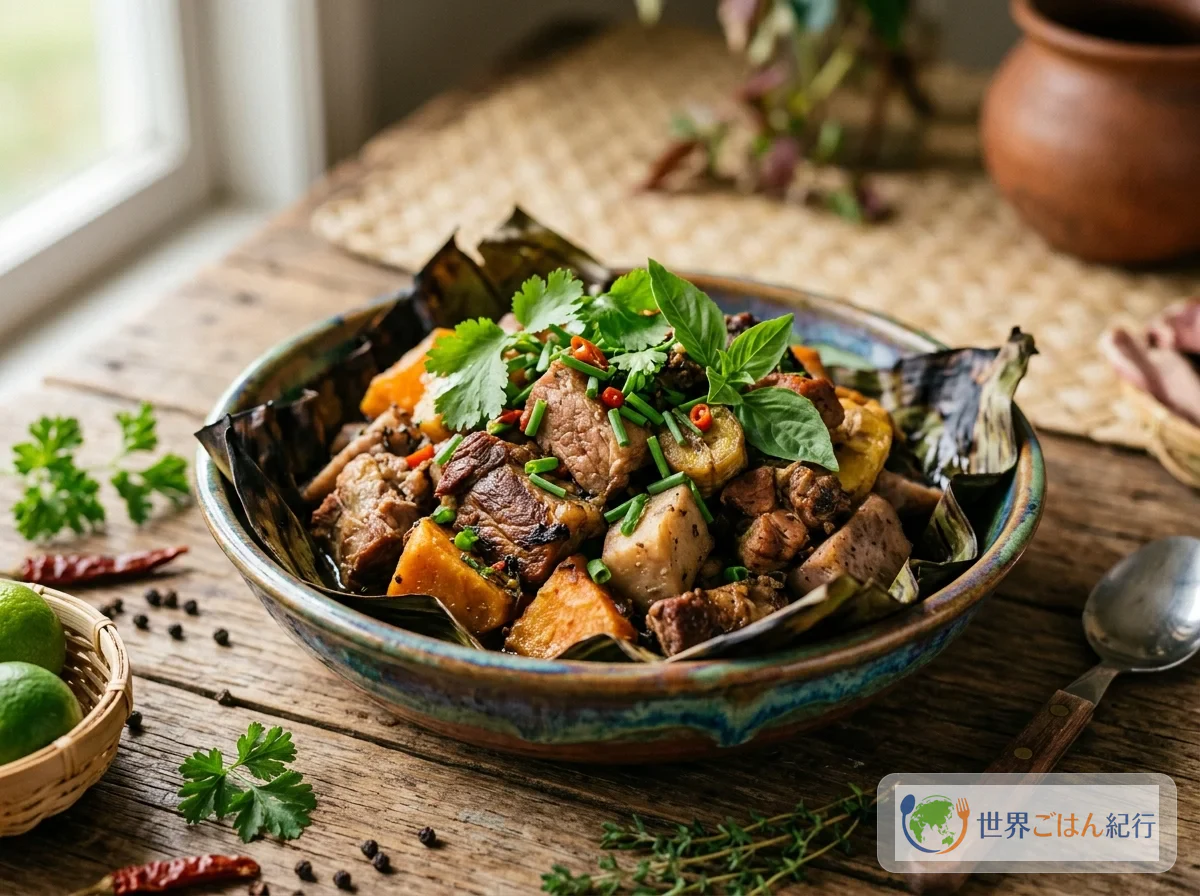
Ingredients
Main meat
| Ingredient | Amount | Substitutes & notes |
|---|---|---|
| Pork belly (block) | 1.75 lb (800 g) | 1.25 lb (600 g) chicken thighs also works |
| Chicken thighs (bone-in) | 4 (about 1.25 lb (600 g)) | 8 drumettes can substitute |
| Salt | 1.5 tbsp | — |
Root vegetables
| Ingredient | Amount | Substitutes & notes |
|---|---|---|
| Sweet potatoes | 3 (about 1.25 lb (600 g)) | Substitute for kumara (Papua New Guinean sweet potato) |
| Taro | 10.5 oz (300 g) | 14 oz (400 g) satoimo can substitute |
| Pumpkin | 1/4 (about 10.5 oz (300 g)) | Butternut squash recommended |
| Bananas (firm, before fully ripe) | 2 | Plantains recommended. Omit if unavailable |
Coconut milk and greens
| Ingredient | Amount | Substitutes & notes |
|---|---|---|
| Coconut milk | 1¾ cups (400 ml) (1 can) | For coconut cream, ¾ cup (200 ml) plus ¾ cup (200 ml) water |
| Spinach or komatsuna | 10.5 oz (300 g) | Substitute for amaranth leaves (the Papua New Guinean tradition) |
| Banana leaves | 4–6 | Aluminum foil can substitute |
| Garlic | 4 cloves (crushed) | — |
| Ginger | 1 piece (thinly sliced) | — |
Steps
1Prepare the banana leaves
10 min
What decides the flavor and look of mumu above all is the banana leaves. If using frozen banana leaves, first thaw them at room temperature for about 30 minutes, wash under running water, and wipe off the moisture. Prepare 4–6 large leaves and cut off the tough stem portion to a width of about 1–1 inches (2 cm).
If the leaves tear easily, quickly pass them over an open flame or a gas burner to make them pliable and easier to wrap. In Papua New Guinea, it is the children's job in the morning to cut fresh leaves from the banana tree and carry them carefully so that they do not tear.
If you cannot get banana leaves, aluminum foil can substitute. But the faint green fragrance and sweetness that banana leaves add are an essential element of mumu's taste, so use real leaves whenever possible.
2Season the meat
15 min
Cut the pork belly into large 2 inches (5 cm) blocks. In traditional Papua New Guinean mumu a whole pig is sometimes used, and large pieces of meat suit the long cooking of steam roasting. Salt the meat until the surface has taken the salt and the meat looks moist and slightly darker. Cutting it too small lets the moisture escape and makes it dry.
Use the chicken thighs with the bone in. The savor from the bones melds with the coconut milk broth and creates mumu's characteristic depth.
Rub salt, black pepper, crushed garlic, and thinly sliced ginger into all the meat.
The rule for mumu is "cut big"Traditional mumu is a long steam roast of 3 to 4 hours. Meat cut small loses its moisture. Cutting the pork at least 2 inches (5 cm) and keeping the chicken on the bone keeps it juicy through long cooking. The same principle applies when reproducing it in a Dutch oven (cooking time about 2.5 to 3 hours).
3Prepare the root vegetables
15 min
Cut the sweet potatoes, skin on, into 1 inch (3 cm) thick rounds. In Papua New Guinea a local variety of sweet potato called kumara (kaukau) is used, but ordinary sweet potatoes, preferably sweet varieties, reproduce it quite deliciously.
Peel the taro (satoimo can substitute) and cut into bite-size pieces. Taro can make your hands itch, so wet your hands with vinegar before handling it. Remove the seeds from the pumpkin and cut into 2 inches (5 cm) cubes. Cut firm, not-yet-ripe bananas (or cooking plantains), skin on, into 1 inch (3 cm) widths.
4Wrap in the banana leaves
10 min
On the bottom of a Dutch oven (or large pot), lay two banana leaves in a cross. Ideally the leaves are large enough to hang over the sides of the pot, to be folded over at the end like a lid.
First arrange the root vegetables (sweet potato, taro, pumpkin) on the bottom. Pack them with no gaps, so that when you finish wrapping the leaves do not tear and the whole is stable and softly enclosed. On top place the pork belly and chicken thighs, and scatter rounds of banana among the meat. Lay the greens (spinach or komatsuna) over the meat, and pour the coconut milk evenly over everything.
Finally fold the overhanging parts of the banana leaves inward to wrap all the ingredients without gaps. Cover with one more banana leaf on top so steam does not escape.
In traditional Papua New Guinean mumu, heated stones are laid on top of this, covered with more banana leaves and a damp cloth, and then buried in soil, but in a home kitchen the heavy lid of the Dutch oven plays the same role.
5Steam-roast
2 hours 30 minutes–3 hours
Close the lid with no gaps and steam-roast in an oven preheated to 275°F (140°C) for 2 hours 30 minutes to 3 hours. Do not open the lid partway through. The essence of mumu is "slowly steaming in a sealed space." It is a dish of patience, waiting for the heat of the stones and the steam to cook the ingredients evenly, for a chopstick to slide easily into the meat, and for the savor of the ingredients to meld.
If you have no oven, put the Dutch oven on the lowest flame of a gas burner, cover it, and heat for 3 hours. Check from time to time that the bottom is not scorching, and add 2–3 tbsp water if necessary.
Substitute method with a slow cookerWith a slow cooker, layer the ingredients in the same way and cook on LOW for 6–8 hours. The banana leaves can be laid inside the pot of the slow cooker.
6Open the lid and serve
5 min
When cooking is done, take it out of the oven and rest for 5 minutes. The moment you lift the lid, a sweet, rich steam in which coconut milk, banana leaf, and pork have melded rises up.
Open the banana leaves, check that the meat is meltingly tender, and then serve it generously on a large plate or cutting board. In Papua New Guinea the tradition is to use the banana leaves themselves as tablecloth and plate, with everyone sitting around and eating by hand.
The coconut milk has absorbed the savor of the meat and root vegetables and turned into a thick broth. This broth is called "gravy," and it is superb coated over the sweet potato and taro.