Ingredients and steps on one page. Print it, or choose “Save as PDF” in the print dialog.
Sekai Gohan
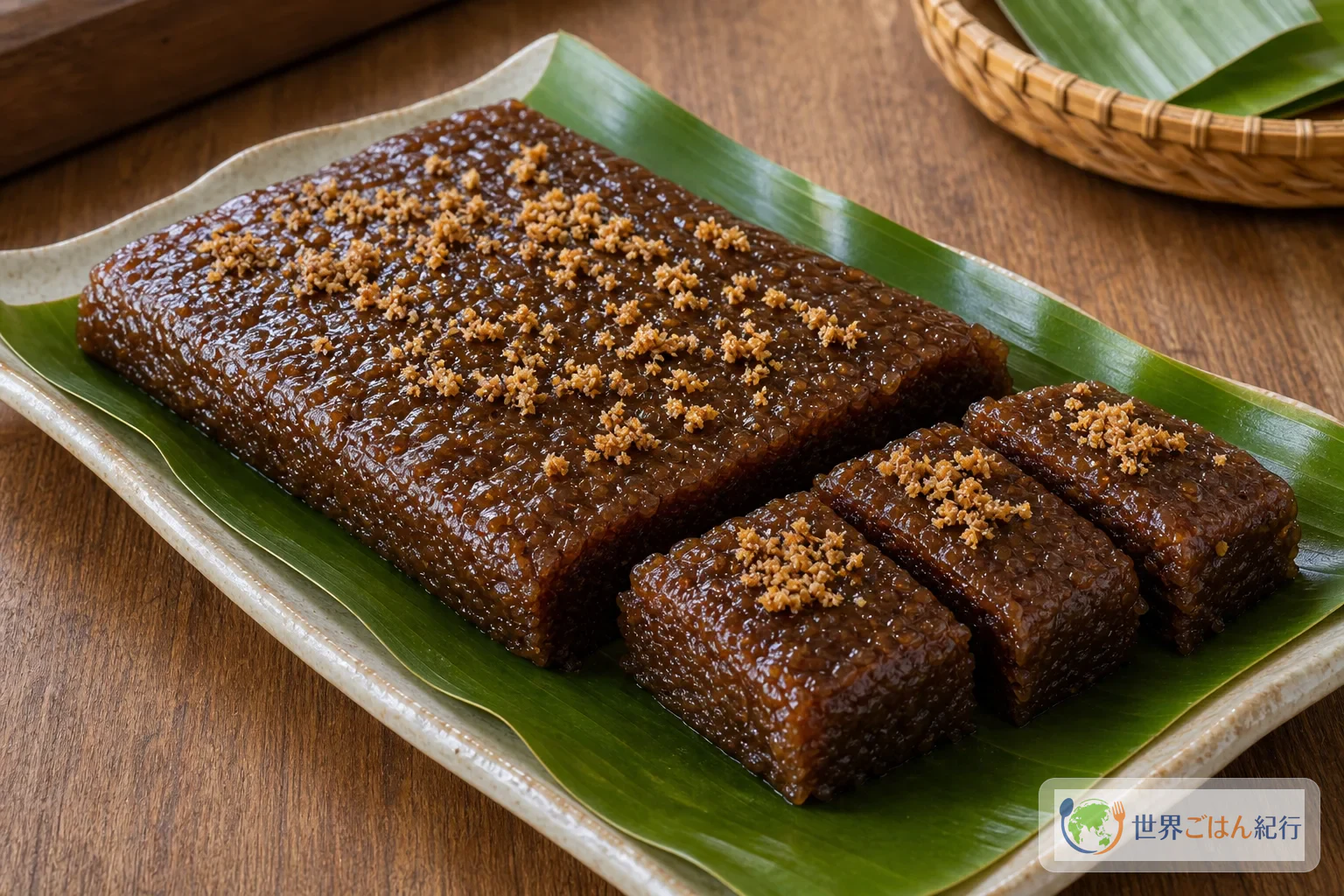
Kalamay: Filipino Brown Sugar and Coconut Sticky Rice Cake
Ingredients
| Ingredient | Amount | Substitutes & notes |
|---|---|---|
| Glutinous rice flour | 300g | If using shiratamako, crush the grains fine. Regular rice flour alone isn't sticky enough |
| Coconut milk | 400ml | Shake the can well. If it has separated, warm it to body temperature and stir |
| Coconut cream | 200ml | For the latik. If you have none, use a coconut milk with a lot of thick cream |
| Brown sugar or muscovado | 180g | Light cane sugar also works. White sugar alone has too little aroma |
| Water | 120ml | For loosening the flour. Add 20 ml if the shiratamako grains are coarse |
| Salt | 2g | Sharpens the sweetness |
| Rice bran oil | 2 tsp | For the pan and spatula. Oil rendered from the latik also works |
| Banana leaf | 1 sheet for a 20 cm square pan | 8 in square pan. Use thawed frozen leaf. Parchment paper if you have none |
| Latik for finishing | all of what you made | Pull it before it burns and let it cool |
Steps
1Make the latik
18 min
Put ¾ cup (200 ml) coconut cream in a small pot and warm it over medium heat for 3 minutes. When it begins to bubble, lower the heat and simmer for 12 to 15 minutes, tracing the bottom with a wooden spoon. When the white liquid separates into clear oil and curds, and the curds turn pale golden, turn off the heat. Color keeps deepening from the residual heat, so strain it before it turns dark brown. Save the oil as well, for greasing the pan.
2Whisk the glutinous rice flour with the brown sugar
7 min
In a large bowl, put 10.5 oz (300 g) glutinous rice flour, 6.5 oz (180 g) brown sugar and 2 g salt, and break up the lumps with a whisk. Add 1¾ cups (400 ml) coconut milk and ½ cup (120 ml) water in 3 additions, mixing about 1 minute after each. No heat in this step. If using shiratamako, crush the grains between your fingers first. When the white streaks are gone, the surface is smooth, and the batter is a little looser than pancake batter, it is enough. Lift the whisk: it should fall in a thick ribbon and leave a mark on the surface of the bowl for about 2 seconds.
3Start stirring over low heat
10 min
Strain the batter into a deep skillet and set it over low heat. Keep it at the point where small bubbles appear at the edge, and do not boil it. Trace the whole bottom with a wooden spoon, continuing to draw it from the edge toward the center. After about 5 minutes the batter is as thick as loose custard and begins to come together a little heavily. A guide is that the line drawn with the spatula stays for about 1 second while the surface remains smooth and still flows. If you raise the heat to medium here, only the bottom will scorch first, so stay on low.
4Stir until it pulls away from the sides
20 min
Still on low heat, stir for another 18 to 20 minutes. The guide is a batter that has darkened to brown sugar color, pulls together away from the sides of the pan, and stretches like a heavy ribbon when you lift the spoon. When the line traced across the bottom with the spatula stays about 3 seconds and does not flow back at once, turn off the heat. If you smell scorching, don't scrape the bottom too hard; move the portion that hasn't burned into another container.
5Transfer to the pan and smooth
7 min
Line an 8-inch (20 cm) square pan with banana leaf and brush it thinly with the oil from the latik or 2 tsp rice bran oil. Take the dough off the heat and move it into the pan right away, pressing and smoothing the surface with an oiled spatula. No heat in this step. The dough becomes hard to handle as it cools, so even out the thickness rather than packing the corners perfectly.
6Cool, cut and scatter the latik
45 min
Cool it in the pan at room temperature for 30 minutes, and once the surface heat has gone, firm it in the refrigerator for about 15 minutes. It hardens if over-chilled, so there is no need to chill long. Wet a knife with water and cut into 10 equal pieces, each about 1.5 inches (4 cm) wide and 1 to 1 1/4 inches (2.5 to 3 cm) thick. No heat in this step. Scatter the latik just before eating, and it won't go limp from moisture and keeps its toasty flavor.