Ingredients and steps on one page. Print it, or choose “Save as PDF” in the print dialog.
Sekai Gohan
Laing: Bicol's Dried Taro Leaves Simmered in Coconut Milk
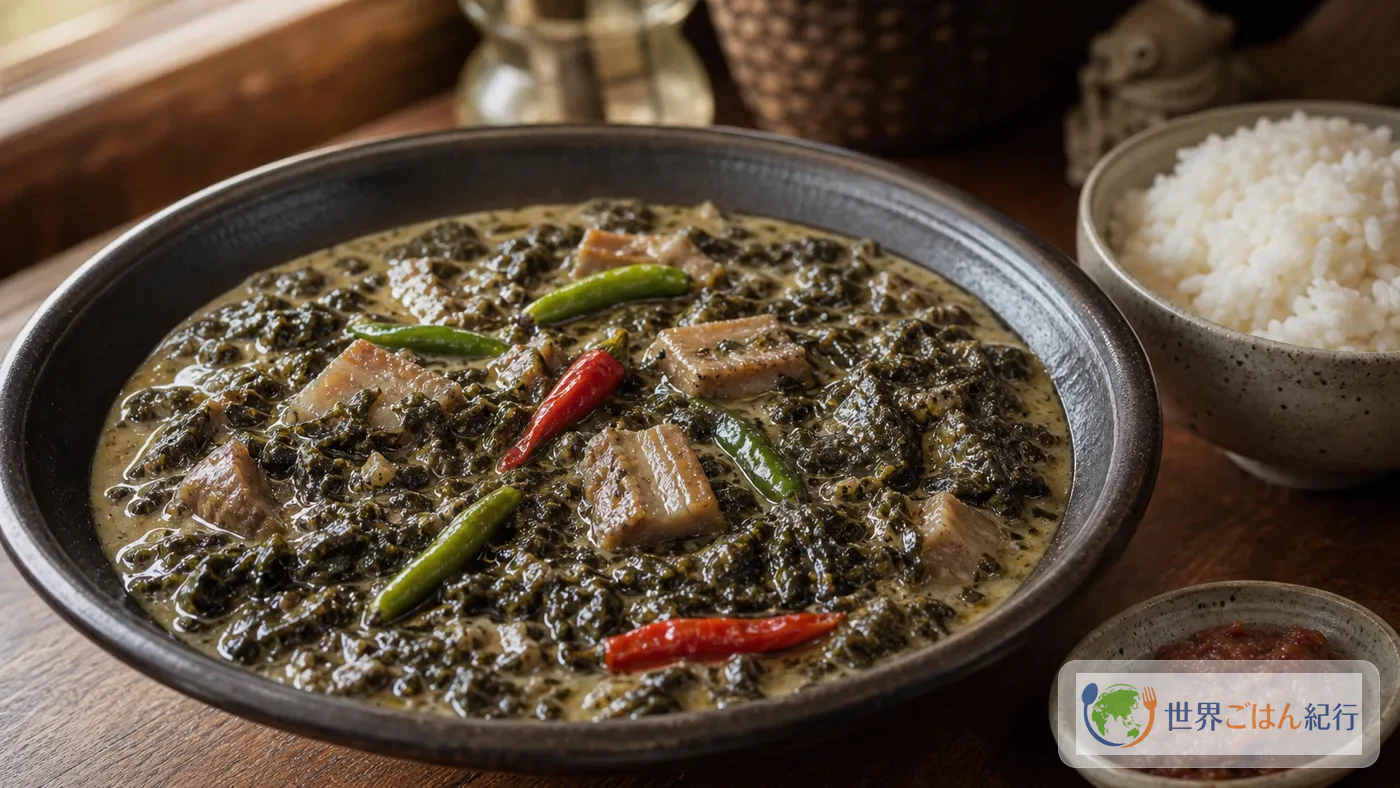
Ingredients
Ingredients
| Ingredient | Amount | Substitutes & notes |
|---|---|---|
| Dried taro leaves | 2.75 oz (80 g) | Filipino grocery or online. Leafy-green substitutes are described below |
| Pork belly, in a block | 9 oz (250 g) | Pork shoulder also works. Cut into 0.5 inches (1.5 cm) widths |
| Coconut milk | 2½ cups (600 ml) | Unsweetened canned. Light types are thin |
| Coconut cream | ¾ cup (200 ml) | For finishing. If none, ¾ cup (200 ml) ordinary coconut milk |
| Bagoong alamang | 2 tbsp | Shrimp paste. Very salty, so use in portions |
| Fish sauce | 2 tsp | A boost when the bagoong is weak |
| Water | ½ cup (100 ml) | To prevent scorching. Adjust during simmering |
Ingredients
| Ingredient | Amount | Substitutes & notes |
|---|---|---|
| Onion | 1 (about 7 oz (200 g)) | Thinly sliced |
| Garlic | 4 cloves | Roughly chopped |
| Ginger | 25 g | Cut into thin strips. Cuts the heaviness of the coconut |
| Lemongrass | 1 stalk | Bruised and cut into 2 inches (5 cm) lengths. Omit if none |
| Green chilies | 3 | 6 shishito peppers plus 1 red chili also work |
| Red chili | 1 | Remove the seeds for less heat |
| Black pepper | 1/4 tsp | For finishing |
| Salt | from 1/4 tsp | Adjust at the end by the saltiness of the bagoong |
| Cooked white rice | 4 servings | Cooked slightly firm, it takes the sauce better |
Steps
1Cut the ingredients
Cut the pork belly into strips about 0.5 inches (1.5 cm) thick and 1.5 inches (4 cm) long. Slice the onion 0.25 inch (5 mm) thick, roughly chop the garlic and cut the ginger into 0.125 inch (2 mm) strips. Cut half of the green chilies on the diagonal and set the rest aside whole for finishing. This takes 10 minutes. Spread out the dried taro leaves and check for large stems or different leaves; the parts that have crumbled to a powder scorch easily, so avoid gathering them in the upper layer of the pot.
2Simmer the coconut base
In a deep pot put 2½ cups (600 ml) coconut milk, ½ cup (100 ml) water, the pork, onion, garlic, ginger, lemongrass and 1 tbsp bagoong. Warm over medium heat for about 5 minutes, and when small bubbles appear at the side of the pot, lower to medium-low. Set the lid slightly ajar and simmer for 12 minutes. Move on when the surface of the pork has turned white, the onion is translucent and the scent of ginger mingles in the coconut steam. Boiling hard makes coconut milk separate easily, so keep a heat at which the surface trembles gently.
3Lay on the dried taro leaves
Lower the heat to low and spread the 2.75 oz (80 g) dried taro leaves over the pot. Do not stir at once. Press lightly from above with a wooden spatula so that only the lower half of the leaves touches the coconut milk. Cover and simmer 15 minutes. The leaves sink little by little, and the dry green of the surface turns to a deep green-brown. You will know it is working when pressing the bundle makes it sink slowly, the white liquid coats the leaves and the crackling sound stops. If dry parts remain, spoon coconut liquid from the edge of the pot over them rather than adding water, and sink them without breaking the leaves.
4Simmer the leaves soft and reduce
Once the leaves have sunk, turn them over from the bottom just once or twice, broadly. Simmer 25 minutes over low heat. If the bottom of the pot looks about to scorch, add 2 tbsp of water at a time, but keep it to a minimum so as not to thin the sauce too much. It is ready when the leaves are completely soft, no hard stem fibers are left on the tongue and the sauce has reduced to about half its first amount. If the leaves are still hard here, or a green smell that could prickle the throat remains, simmer another 10 minutes.
5Add coconut cream and chilies
Add ¾ cup (200 ml) coconut cream, the remaining 1 tbsp bagoong, the diagonally cut green chilies, the red chili and the black pepper. Simmer over low heat for 8 to 10 minutes. It is enough when the sauce has a gloss and, when you draw a wooden spatula across the bottom of the pot, a line stays for just a moment. Taste for salt, and if it is lacking add 1/4 tsp salt or 1 tsp fish sauce. If you want more bagoong, adding it from a small dish at the table is less likely to turn it salty than adding it to the whole pot.
6Rest and serve with rice
Turn off the heat, cover and rest for 5 minutes. The coconut oil settles and the sauce returns to the leaves. Do not heap it up in the bowl; place about 3 to 4 tablespoons beside the white rice. A small dish of bagoong on the side, and lime or calamansi for a squeeze, keep the rich sauce from becoming too heavy. The temperature right before serving is piping hot, and the ideal is a state where the sauce does not spread across the plate but clings to the leaves.