Ingredients and steps on one page. Print it, or choose “Save as PDF” in the print dialog.
Sekai Gohan
Pancit Palabok: Filipino Rice Noodles with Shrimp-Stock Sauce
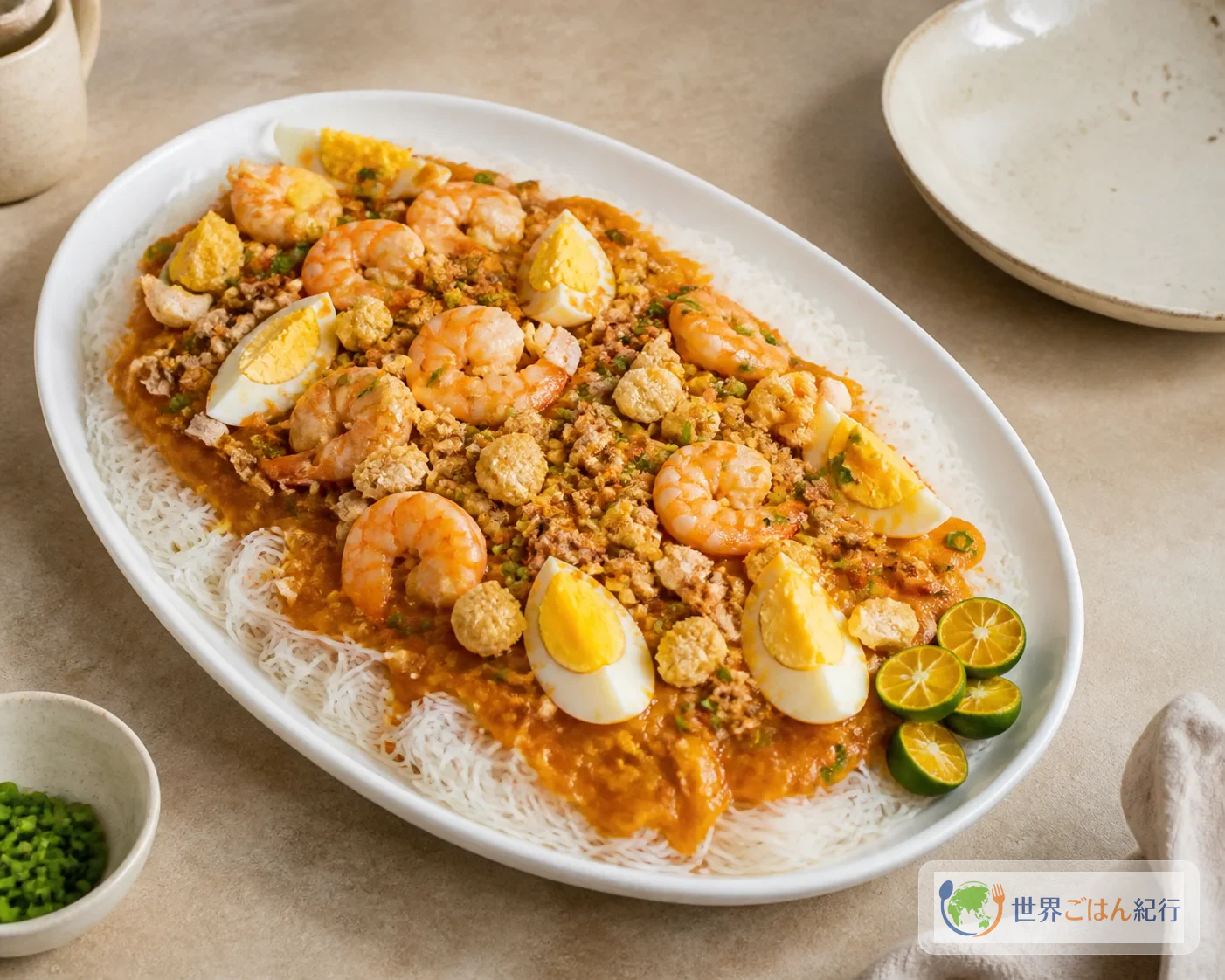
Ingredients
Noodles and sauce
| Ingredient | Amount | Role and substitutes |
|---|---|---|
| Thin dried rice vermicelli | 8.5 oz (240 g) | Rice noodles. Filipino bihon is preferred. Thick noodles lean toward luglug |
| Shell-on, head-on shrimp | 10.5 oz (300 g) | Heads and shells for the stock, the flesh for finishing. If there are no heads, use 12.5 oz (350 g) shell-on shrimp |
| Water | 3¼ cups (800 ml) | For the shrimp stock. Add boiling water if it runs short |
| Ground pork | 6.5 oz (180 g) | Fat and savory depth for the sauce. To avoid pork, replace with 5.5 oz (150 g) firm tofu |
| Onion | 1/2 (3.5 oz / 100 g) | Finely chopped into 0.25 inch (5 mm) pieces |
| Garlic | 4 cloves (about 20 g) | 2 cloves for the sauce, 2 for the fried garlic |
| Annatto seeds | 1 tbsp (about 8 g) | Achiote. 2 tsp if using powder. You can make the dish without it, but the color and aroma will be paler |
| All-purpose flour | 2 tbsp (18 g) | Thickens the sauce. If using cornstarch, dissolve 1 1/2 tbsp in water |
| Patis | 1 tbsp (15 ml) | Filipino fish sauce. If using Thai-style fish sauce, start with 2 tsp and taste |
| Neutral oil | 3 tbsp (45 ml) | 2 tbsp for the annatto oil, 1 tbsp for the fried garlic |
| Black pepper | 0.5 g | For the stock and sauce |
| Salt | 1 g | To season the shrimp. Skip it if the fish sauce is already salty |
Toppings
| Ingredient | Amount | Role and substitutes |
|---|---|---|
| Flaked tinapa | 1.75 oz (50 g) | Smoked fish. If hard to find, substitute 1.75 oz (50 g) smoked mackerel, 1.75 oz (50 g) smoked trout, or 15 g bonito flakes |
| Chicharron | 1.5 oz (40 g) | Fried pork skin. Otherwise crush a salted pork rind snack |
| Eggs | 4 | Hard-boiled and cut lengthwise into quarters |
| Scallions | 3 (about 1 oz / 30 g) | Sliced thin. The white parts can go into the sauce |
| Calamansi | 4 | Substitute 1 lemon or 6 sudachi/limes |
| Fried garlic | about 15 g, made with the oil above | If store-bought, 2 tbsp. Do not omit; it adds aroma |
Steps
1Make the annatto oil, fried garlic, and hard-boiled eggs
15 min
Put 2 tbsp neutral oil and 1 tbsp annatto seeds in a small skillet and set over medium-low heat. Warm for about 2 minutes, until fine bubbles form around the seeds and a red-orange color spreads through the oil. Take it off the heat before the seeds turn black, and strain through a fine sieve. It is ready when the annatto aroma rises and the oil is a sunset orange, not a bright vermilion. If you scorch the seeds over high heat, bitterness remains instead of an earthy aroma. In the same skillet, add the remaining 1 tbsp oil and 2 thinly sliced garlic cloves, and fry over low heat for 3–4 minutes until pale golden, then drain on paper (fried garlic). Meanwhile, put 4 eggs into boiling water and boil over medium heat for 12 minutes, then cool in cold water and peel to get hard-boiled eggs.
2Make the stock from the shrimp heads and shells
15 min
Peel the shrimp and return the flesh to the refrigerator. Do not throw away the heads, shells, and tails; stir-fry them in a pot with 2 tsp of the annatto oil over medium heat for 3 minutes. When the shells turn from gray to red-orange and the aroma clings to the bottom of the pot, pour in 3¼ cups (800 ml) water. Bring to a boil, lower the heat, and simmer for 10 minutes with small bubbles continuing on the surface. Skim off any white foam so the stock does not become too cloudy.
Strain through a fine sieve and set aside 2½ cups (600 ml) of stock. Add the seasoned shrimp to the remaining stock, boil over medium heat for 2–3 minutes, and remove when the center turns white. Left in the stock, the shrimp turn tough from residual heat, so move them to a plate and cover with plastic wrap.
3Stir-fry the pork and aromatics
8 min
Put 1 tbsp annatto oil in a wide skillet or wok and warm over medium heat for 30 seconds. Spread 6.5 oz (180 g) ground pork in the pan and do not stir right away; let it sear for 2 minutes until the underside browns. Turn it and stir-fry another 3 minutes. When the color has changed all the way through each piece, add the onion and garlic and stir-fry for 2 minutes. Move on when the onion turns translucent and the garlic smells fragrant. If burnt garlic gets mixed in, the whole sauce turns bitter, so when the bottom of the pan starts to blacken, lower the heat to medium-low.
4Add the shrimp stock and thicken
10 min
Lower the heat, add 2 tbsp flour, and stir-fry for 1 minute. When no white flour remains and it has blended with the pork fat into a moist mass, pour in 2½ cups (600 ml) shrimp stock in 3 additions. Each time, stir with a whisk, tracing the bottom of the pan, to avoid lumps.
Add 1 tbsp patis and 0.5 g black pepper, and bring to a boil once over medium heat. When it boils, lower the heat and simmer for 5–6 minutes. It is ready when a line drawn with a spoon on a plate stays about 3 seconds before slowly closing. If it is loose, reduce it over low heat 1 minute at a time; if it is thick, add the reserved shrimp stock 1 tbsp at a time. Do not simmer all the tinapa in at this stage; scatter it at the end to keep the smoky aroma.
5Boil the rice noodles
3 min
Bring 2 quarts (2 L) of water to a boil over high heat in a large pot and add 4 g salt. Loosen 8.5 oz (240 g) vermicelli and add it, boiling 30 seconds less than the package time, about 1 minute 30 seconds to 2 minutes. Take out one strand: it is ready when it is soft enough to cut with a finger and no powdery white core remains in the center. Drain well in a colander and do not rinse in cold water. Rinsing makes the sauce cling poorly, and if the noodles sit, they hold water and the flavor turns weak.
6Layer the toppings and finish just before eating
10 min
Keep the sauce warm over low heat, spread the noodles on a large platter, and pour the warm sauce over from the center. Arrange the boiled shrimp, eggs cut into quarters, tinapa, scallions, fried garlic, and crushed chicharron so the noodles are not hidden entirely. Do not squeeze the calamansi; serve it as wedges. That way each person can add sourness as they like. It is ready when the surface of the sauce has not dried and a little of the white noodles shows. If it sits for 10 minutes or more after plating, the noodles absorb the sauce and turn heavy, so carry it to the table while the sauce is warm.