Ingredients and steps on one page. Print it, or choose “Save as PDF” in the print dialog.
Sekai Gohan
Sapin-Sapin: Filipino Layered Rainbow Sticky Rice Cake
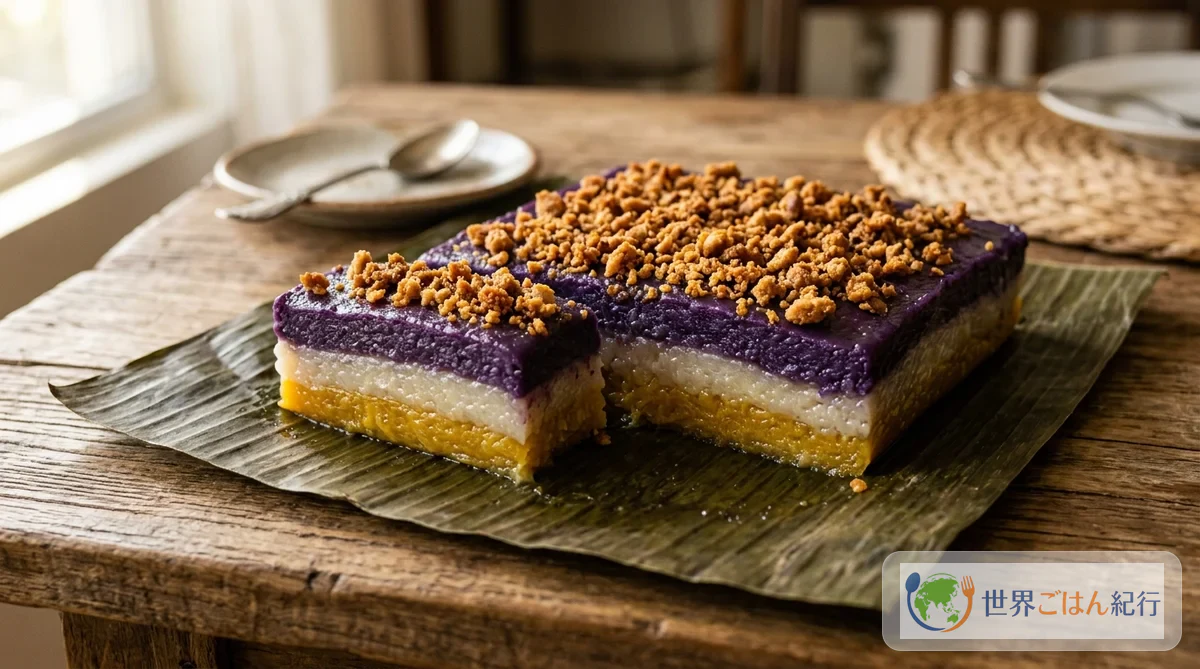
Ingredients
| Ingredient | Amount | Role and substitutes |
|---|---|---|
| Glutinous rice flour | 10.5 oz (300 g) | If using shiratamako (glutinous rice flour dumpling flour), crush it fine first. Regular rice flour lacks stickiness |
| Coconut milk | 1¾ cups (400 ml) | For the batter. Shake the can well before using |
| Sweetened condensed milk | 3.5 oz (100 g) | Sweetness and the roundness of milk. Keep at least 2 oz (60 g) even to reduce sweetness |
| Light brown (unrefined) sugar | 2.75 oz (80 g) | White sugar also works. Avoid dark brown sugar, which muddies the color |
| Water | ½ cup (100 ml) | To adjust the thickness of the batter |
| Salt | 1.5 g | Tightens the sweetness |
| Ube halaya | 2.75 oz (80 g) | For the purple layer. 2.5 oz (70 g) purple sweet potato paste also works |
| Ube extract, or purple sweet potato powder | 1 tsp | An aid for color. You can make it without |
| Canned jackfruit | 2.5 oz (70 g) | For the yellow layer. Chop into 0.25 inch (5 mm) pieces |
| Turmeric | 0.4 g | An aid for the yellow. Too much shows in the aroma |
| Coconut flakes | 1 oz (30 g) | For the white layer. Replace with the same amount of macapuno if you have it |
| Coconut cream | ¾ cup (200 ml) | For the latik. If none, use coconut milk |
| Rice bran oil | 2 tsp | To grease the pan. Use the oil released from the latik if you have it |
| Banana leaf | 1 sheet (for an 8-inch (20 cm) round pan) | Thaw if frozen. Parchment paper if none |
Steps
1Make the latik
25 min
Put ¾ cup (200 ml) coconut cream in a small pot and warm over medium heat for about 3 minutes. When it starts to bubble, lower the heat to low and cook for 18 to 22 minutes, tracing the bottom of the pot with a wooden spoon. Turn off the heat when the white liquid separates into oil and solids and the solids are a light golden brown. The color keeps deepening from residual heat, so take it out before it turns dark brown. Drain the oil with a sieve or paper, and keep the oil too, for greasing the pan.
2Mix the glutinous rice flour batter
8 min
In a large bowl put 10.5 oz (300 g) glutinous rice flour, 2.75 oz (80 g) unrefined sugar and 1.5 g salt and loosen the flour with a whisk. Add 1¾ cups (400 ml) coconut milk in 3 portions, mixing about 1 minute each time. This step uses no heat. Mix until no dry flour remains; the batter should fall in a thick ribbon when you lift the whisk. If you use shiratamako, crush the lumps with your fingers before mixing.
3Add the sweetness and strain the batter
7 min
Add 3.5 oz (100 g) condensed milk and ½ cup (100 ml) water and mix for 2 more minutes without heat. Once the graininess of the sugar is gone, strain the batter through a fine sieve. Do not force small lumps left in the sieve through; crush them with a spoon and return them. The batter should be a little thicker than drinking yogurt, with the whisk streaks remaining for about 2 seconds before vanishing. Go on when the surface is smooth and no small flour lumps are visible.
4Divide into three colors
10 min
Divide the batter into 3 equal parts with a measuring cup, about 260 ml each. Into the first put 80 g ube halaya and 1 tsp ube extract for the purple layer. Into the second put 30 g coconut flakes for the white layer. Into the third put 70 g jackfruit chopped into 5 mm pieces and 0.4 g turmeric for the yellow layer. This step also uses no heat. Large pieces would crack the layer boundary, so chop the jackfruit small.
5Prepare the pan and the steamer
8 min
Grease an 8-inch (20 cm) round pan with the oil from the latik or 2 tsp rice bran oil. Pour boiling water over the banana leaf or hold it over low steam for 10 seconds, and when it is pliable lay it in the pan. Bring the steamer water to a boil over high heat, and when steam is rising firmly, lower to medium-high. Keep at least 1 inch (3 cm) of water from the bottom of the pot. Set it at a height where the water does not touch the pan once it is in.
6Steam the yellow layer
13 min
Pour the yellow batter into the pan and pop large surface bubbles with a bamboo skewer. Make the layer about 0.5 inch (1.2 cm) thick with a flat, smooth surface. Steam over medium-high heat for 10 minutes, and go on when the surface does not flow and the center does not ripple much when you shake the pan lightly. If liquid still moves, add 2 to 3 minutes at the same heat. If you keep steaming over high heat, drops of water fall from the lid and leave holes in the surface.
7Add the white layer
13 min
Pour the white batter gently against the back of a spoon. Dropping it directly would make holes in the yellow layer. Steam over medium-high heat for 10 minutes; it is cooked when the surface is white and opaque and a bamboo skewer inserted shallowly comes out without liquid. If your lid tends to drip, wrap the lid in a kitchen towel, tying the ends on top so the towel does not touch the flame.
8Steam the purple layer to finish
18 min
Pour the purple batter gently in the same way. Spread the purple layer to about 0.5 inch (1.2 cm) too, lightly level the surface with a spatula and steam. Steam over medium-high heat for 12 minutes; it is done when a skewer in the center comes out without raw liquid. If the skewer picks up only a little translucent glutinous dough, add 3 minutes without turning off the heat. If the surface dries and looks about to crack, the heat is too high. Lower it toward medium, within a range where steam does not stop.
9Cool and cut
1 hr 30 min
Turn off the heat, take out the pan and cool on a rack for 30 minutes. Covering it while hot returns steam and makes the surface watery, so once the heat has eased, cover loosely with plastic wrap and chill in the refrigerator for 1 hour. Run a wet knife around the edge of the pan and turn it out onto a plate. Cut into 8 pieces, wetting the knife with water, and scatter with the latik. If it is too cold and hard, take it out to room temperature 20 minutes before eating.