Ingredients and steps on one page. Print it, or choose “Save as PDF” in the print dialog.
Sekai Gohan
Orh Luak (Oyster Omelette): Singapore Hawker-Style Recipe
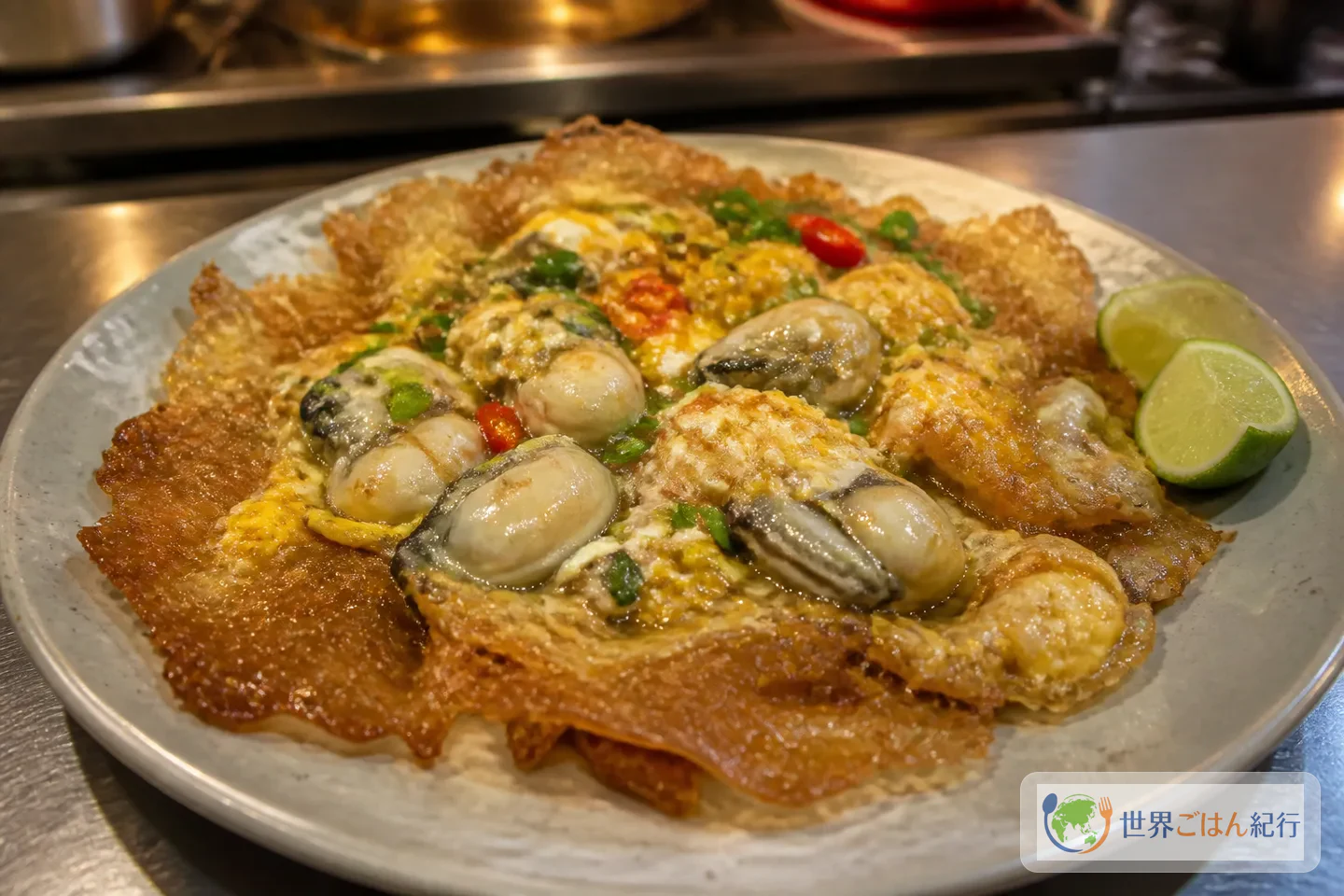
Ingredients
| Ingredient | Amount | Role & substitutes |
|---|---|---|
| Shucked oysters, for cooking | 160 g | 8–12 oysters (about 5.6 oz). Thaw frozen ones in the fridge and drain the liquid |
| Eggs | 3 | Beat lightly. Don't make the yolks completely uniform |
| Tapioca starch | 45 g | Gives the edges bounce and translucency. Potato starch alone changes the texture |
| Rice flour | 15 g | Shapes the batter and tones down the tapioca's stickiness |
| Water | 150 ml | About 2/3 cup. Lets the batter pour thin. Don't add the oyster liquid |
| Fish sauce (nam pla or similar) | 2 tsp | 1 tsp in the batter, 1 tsp in the egg |
| Light soy sauce | 1 tsp | Seasons the egg. With regular (dark-style) soy sauce, start with half |
| Sugar | 1/2 tsp | Rounds off the edge of the fish sauce |
| White pepper | 1/4 tsp | Sharpens the oyster aroma |
| Neutral oil such as rice bran oil | 2 tbsp | 1 tbsp per batch. Add a little more if needed |
| Scallions | 2 | White parts cooked in, green parts for garnish |
| Red chili | 1/2 | Sliced into rings. Leave out if you don't want heat |
| Lime or lemon | 1/2 | Squeeze just before eating |
| Chili sauce | To taste | On the side. Sweet-sour or hot, as you like |
Steps
1Dry the oysters and season the eggs
8 min
Tip the oysters into a colander and press the surface dry with paper towels. Washing them too much dulls the flavor, so if they're shucked oysters for cooking with no grit or shell fragments, just wipe the surface lightly. Separate the white and green parts of the scallions, and slice the red chili into rings. Wash any hands, colander or cutting board that touched raw oysters before moving on to the eggs or serving utensils.
Crack 3 eggs into a bowl and add 1 tsp fish sauce, 1 tsp soy sauce, 1/2 tsp sugar and the white pepper. Beat just until some streaks of yolk and white remain, so the egg doesn't cook up one-note. Some oysters are quite salty, so don't add any extra salt here.
Prep is done when the oyster surfaces are dry with the excess moisture gone and the egg mixture is smooth, with a few streaks of white left.
2Make the starch batter
3 min
Put 1.5 oz (45 g) tapioca starch, 15 g rice flour, ½ cup (150 ml) water and 1 tsp fish sauce in a bowl and whisk, scraping the bottom. The starch settles, so whisk again right before frying. Aim for slightly thinner than heavy cream: when you lift the whisk, the batter should fall in a thin stream and blend back into the surface within a few seconds.
3Spread it thin in a hot pan
4 min
Preheat a 26 cm (10-inch) skillet or wok over medium-high heat for about 2 minutes, then add 1 tbsp oil. Stir the batter again, pour half into the center of the pan, and tilt the pan to spread it to about 20 cm (8 inches) across. In about 30 seconds, tiny bubbles appear on the surface and the edges begin to turn white and set. If you add the oysters before the edges set, their moisture can tear the batter, so don't touch it until the edges change color.
4Layer on the oysters, then the egg, and fry
5 min
When the surface of the batter turns from translucent to white, scatter half the oysters and the white parts of the scallions evenly over it. Fry for 30 seconds to warm the bottoms of the oysters, then pour half the egg around the edges and drizzle a little over the oysters. Swirl the pan to spread the egg and cook over medium-high heat for about 2 minutes, until the edges set and the center no longer runs.
5Break it up with a spatula and cook through to the center
5 min
Cut the large round into 4–6 pieces with a spatula, and flip or fold them to give them more contact with the pan. If it's short on oil, add 1 tsp around the edge of the pan, and fry about 1 minute per side until the edges are deep golden brown. Check that the oysters are white and opaque even at their thickest point and that their juices are bubbling.
With oysters and other bivalves, don't assume at home that "half-raw is more like the stall." Put safety first. For bivalves, heat the center of the thickest part to 85–90°C (185–194°F) and hold it there for at least 90 seconds. Without a thermometer, cut one oyster open to check that the center isn't cold and that it's opaque all the way through; if not, break the pieces smaller and keep cooking.