Ingredients and steps on one page. Print it, or choose “Save as PDF” in the print dialog.
Sekai Gohan
Gaeng Som: Southern Thailand's Sour and Spicy Fish Curry
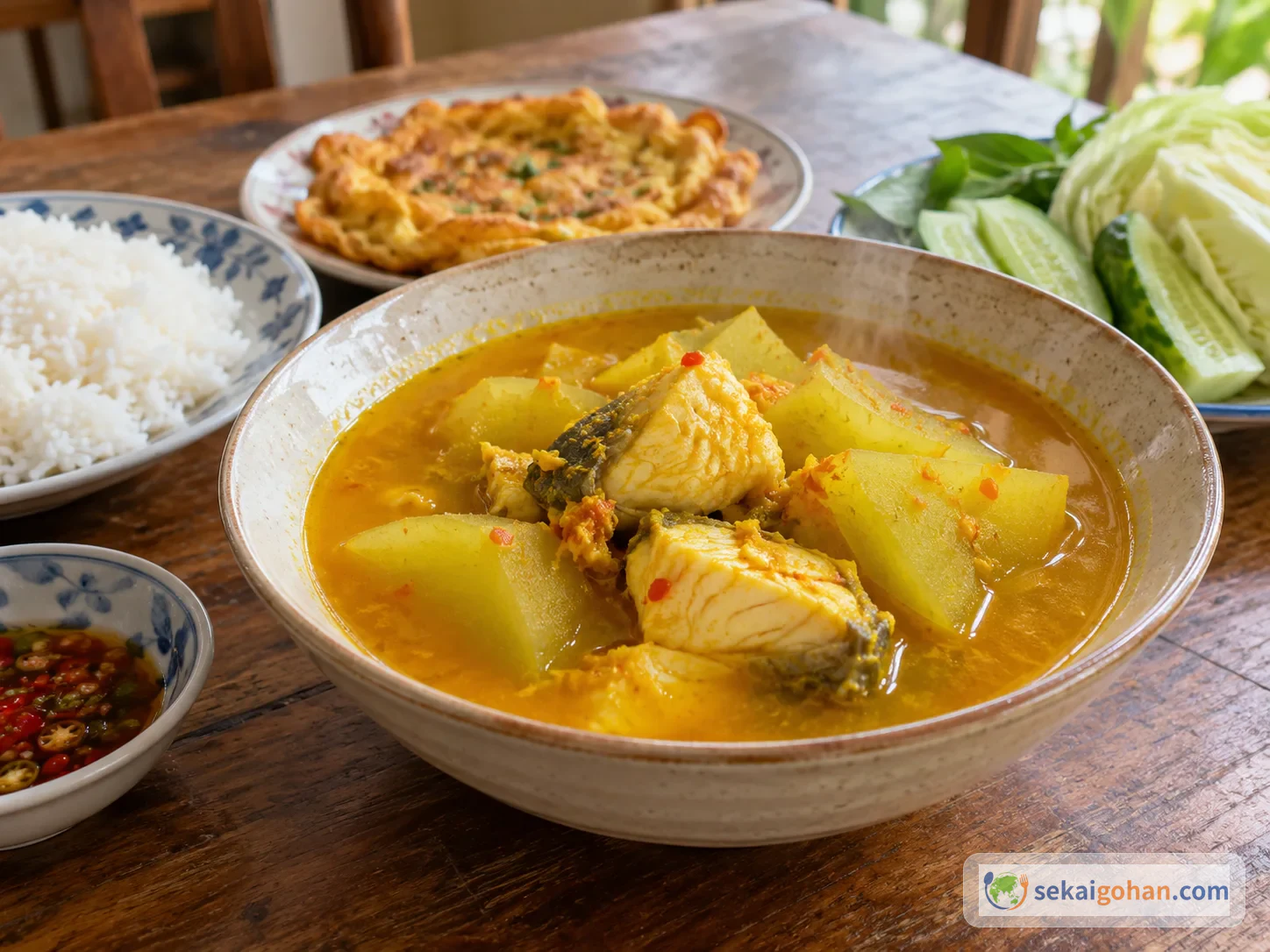
Ingredients
Aromatic paste
| Ingredient | Amount | Substitutes & notes |
|---|---|---|
| Red chili (fresh) | 20g | Use small Thai chilies if you have them. To lower the heat, remove some of the seeds, but the aroma weakens too |
| Garlic | 20g | Peel. If the cloves are small, 5–6 |
| Shallot or red onion | 1.75 oz (50 g) | Use red onion if you have no shallots. Slice thinly |
| Lemongrass | 1 stalk (about 1 oz / 30 g) | Use the tender part near the base, cut 2–3 mm wide |
| Fresh turmeric | 20g | If using turmeric powder, about 2 tsp, but the fresh, vivid aroma is weaker |
| Shrimp paste (kapi) | 15g | Strong in salt and aroma. Do not use it if you avoid crustaceans |
| Water | ½ cup (100 ml) | For blending the paste. Prepare it separately from the 1.25 quarts (1.2 L) of broth |
Fish, vegetables and sourness
| Ingredient | Amount | Substitutes & notes |
|---|---|---|
| Firm white fish | 1 lb (500 g) | Sea bass, cod, sea bream and the like. Cut skinless, boneless fillets into 4–5 cm pieces. Choose a fish whose flesh does not fall apart |
| Green papaya | 14 oz (400 g) net | Fully green, hard, unripe fruit. If you cannot find it, replace with 12.5 oz (350 g) daikon or 14 oz (400 g) winter melon and accept the difference in texture and sweetness |
| Water | 1.25 quarts (1.2 L) | Enough to cover the fish and vegetables. Adjust by about ½ cup (100 ml) depending on the shape of the pot |
| Tamarind paste | 1.5 oz (45 g) | Unsweetened type. Dissolve in ½ cup (90 ml) water, strain, and start with ¼ cup (60 ml), checking the concentration |
| Fish sauce | 2 tsp | Taste at the end and adjust for the saltiness of the shrimp paste |
| Salt | from 3g | Check the saltiness of the shrimp paste and fish sauce and adjust at the end |
For serving
| Ingredient | Amount | Substitutes & notes |
|---|---|---|
| Hot rice | 4 servings | Any medium- or long-grain rice works. Cook it a little firm so it can take the broth |
| Eggs | 4 | If serving a Thai omelet. Gaeng som holds up as a main dish without it |
| Raw vegetables such as cucumber and cabbage | as needed | A side that rests the palate from the heat. Wash and drain them |
Steps
1Blend the aromatics into a coarse paste
10 min
Put the chilies, garlic, shallots, thinly sliced lemongrass, fresh turmeric, shrimp paste and ½ cup (100 ml) water in a blender or mortar. Do not make it smooth; blend to a deep yellow, coarse paste with fine fibers still visible. Only if the blade spins without catching because there is too little water, add 1 tsp at a time. Hold the lid down so the juice of the fresh turmeric and chilies does not splash, and do not put your face near it right after blending.
2Cut the fish and green papaya
10 min
Peel and seed the green papaya and cut it into strips or thin slices about 4–5 cm long and 0.25 inch (5 mm) thick. Rinse in water before it goes into the broth to wash off the white sap on the surface. Check the fish for skin and bones, cut it into thick 4–5 cm fillet pieces and pat dry. Thin fillets and small scraps break up easily later. Remember thick fish, 0.25 inch (5 mm) papaya and your hands will not hesitate. Last, dissolve 1.5 oz (45 g) tamarind paste in ½ cup (90 ml) water, strain out any seeds or fibers, and make a concentrated liquid.
3Turn the aromatic paste into a broth
8–10 min
In a deep pot, put the paste, the remaining 1.25 quarts (1.2 L) water and ¼ cup (60 ml) of the strained tamarind liquid, and bring to a boil once over medium heat while stirring. When the shrimp paste is not clumping on the bottom and the whole broth is evenly colored from yellow to orange, add the green papaya. After it goes in, keep the heat at medium and simmer for 8–10 minutes at a steady boil. The signal to add the fish is a translucent state where only the surface is soft and a little resistance remains at the center. Tamarind strength differs by product. First check the sourness with ¼ cup (60 ml), and if it is weak, add more at the finish.
4Cook the fish without moving it
7–8 min
Lower the heat from medium, where the broth bubbles, to medium-low, and lower the fish in one piece at a time. Once the fish is in, do not stir. Stirring right after adding it breaks up the fish while it is still raw and spreads a fishy smell through the broth. Just spoon the broth gently over the top and wait until the surface turns white and the flesh flakes to the thick part. When it is cooked to the center, shake the pot to shift positions. Do not turn the pieces over with chopsticks again and again.
5Turn off the heat and set the sourness and salt
3 min
When the fish is cooked to the center, turn off the heat and take the pot off the burner. Matching the sourness after the heat is off is the crux of this step. Take a little broth, add the tamarind liquid 1 tbsp (15 ml) at a time, then fish sauce and salt a little at a time, and taste in the order of sourness, heat, saltiness. The target is a taste where the sourness arrives first, the chili lingers at the back of the tongue and the saltiness of the shrimp paste follows. Do not add sweetness to cover up the sourness. If it lacks sourness, add tamarind. If you use lime, add it a little at a time after turning off the heat. Boiling it drives off the aroma.
6Set out rice and sides, and serve
3 min
Put hot rice in bowls, then add the fish, green papaya and yellow broth in that order. If you serve a Thai omelet, cook 4 eggs separately over medium heat, cut into easy-to-eat pieces when the surface has set, and put washed raw vegetables such as cucumber and cabbage on a small plate. When eating, spoon a little broth over the rice first. The white rice takes in the sourness, so you can taste the crunch of the green papaya and the sourness of the broth together without breaking the fish. Be careful of burns when bringing the hot pot to the table.