Ingredients and steps on one page. Print it, or choose “Save as PDF” in the print dialog.
Sekai Gohan
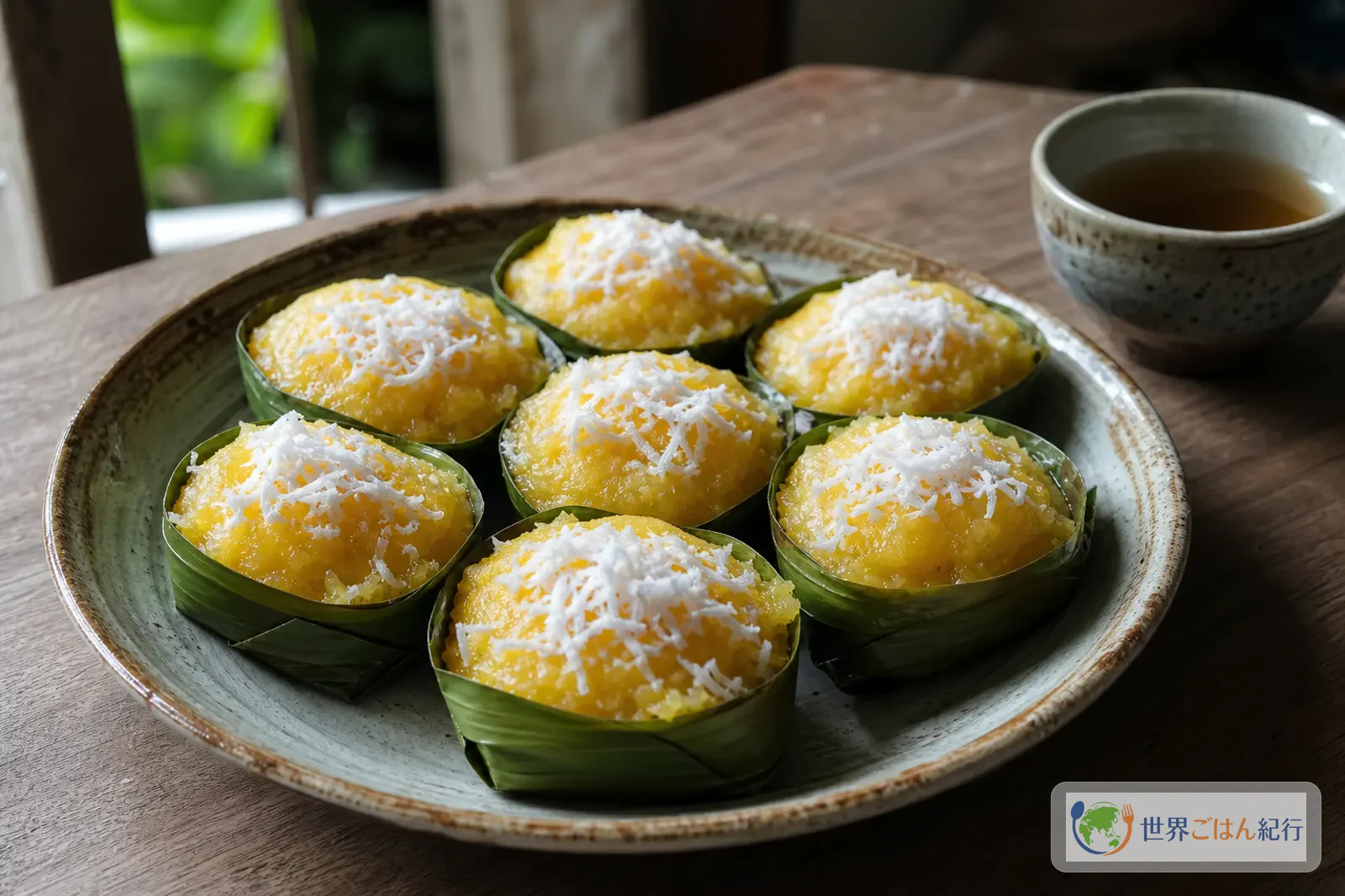
Khanom Tan Recipe: Thai Steamed Palm Cakes
Ingredients
Batter
| Ingredient | Amount | How to choose it |
|---|---|---|
| Ripe palmyra palm pulp paste | 4 oz (120 g) | Frozen or jarred. If you have none, make it from the substitute table below |
| Joshinko (Japanese rice flour) or baking-grade rice flour | 4 oz (120 g) | Fine and smooth. A coarse dumpling-grade flour alone makes it heavy |
| Tapioca starch | 25 g | Adds airy springiness. If using potato starch, reduce to 18 g |
| Coconut milk | ¾ cup (180 ml) | Canned type. Shake well before measuring |
| Palm sugar or unrefined cane sugar | 2.75 oz (75 g) | If using dark brown sugar, reduce to 2 oz (60 g) |
| Instant dry yeast | 1 g | A little under 1/3 tsp. Used as a bubble aid, not for flavor |
| Baking powder | 5 g | Added just before steaming |
| Salt | 2 g | Tightens the sweetness of the batter |
Topping and molds
| Ingredient | Amount | Role |
|---|---|---|
| Fine shredded coconut | 45 g | For topping. If frozen, thaw and press out moisture |
| Salt | 1 g | Mixed into the coconut |
| Banana leaves | 15 cm square × 4 | Cut in half for 8 pieces. If you have none, 8 silicone cups |
| Toothpicks | 16 | To hold the banana-leaf cups |
| Water for the steamer | 1.5 L | An amount that will not boil dry partway through |
Steps
1Strain the pulp to build the aromatic base
10 min
Put 4 oz (120 g) of ripe palmyra palm pulp paste in a bowl, add ¼ cup (60 ml) of the ¾ cup (180 ml) of coconut milk, and loosen it. Pass it through a sieve or fine strainer to remove fibers and hard bits. If you use the substitute paste, cut the pumpkin and sweet potato into 0.5 inches (1.5 cm) cubes, spread them on a heatproof plate, sprinkle with 2 tsp of water, and heat at 600 W for 4 minutes, until a bamboo skewer goes in without resistance. Let the steam settle, remove the skins, and mash 2.75 oz (80 g) of steamed pumpkin, 1.5 oz (40 g) of steamed sweet potato, and 2 tbsp (30 ml) of coconut milk until smooth. Press through a sieve. If you use only the pulp paste, no heat is needed. It is ready when it falls slowly from a spoon and leaves no grit on the tongue.
2Mix the flour and liquid
8 min
In a separate bowl, whisk 4 oz (120 g) of joshinko, 25 g of tapioca starch, 2.75 oz (75 g) of sugar, 2 g of salt, and 1 g of instant dry yeast for 30 seconds. Add the strained pulp liquid and the remaining ½ cup (120 ml) of coconut milk a little at a time, and mix for 2 minutes until no dry flour is left. No heat is used. The batter should be a little heavier than pancake batter. It falls in a thick ribbon when you lift the whisk and leaves a trace for about 5 seconds. If it is stiff, add 1 tbsp of coconut milk; if loose, add 2 tsp of joshinko.
3Rest the batter in a warm place
45–60 min
Cover the bowl with plastic wrap or a clean cloth and put it in a warm place at 28 to 30°C. On days when the room is cool, float the batter bowl in a larger bowl of lukewarm water at about 95°F (35°C). Do not expose it to direct flame or water above 104°F (40°C). Move on when fine bubbles appear on the surface, the volume has grown about 1.2 times, and the smell of sweet flour has a slightly fermented note mixed in. If no bubbles appear, rest it for 15 minutes more.
4Make the banana-leaf cups
10 min
Cut the banana leaves into rounds or squares 12 to 13 cm across, and make them pliable by warming in a 600 W microwave for 20 seconds or holding them over steamer steam for 30 seconds. Press the center down to make a small cup shape and fasten the four corners with toothpicks. If using silicone cups, brush the inside with 1/2 tsp of oil. At this point turn the steamer to high heat and start bringing 1.5 L of water to a boil. Shaping the cups at least 2 cm deep and about 5 cm across keeps the steaming times even.
5Mix in the baking powder and pour into the molds
5 min
Turn the rested batter over from the bottom about 10 times with a spatula, and sift in 5 g of baking powder through a tea strainer. Mix for only 20 seconds so you don't crush the bubbles. When you finish mixing, there should be no dry flour, a smooth consistency, a slow drip off the spatula, and fine small bubbles left on the surface. The batter at this step is not heated, but have the steamer on a separate pot over high heat and keep steam coming from the gap in the lid. Pour the batter into the cups to about 7/10 full, and divide 45 g of shredded coconut mixed with 1 g of salt evenly on top. If you fill them to the top they overflow while steaming, so leave about 8 mm of space from the rim.
6Steam with strong steam
15–18 min
Get the steamer water boiling hard so that steam rises straight up when you open the lid. Arrange the cups, wrap a cloth around the lid before closing it, and steam over medium-high heat without opening for 12 minutes. Then slide the lid slightly ajar to check. They are cooked when the surface is rounded and puffed, a bamboo skewer inserted in the center comes out with no wet batter, and the yellow has changed from translucent to a bright opaque. If still damp, add 2 minutes at a time over medium-high heat. If the water runs low, add 200 ml of boiling water down the side of the pot.
7Cool slightly and let the aroma settle
10 min
Turn off the heat, open the lid, let the steam escape for 30 seconds, and then take out the cups. Set them on a rack to cool for 5 minutes, and eat once the surface moisture has settled. If too hot, the rice flour aroma comes forward, so around 45°C, when the center is still warm and the coconut on top is moist, is easiest to eat. When cutting in half, wet the knife and cut the 5 cm cake into half-moons 2.5 cm wide, which keeps the cut face from being crushed and shows the fine air bubbles.