Ingredients and steps on one page. Print it, or choose “Save as PDF” in the print dialog.
Sekai Gohan
How to Make Khao Niao Mamuang: Thai Mango Sticky Rice
Ingredients
| Ingredient | Amount | Role and how to choose |
|---|---|---|
| Thai glutinous rice | 10.5 oz (300 g) | Glutinous rice. 10.5 oz (300 g) of domestic glutinous rice also works |
| Water for steaming | 1.5 quarts (1.5 L) | Not for the rice to absorb, but the water for the steamer |
| Coconut milk | 1¼ cups (300 ml) | Unsweetened, canned or in a carton. Shake before opening |
| Sugar | 2.75 oz (80 g) | White sugar tastes brighter; raw cane sugar gives a deeper aroma |
| Salt | 4 g | Tightens the sweetness. About 2/3 tsp |
| Rice flour | 8 g | Thickens the finishing sauce. 6 g potato starch also works |
| Water | 1 tbsp (15 ml) | To dissolve the rice flour |
| Ripe mango | 1.25 lb (600 g) edible flesh | 2 large or 3 medium. Fragrant ones whose flesh does not collapse too much |
| Toasted mung beans | 20 g | For finishing. If you have none, 10 g white sesame instead |
| Pandan leaf | 10 g | Use for aroma if you have it. The dish works without it |
Steps
1Wash the glutinous rice and soak for 4 hours
4 hours 10 min
Put 10.5 oz (300 g) glutinous rice in a bowl and wash it, changing the water 3–4 times until the cloudiness thins. Soak in plenty of water to cover the rice at room temperature for 4 hours. After soaking, drain in a colander and leave for 10 minutes to remove surface water. When you split one grain with a finger, a little white firmness should remain at the center. If you soak until it is fully clear, the surface crumbles easily when steamed.
To shorten the soaking time, you can cut it to 2 1/2 hours with lukewarm water at about 30 degrees C. But hot water makes only the surface of the rice absorb first, so prefer room-temperature water. If you forget to drain after washing, the bottom of the steamer gets wet and the grains turn sticky, so shake the colander lightly to remove the excess water.
2Steam the glutinous rice and turn it halfway
25 min
Put 1.5 quarts (1.5 L) of water in a pot and bring it to a boil over high heat; once boiling, lower to medium heat and keep steam rising vigorously from the steamer. Line the steamer with clean cheesecloth or a steaming cloth and spread the rice in the center. Keep the layer within 1 inches (2 cm) so the steam reaches the center.
Cover and steam for 15 minutes, then lift the mass of rice with the cloth and turn it over. Steam another 8–10 minutes, then eat one grain to check whether there is a hard white core at the center. It is done when the grains are not crushed, spring back when pressed with a finger, and no water droplets float on the surface. If a core remains, add water and extend by 5 minutes at a time.
With a bamboo steamer, water droplets from the lid fall less than from a metal lid, and it is easier to make a surface to spread the rice. But you can also make it without a steamer, with a metal steaming rack that fits in the pot and a cloth. If you buy a steamer, check not only the diameter but also the inner diameter of your pot, the number of tiers, and whether it has a lid.
3Make the coconut sauce in two kinds
8 min
Put 1 cup (230 ml) coconut milk, 2.5 oz (70 g) sugar, and 3 g salt in a small pot and warm over low heat. If using 10 g pandan leaf, cut the leaf into 2 inches (5 cm) widths and add it, and take it out when the sugar grains are gone. Hold about 60–70 degrees C, a temperature where steam rises but the surface does not ripple, and turn off the heat when the sugar has dissolved. If you boil it the fat separates, and when worked into the rice, watery and oily parts easily separate.
In another small pot, put the remaining ¼ cup (70 ml) coconut milk, 10 g sugar, and 1 g salt. Dissolve 8 g rice flour by scattering it little by little into 1 tbsp (15 ml) water so that no lump even 0 inch (1 mm) across remains. Add to the small pot and stir over low heat for 1–2 minutes. Stop at a smooth, loose custard stage in which the trail of a rubber spatula drawn across the bottom lasts about a second. It tightens a little as it cools, so it is important not to make it too firm in the pot.
4Work the sauce into the warm rice
20 min
Move the steamed glutinous rice to a heatproof bowl and pour the warm working sauce over it in 3 additions. Mix by turning from the bottom with a rice paddle, without crushing the rice. Cover with a lid or plastic wrap and leave at room temperature for 20 minutes. It is a success when the grains have a sheen, the sauce does not pool at the bottom, and a scoop with a spoon gathers slowly.
If the center is hard when you taste it, sprinkle 1–1.5 tbsp (15–20 ml) hot water over everything, cover, and steam again for 5 minutes. If it is watery, take off the lid and leave for 5 minutes to drive off the extra moisture. Adding sugar afterward increases the amount of sauce and loosens the rice, so adjust the sweetness with the serving sauce.
5Cut the mango and plate
10 min
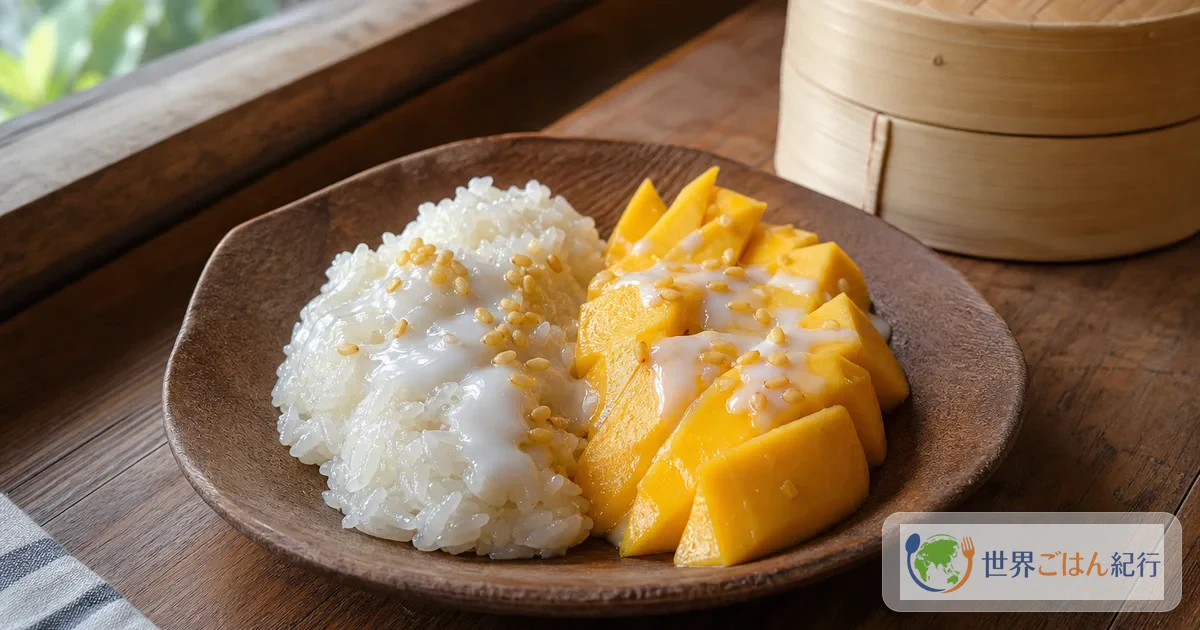
Peel the mango and cut wedges 0.5 inches (1 cm) wide from both sides of the pit. If the flesh is too soft it collapses on the plate, so choose one firm enough to take a knife and whose cut surface does not run with juice. Put 5.5 oz (150 g) of rice on each plate, add about 5.5 oz (150 g) of mango per person, and pour about 1.5 tbsp (20 ml) of finishing sauce per person. Divide the 20 g toasted mung beans into 4 and scatter them just before eating.
If you pour all the sauce on first, the outline of the rice disappears. Draw a thin line at first and serve the rest in a small dish. If the plating lets each person move among the sweetness, the saltiness, and the acidity of the fruit, you can adjust for how the mango differs from day to day.