Ingredients and steps on one page. Print it, or choose “Save as PDF” in the print dialog.
Sekai Gohan
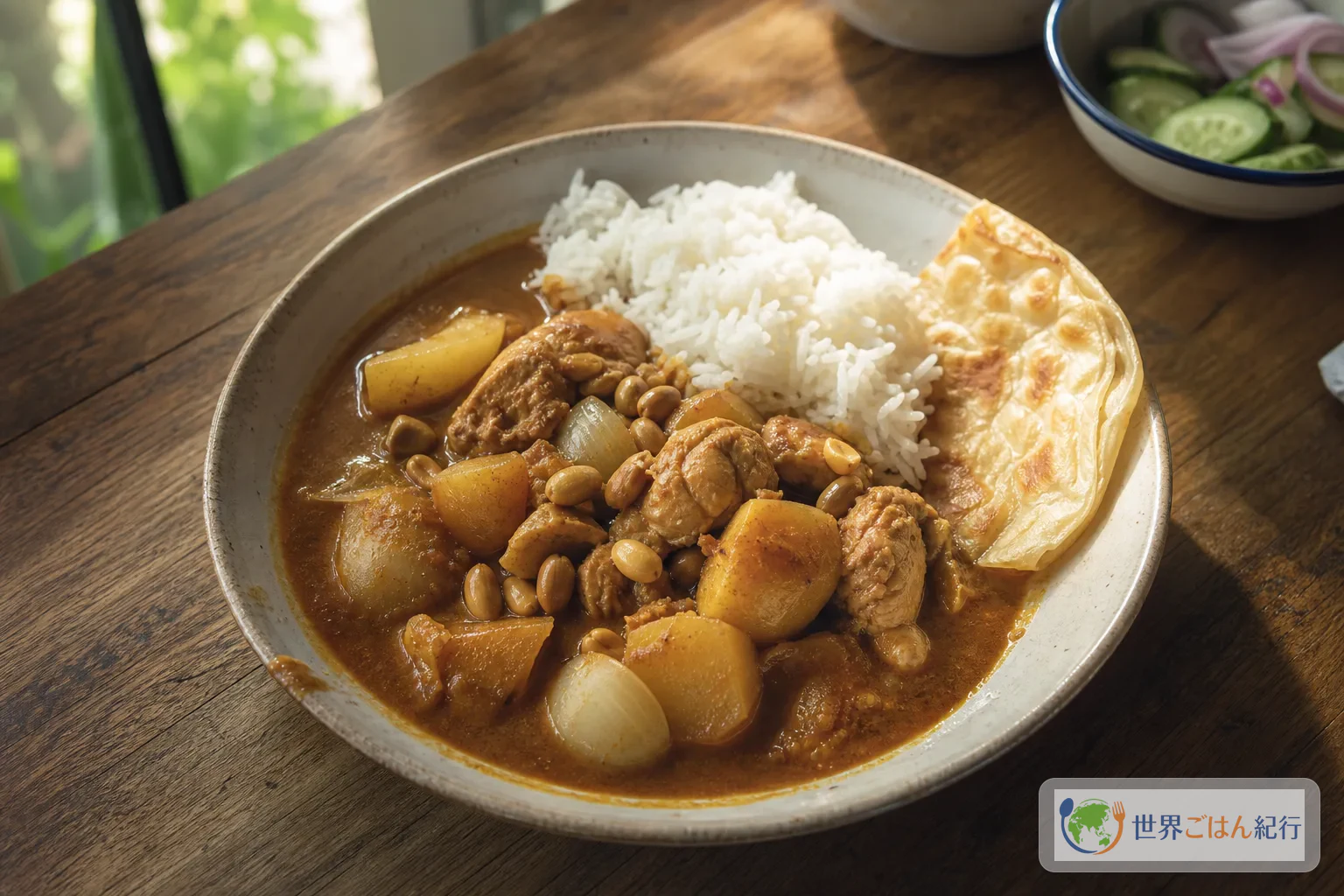
Massaman Curry: Southern Thailand's Sweet-Savory Coconut Stew
Ingredients
Main ingredients
| Ingredient | Amount | Notes |
|---|---|---|
| Chicken thighs | 1.25 lb (600 g) | Skin on. Cut into 1.5 inches (4 cm) pieces, with the thick parts trimmed to about 1 inches (2.5 cm) |
| Potatoes | 12.5 oz (350 g) | Peeled and cut into 1 inches (3 cm) pieces. Waxy potatoes hold their shape best |
| Onion | 1, 7 oz (200 g) | Cut into 1 inches (2 cm) wedges. Don't slice thin |
| Roasted peanuts | 1.75 oz (50 g) | Unsalted. Set aside 10 g for finishing |
| Warm cooked rice | 4 servings | Thai rice has the right aroma. Regular short-grain rice works if cooked a bit firm |
| Roti or thin flatbread | 4 pieces | Can be omitted. Rice alone works |
| Cucumber | 1 | Cut on the diagonal 0.5 inches (1 cm) thick. To refresh the palate |
Curry sauce
| Ingredient | Amount | Notes |
|---|---|---|
| Massaman curry paste | 2.5 oz (70 g) | Salt content differs by brand, so stop at 2.5 oz (70 g) at first |
| Coconut milk | 1¾ cups (400 ml) | Use the thick part set on top of the can first |
| Water | ¾ cup (200 ml) | Rinse out the coconut can with it so nothing is wasted |
| Neutral oil | 2 tsp | Only if the coconut oil isn't separating out |
| Cinnamon stick | 1 | Add if the paste's aroma is weak |
| Bay leaf | 1 | If you have it. Adds depth with its laurel aroma |
Seasoning
| Ingredient | Amount | Notes |
|---|---|---|
| Tamarind paste | 1 1/2 tbsp | Dissolve in 2 tbsp water before adding |
| Fish sauce | 1 1/2 tbsp | Don't add it all at first; you can stop at 1 tbsp and taste |
| Raw cane sugar or palm sugar | 1 tbsp | Palm sugar is closer to the Thai original. Dark brown sugar has a strong aroma |
| Salt | 1/4 tsp | For final adjustment. Leave out if the fish sauce is enough |
Steps
1Cut the ingredients
10 min
Cut the chicken thighs, skin on, into 1.5 inches (4 cm) pieces, and lay the knife nearly flat to trim the thick parts to about 1 inches (2.5 cm). Cut the potatoes into 1 inches (3 cm) pieces and the onion into 1 inches (2 cm) wedges, leaving a little core. Coarsely chop 1.5 oz (40 g) of the peanuts for the pot and keep 10 g for the plate. Dissolve the tamarind paste in 2 tbsp water, and if any lumps remain, press it through a small strainer.
2Wake up the paste
6 min
In a heavy pot, put ½ cup (120 ml) of the thick part set on top of the coconut milk and let it bubble over medium heat for about 2 minutes. When the water has cooked off and small droplets of oil show on the surface, add 2.5 oz (70 g) massaman paste, the cinnamon stick and the bay leaf, and fry for 3–4 minutes, pressing it across the bottom of the pot with a wooden spoon. Move on when the brown color has deepened a little, oil seeps out around the edge, and the raw, powdery smell of the spices has rounded off. If it looks like it will scorch, add 2 tsp neutral oil.
3Coat the chicken
5 min
Add the chicken over the same medium heat and turn it so the paste clings all over. Stop when the surface turns whitish and only the edges are lightly firmed, with the center still raw. Cooking it all the way through here makes it tough after the simmer. If the paste threatens to stick to the bottom, add 2 tbsp water, which carries the aroma into the chicken without making a scorch.
4Simmer in the coconut
18 min
Add the rest of the coconut milk, ¾ cup (200 ml) water, the potatoes and the onion. When it comes to a boil, lower to medium-low and simmer for 15–18 minutes at a heat where the surface bubbles quietly. The signs are chicken cooked white through the center, no clear juices when you cut into a thick piece, and potatoes that a bamboo skewer slides into easily but whose corners remain. Boiling hard makes the coconut split coarsely and breaks the potatoes down.
5Finish sweet and sour
8 min
Lower to low heat and add the tamarind dissolved in water, 1 tbsp fish sauce, 1 tbsp raw cane sugar and the 1.5 oz (40 g) peanuts for the pot. Stir for 2 minutes, then simmer on low for 5–6 minutes until the sauce thinly coats a wooden spoon and tastes a little strong when spooned over rice. If it needs more salt, add 1 tsp fish sauce; if the sourness is weak, add 1 tsp tamarind. Adding only sugar makes it heavy, so move sweetness, salt and sourness in small steps.
6Rest and serve
5 min
Turn off the heat and let it rest in the pot for 5 minutes. When the oil on the surface settles into fine droplets and the potatoes have taken up a little sauce, put rice in a bowl and ladle the curry over it. Scatter the 10 g finishing peanuts and add roti and cucumber. The best texture isn't completely runny; it should spread slowly over the rice when spooned on.