Ingredients and steps on one page. Print it, or choose “Save as PDF” in the print dialog.
Sekai Gohan
Sangkhaya Fak Thong: Thai Custard Steamed in a Whole Kabocha
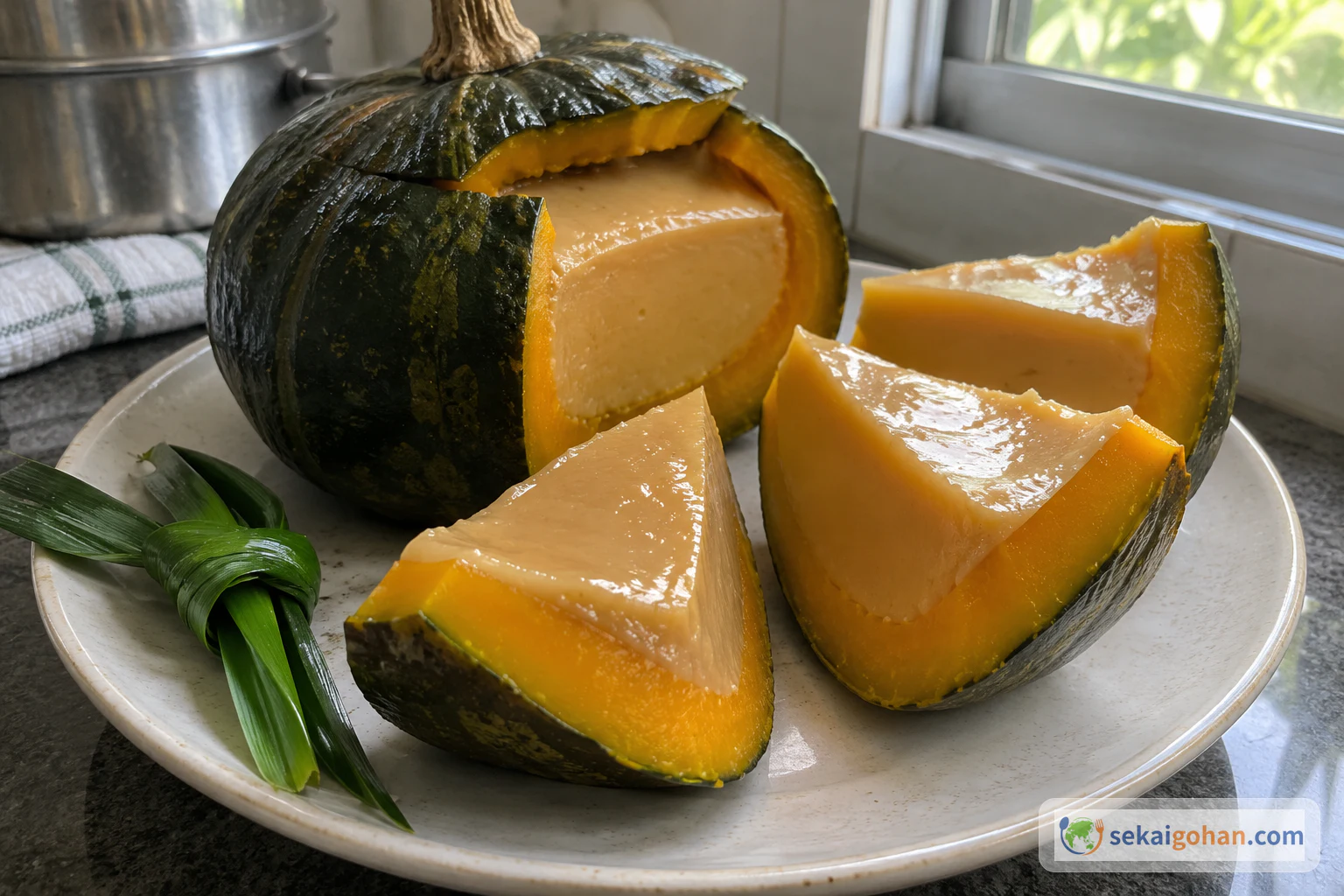
Ingredients
| Ingredient | Amount | Role |
|---|---|---|
| Kabocha squash (ฟักทอง) | 1 small, about 1 lb 5 oz (600 g) | The bowl, and the sweet flesh eaten with the custard |
| Eggs (ไข่ไก่) | 4 small or 3 large | What sets the custard |
| Coconut milk (กะทิ), or milk (นมสด) | ½ cup (120 ml) | The body and creaminess of the custard |
| Palm sugar (น้ำตาลปี๊บ) | 3½ oz (100 g) | Sweetness, the brown color and the caramel scent |
| Pandan leaves (ใบเตย) | 3–4 leaves | Bruised into the eggs for fragrance, strained out |
| Salt (เกลือ) | A little | Sharpens the sweetness |
Steps
1Cut a square lid and hollow the squash
Wash the squash and dry the outside. Set it upright on a cutting board and, with a pointed knife, cut a square opening around the stem to make a lid. Lift the lid out and scrape the seeds and stringy pulp from both the cavity and the underside of the lid with a spoon. The squash is ready when the inside walls look smooth and orange with no fibers clinging to them.
Knife handlingRaw kabocha is hard. Keep the squash steady on the board, cut with short controlled strokes, and keep your free hand away from the path of the blade.
2Drain the shell upside down
Turn the hollowed squash and its lid upside down on a clean kitchen towel set on a wire rack. Leave them there to drain while you make the custard. Fill the bottom of the steamer with water and put it on the heat now so it is boiling by the time the squash is filled. When you turn the squash back over, no water should be pooled inside.
3Beat the eggs with palm sugar, salt and pandan
Put the crumbled palm sugar in a bowl, crack in the eggs and add the salt. Twist and squeeze the pandan leaves in your hands until they are bruised and fragrant, then drop them in. Whisk by hand until the mixture is foamy. It is ready when the surface is frothy, the eggs have turned brown from the sugar and the bowl smells green and sweet.
4Add the coconut milk and strain
Pour in the coconut milk and keep stirring until the sugar has fully dissolved. Tilt the bowl and check the bottom for grains. Strain the mixture through a fine-mesh sieve into the jug, leaving the pandan leaves and any bits of sugar or egg behind. The strained custard should be smooth and an even light amber with no white streaks of coconut milk.
Strain twice, pour slowlyFor the smoothest custard, strain it a second time. Foam on the custard becomes pits and bubbles on the set surface, so pour without stirring up froth, and let any bubbles settle in the jug before filling the squash.
5Fill the squash
Set the squash upright on the heatproof plate. Pour the custard in slowly, letting it run down the inside wall rather than splashing into the middle. Fill it to just below the rim and set the lid beside the squash on the plate. The surface should be flat and still, with no bubbles.
6Steam over boiling water for 45–60 minutes
Make sure the water in the steamer is at a full boil before anything goes in. Set the plate with the squash and its lid in the steamer, cover, and steam for 45–60 minutes. Keep the heat at a steady boil rather than a fierce one, and resist lifting the steamer lid. Begin checking for doneness at 45 minutes (see step 7).
Keep the lid closedOpening the steamer again and again lets the temperature drop and spike, and that is what cracks the squash. Heat that is too strong roughens the custard surface. A closed lid and a steady boil give a smooth custard in an intact shell.
Hot steamSteam burns faster than boiling water. Open the steamer lid away from your face and lift the plate out with oven mitts or a plate lifter.
7Check the center with a skewer and thermometer
Push a skewer into the very center of the custard and draw it out. If liquid custard runs off it, cover the steamer again, keep steaming and test after a short while. Then check the center with a thermometer. The custard is done when the skewer comes out with only a little clean, set custard on it and the center reads 167°F (75°C).
Egg safetyThis custard is made with raw eggs. Cook until the center reaches 167°F (75°C) and the skewer shows no liquid, and do not serve it if the middle is still runny.
8Rest, chill and cut into wedges
Lift the squash out and let it rest for 10–20 minutes, then let it cool to room temperature and chill it in the refrigerator until firm. Cut it into thick wedges with a sharp chef's knife, pressing straight down through the rind. As it chills, the custard shrinks slightly and leaves a small gap at the top; that is normal. The wedges are ready when the custard cuts in a clean, smooth line between the orange flesh and green skin.