Ingredients and steps on one page. Print it, or choose “Save as PDF” in the print dialog.
Sekai Gohan
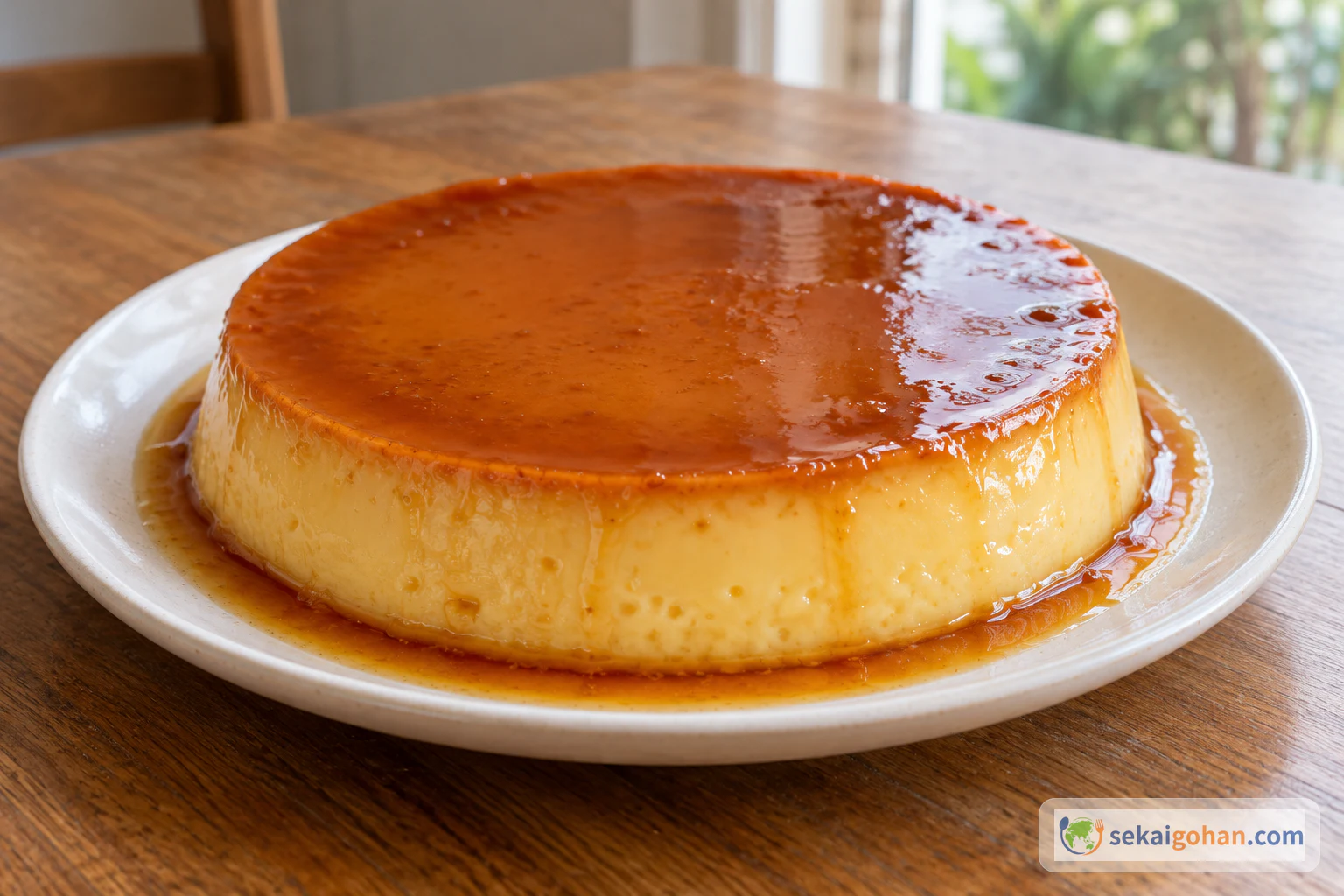
Bánh Flan: Vietnamese Crème Caramel with Whole Eggs and Milk
Ingredients
| Ingredient | Amount | Role |
|---|---|---|
| Granulated sugar (for the caramel) | 1/3 US cup (72g) | Melted to light amber to make the caramel layer |
| Water (for the caramel) | 2 tbsp (28g) | Heated with the caramel sugar |
| Large whole eggs | 4 | Set the custard; whole eggs, not yolks only |
| Granulated sugar (for the custard) | 1/2 US cup (112g) | Sweetens the custard |
| Vanilla extract | 1 tsp | Aroma for the custard |
| Salt | 1/8 tsp | Seasons the custard |
| Unsweetened evaporated milk | 1 US cup | Half of the 2 US cups of milk |
| Whole milk | 1 US cup | The other half of the milk |
Steps
1Make the caramel and pour it into the mold
Put the 2.5 oz (72 g) of caramel sugar and 1 oz (28 g) of water in a small saucepan over medium-high heat. Swirl the pan by its handle rather than stirring with a spoon. Watch the color: when it turns light amber to golden, it is ready. Allow about 5 minutes 30 seconds, but let the color decide. The caramel keeps darkening from the heat of the pan, so pull the pan off the heat as soon as it reaches the color you want.
Wearing oven mitts, pour the hot caramel straight into the bottom of the mold. Tilt and swirl the mold so the caramel spreads over the base. The caramel and the pan are very hot, so keep your hands clear. As it cools, the caramel hardens and can crack. That is normal. It does not need to reach every edge of the base.
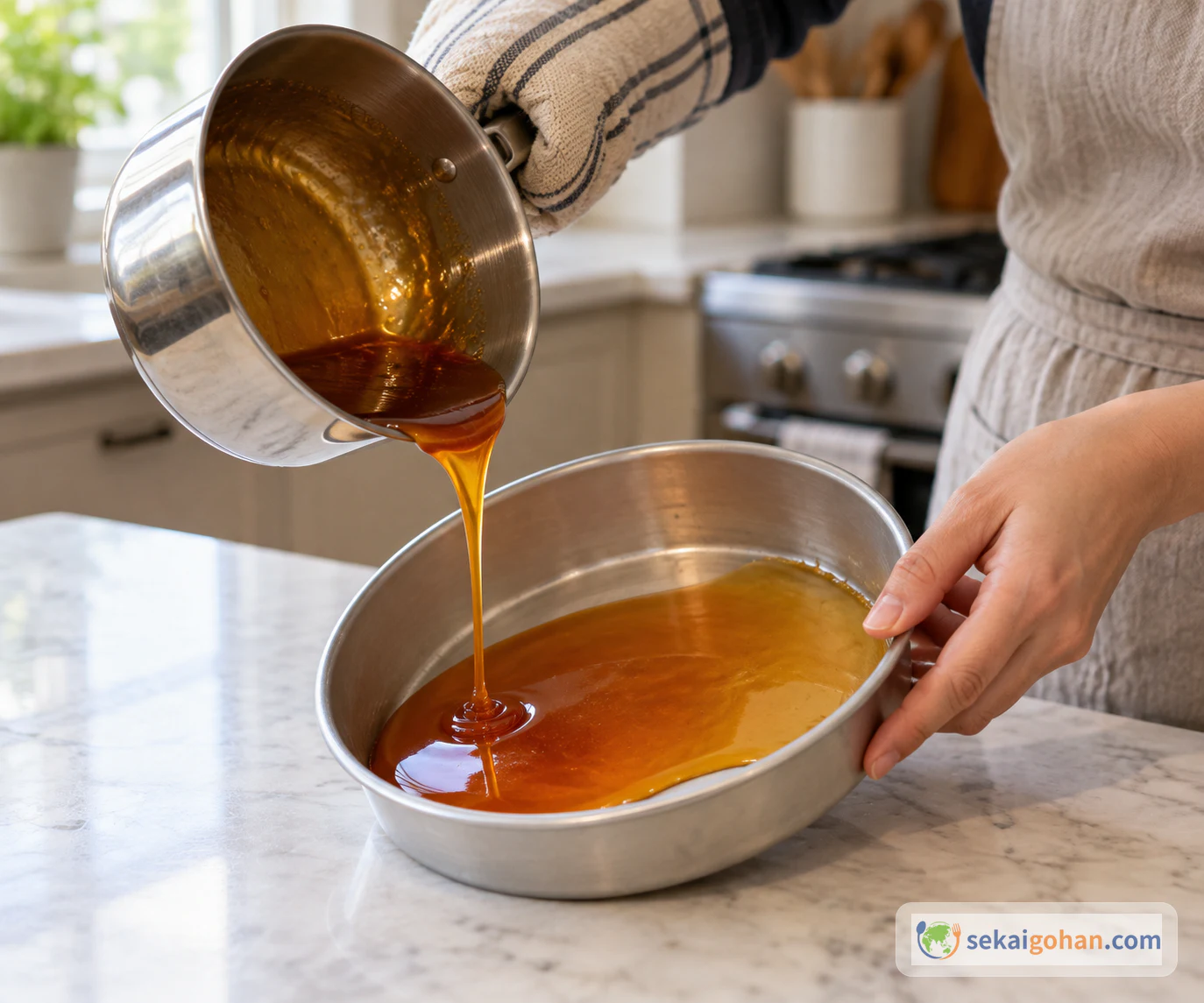
Tilt the mold to coat the base before the caramel sets 2Mix the custard without whipping it
Preheat the oven to 325°F. In a bowl, combine the 4 eggs, 112g of custard sugar, 1 tsp vanilla extract and 1/8 tsp salt, mixing until smooth. Keep the whisk low and move it gently; you want a smooth liquid, not a foam. Add the evaporated milk and whole milk and combine.
A few small bubbles at the edge are fine. A thick white froth means it has been beaten too hard.
3Strain the custard into the caramel-lined mold
Hold a fine-mesh strainer over the mold and pour the custard through it, directly onto the hardened caramel. There is no need to whisk again after straining. Lightly skim off any bubbles left on the surface. Straining removes strands of egg and excess air, which helps the custard set smooth.
4Set up the water bath
Place the filled mold in a larger, deep roasting pan. Pour hot water into the roasting pan, not into the mold, until it comes about halfway up the outside of the mold. Carry the pan to the oven carefully so no water splashes into the custard. Do not skip the water.
5Bake until the edges are set and the center jiggles slightly
Bake for about 1 hour, or until the edges are set and the center still jiggles slightly when you gently move the pan. If the center is still fully liquid, keep baking and check again. Use this time only for one mold of about 7 inches, not for other sizes or other recipes.
6Cool, chill, then turn it out
Lift the mold out of the water bath carefully. Let the flan cool at room temperature for about 1 hour, then refrigerate it for at least 3 hours. Do not cut the chilling short.
To unmold, run a thin knife around the inside edge of the mold. Set the serving plate upside down on top, then turn mold and plate over together. Lift the mold straight up, and the caramel will run down over the custard and onto the plate.
7Serve
Serve the flan cold, with the caramel that has pooled on the plate. If you would like coffee, serve strong espresso separately and add it at the table (see below). Keep it out of the custard itself.