Ingredients and steps on one page. Print it, or choose “Save as PDF” in the print dialog.
Sekai Gohan
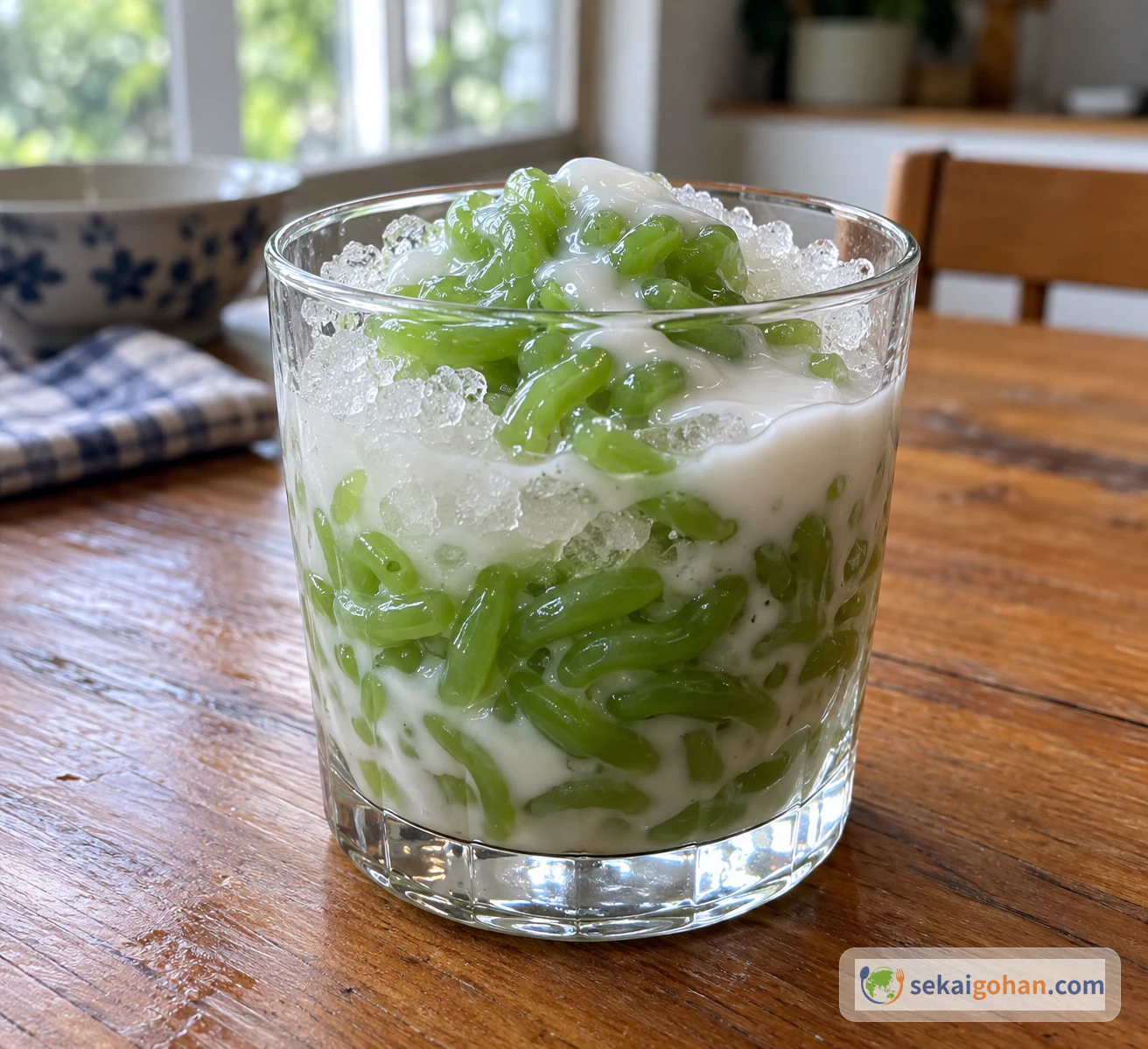
Bánh Lọt: Vietnamese Pandan Jelly Strands with Coconut Sauce and Syrup (Chè Bánh Lọt)
Ingredients
| Ingredient | Amount | Role |
|---|---|---|
| Water chestnut starch (bột củ năng) | 1 c | Dough: the main starch of the strands |
| Tapioca starch (bột năng) | 1 Tbsp | Dough: the second starch, used in a small amount |
| Cold water (nước lạnh) | 6 c | Dough: blended with the pandan, then used to dissolve the starches |
| Pandan leaves (lá dứa) | 8 leaves | Dough: green colour and aroma |
| Pandan essence (tinh dầu lá dứa) | A few drops (optional) | Dough: only if you want a greener colour |
| Cold water and ice for the bath | As needed | Receives the pressed strands and firms them |
| Coconut milk (nước cốt dừa) | 1 can | Coconut sauce: the base |
| Rice flour (bột gạo) | 1 Tbsp | Coconut sauce only; not used in the dough |
| Sugar (đường) | 2 Tbsp | Coconut sauce: sweetness |
| Salt (muối) | 1/4 tsp | Coconut sauce: seasoning |
| Sugar (đường) | 1 c | Syrup: ordinary sugar |
| Water (nước) | 1 c | Syrup |
| Crushed ice | As needed | Serving: added to each glass |
Steps
1Blend and strain the pandan leaves
Cut the 8 pandan leaves into short pieces and put them in a blender with the 6 c cold water.
Blend, then pour the liquid through a fine-mesh sieve to remove the leaves. Strain it several times, until the leaf fibres are gone and only green liquid remains.
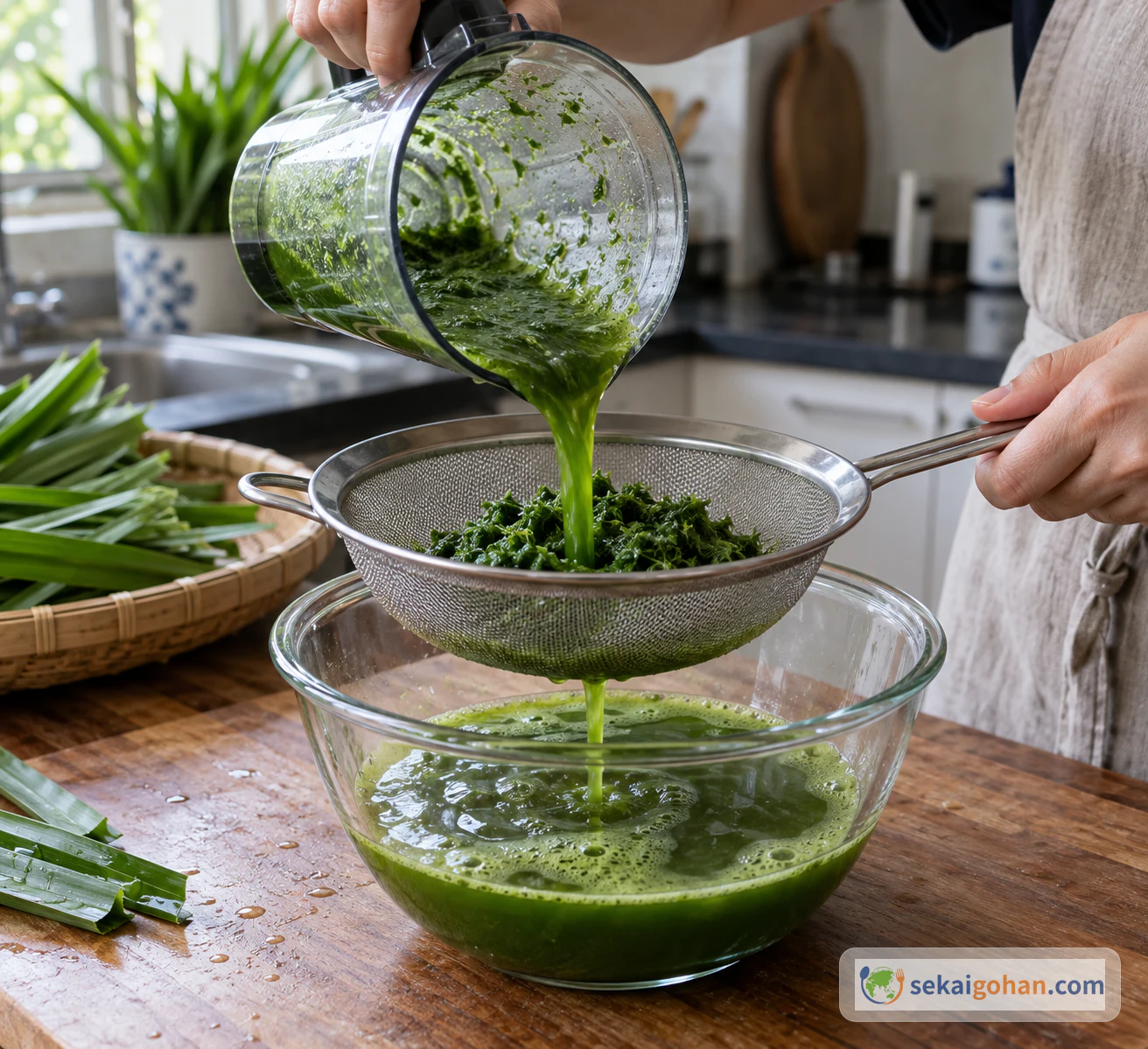
Strain more than once so that no leaf fibres go into the dough 2Dissolve the two starches and strain again
Add the 1 c water chestnut starch and 1 Tbsp tapioca starch to the strained green liquid and stir until they dissolve. If you want a greener colour, add a few drops of pandan essence now; it is optional. Strain the mixture once more.
At this point the mixture is still cold and thin, not a paste.
3Cook over medium heat, stirring constantly, until it boils
Set the saucepan over medium heat and stir continuously. The mixture thickens into a glossy, heavier paste with some translucency. As soon as you see it boil, turn off the heat.
Keep stirring and reach across the whole bottom of the pan, watching for lumps and for paste catching on the bottom. The cue is the boil.
4Press the hot paste through the mold into ice water
Set the perforated mold over the wide bowl of cold water and ice. Put the cooked paste into the mold while it is still hot and push it through the holes with the flat spatula, so that strands drop into the cold water below. Work in amounts you can handle at one time.
The paste comes straight off the boil, so it is hot when you press it. Use food-safe tools.
5Rinse, drain and refrigerate the strands
Lift the strands out, rinse them in cold water, and drain them in a strainer. Check that they are short, rounded, translucent pieces.
Keep the drained strands in the refrigerator until serving.
6Make the coconut sauce
In a small saucepan, mix the 1 can coconut milk, 1 Tbsp rice flour, 2 Tbsp sugar and 1/4 tsp salt. Bring to a boil, then set aside.
7Make the syrup
In another small saucepan, bring the 1 c sugar and 1 c water to a boil, then set aside. Do not cook the syrup down to a caramel; the result is a plain, clear syrup.
8Assemble in glasses
Put the strands in a glass. Pour over coconut sauce and syrup to your taste, then add crushed ice. Each eater can adjust the sweetness glass by glass.
For chè ba màu, add cooked red beans and mung beans, prepared separately.