Ingredients and steps on one page. Print it, or choose “Save as PDF” in the print dialog.
Sekai Gohan
Bánh Mật: Cao Lan Molasses Rice Cakes in Banana Leaf
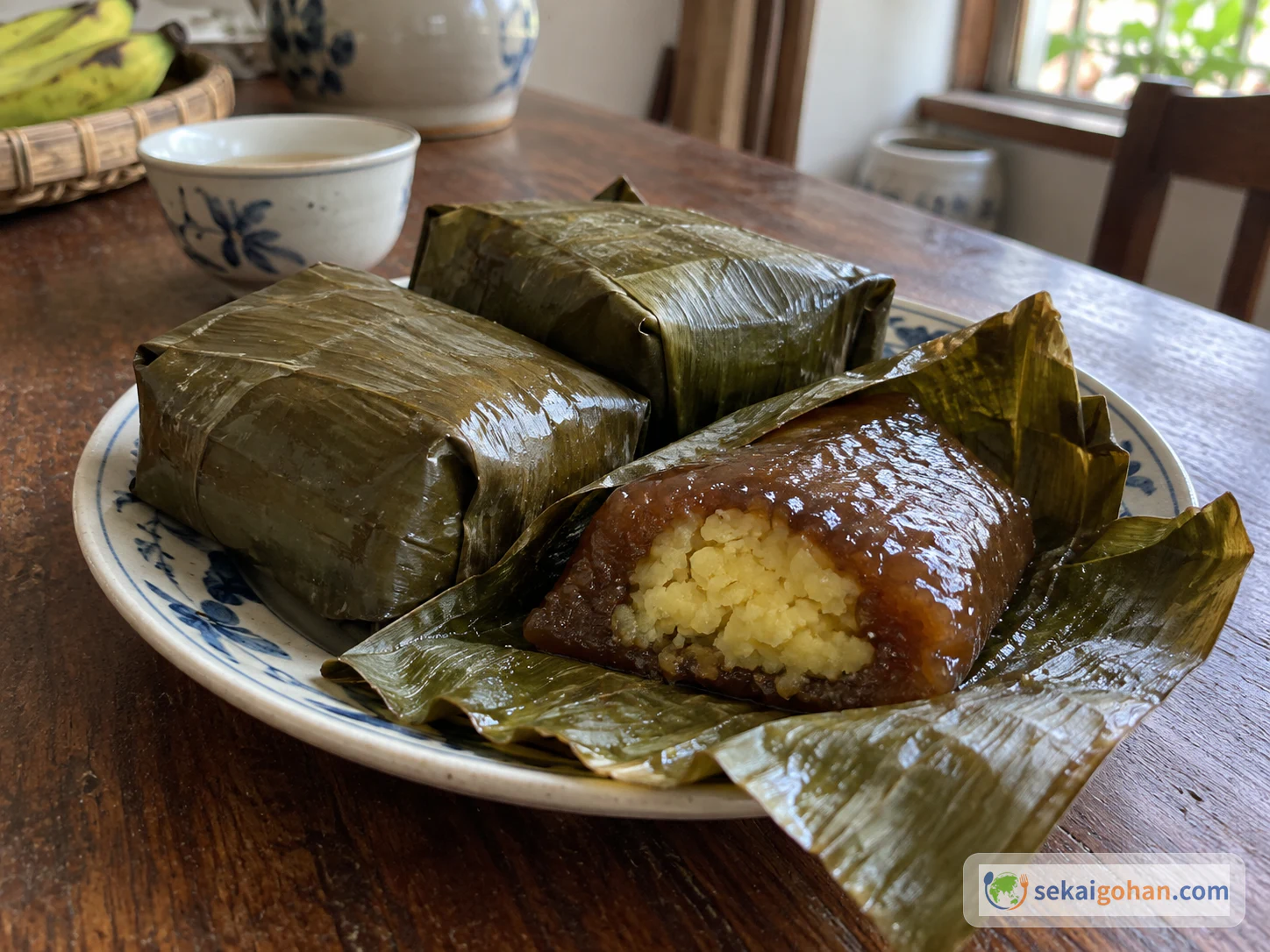
Ingredients
| Ingredient | Amount | Role |
|---|---|---|
| Glutinous rice flour, dry (bột nếp) | 14 oz (400 g) | The chewy body of the dough |
| Sugarcane molasses (mật mía) | 7 oz (200 g) | Sweetness and the brown colour of the dough |
| Warm water, only if needed | up to ¼ cup (60 ml), 1 tbsp at a time | Brings dry flour to a smooth dough |
| Hulled split mung beans, dry (đỗ xanh) | 3½ oz (100 g) | The base of the filling |
| Water for soaking the beans | 1¼ cups (300 ml) | Softens the beans before cooking |
| Water for cooking the beans | ⅔ cup (150 ml) | Cooks the beans until they fall apart |
| Sugar (đường) | 1 oz (30 g) | Lightly sweetens the filling |
| Lard (mỡ) | 1 tbsp (15 g) | Richness in the filling |
| Grated coconut, fresh or unsweetened desiccated (dừa nạo) | 1 oz (30 g) | Flavour and texture in the filling |
| Hot water for desiccated coconut | 2 tbsp | Rehydrates dried coconut |
| Banana leaves, fresh or frozen and thawed, about 8 × 10 inches (20 × 25 cm) (lá chuối) | 16 pieces, 2 per cake | The wrapper the cakes boil in |
| Water for boiling the cakes | enough to cover by 1¼ inches (3 cm) | Cooks the wrapped cakes |
Steps
1Soak the mung beans
Rinse the hulled mung beans in a sieve until the water runs clear. Tip them into a bowl and pour over the 1¼ cups (300 ml) of soaking water. Leave them for 3 hours. Drain them when they have swollen and turned a paler, softer yellow.
2Wash, soak and mill the rice (milled-flour route only)
To make the flour yourself, wash the glutinous rice in a wide basin of water, rubbing it between your hands and pouring off the cloudy water. Soak it, then pass it through a stone mill or wet grinder. It comes out as a smooth, pale, damp paste. Damp flour holds water, so it cannot be swapped gram for gram with the dry flour in the table, and the amounts here are written for dry bagged flour. If you are using dry bagged flour, weigh 14 oz (400 g) into a bowl and skip this step.
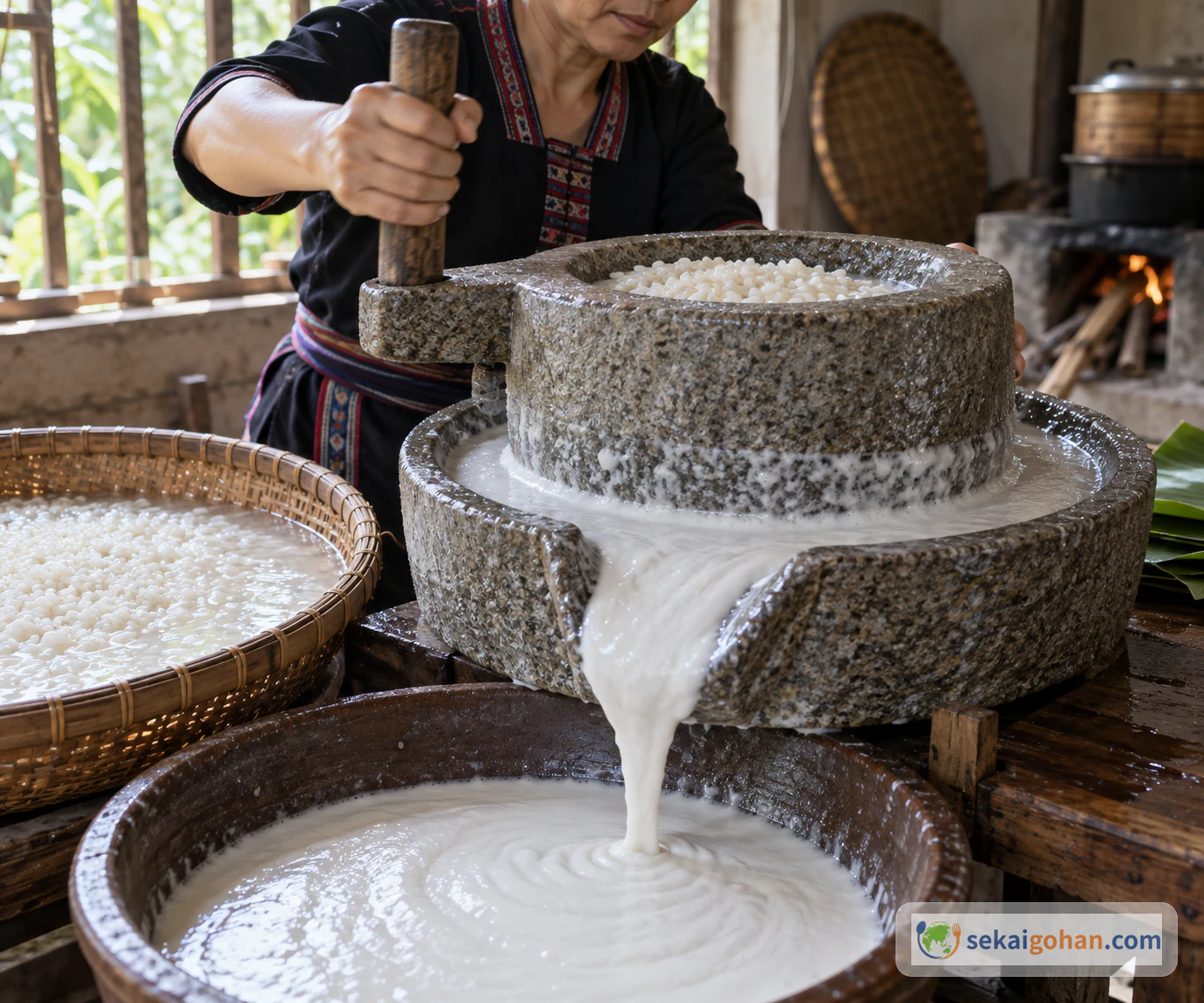
Wet milling gives a damp, fine paste, already moist before any molasses goes in 3Cook and mash the beans
Put the drained beans in a small saucepan with the ⅔ cup (150 ml) of cooking water, or steam them. Cook for 20 to 25 minutes, until they fall apart when pressed with a spoon. Drain off any water that is left. Mash them while they are hot, until no whole beans remain.
4Make the filling and shape the balls
If you are using desiccated coconut, stir it into the 2 tablespoons of hot water first. Mix the hot mashed beans with the sugar, lard and coconut. Cook the mixture in a dry pan over low heat for 3 to 4 minutes, stirring, until it pulls together into one mass. Let it cool, then roll it into 8 balls of a scant 1 oz (25 g) each. They should hold their shape without cracking.
Dry filling, sealed cakeGive the filling its full time in the dry pan. A filling that is still wet softens the dough from inside and can push out through the seam in the pot. Cool balls are firm enough to handle without smearing.
5Knead the molasses dough
Put the flour in a bowl and pour in the molasses. Knead for 5 to 8 minutes, pressing and folding until the colour is even. If the dough is still crumbly, work in warm water 1 tablespoon at a time. Stop when it is smooth and soft like modelling clay and no longer sticks to your hands.
6Divide the dough and enclose the filling
Divide the dough into 8 pieces of about 2¾ oz (75 g). Flatten one piece in your palm into a round, set a filling ball in the middle and bring the edges up around it. Pinch the seam shut and roll the cake into a plump, rounded block. It is ready to wrap when no filling shows anywhere on the surface.
7Soften the leaves and wrap
Wipe the banana leaves clean. Pass each piece quickly over a gas flame, or dip it in hot water for 10 seconds, until it bends without cracking. Wrap each cake in 2 leaves, folding the ends under, and tie the parcel snugly with kitchen string. The finished parcel should feel firm with no loose flaps.
Flame and hot waterKeep the leaf moving over the flame and hold it by the far edge. When you dip leaves, use tongs and lay them on a board to cool for a moment before handling.
8Boil the parcels
Bring a pot of water to the boil and lower the parcels in so they are covered by 1¼ inches (3 cm). Set a heatproof plate on top to keep them under. Cover the pot and keep it at a steady, gentle boil for 45 minutes, topping up with boiling water whenever the level drops. The water should bubble steadily all the way through, with the parcels staying under.
Keep the boil steadyA rolling boil knocks the parcels about and loosens the leaves, and water that drops to a simmer leaves the centres raw. Keep a kettle of boiling water beside the pot so a top-up never cools it down.
9Test one cake and rest
Lift one parcel out with tongs and open it. The dough should be dark brown, glossy and firm, and the centre should have no pale raw flour. If it does, boil the rest for another 10 minutes and test again. Leave the cooked cakes in their leaves for 10 minutes, until they are cool enough to hold.