Ingredients and steps on one page. Print it, or choose “Save as PDF” in the print dialog.
Sekai Gohan
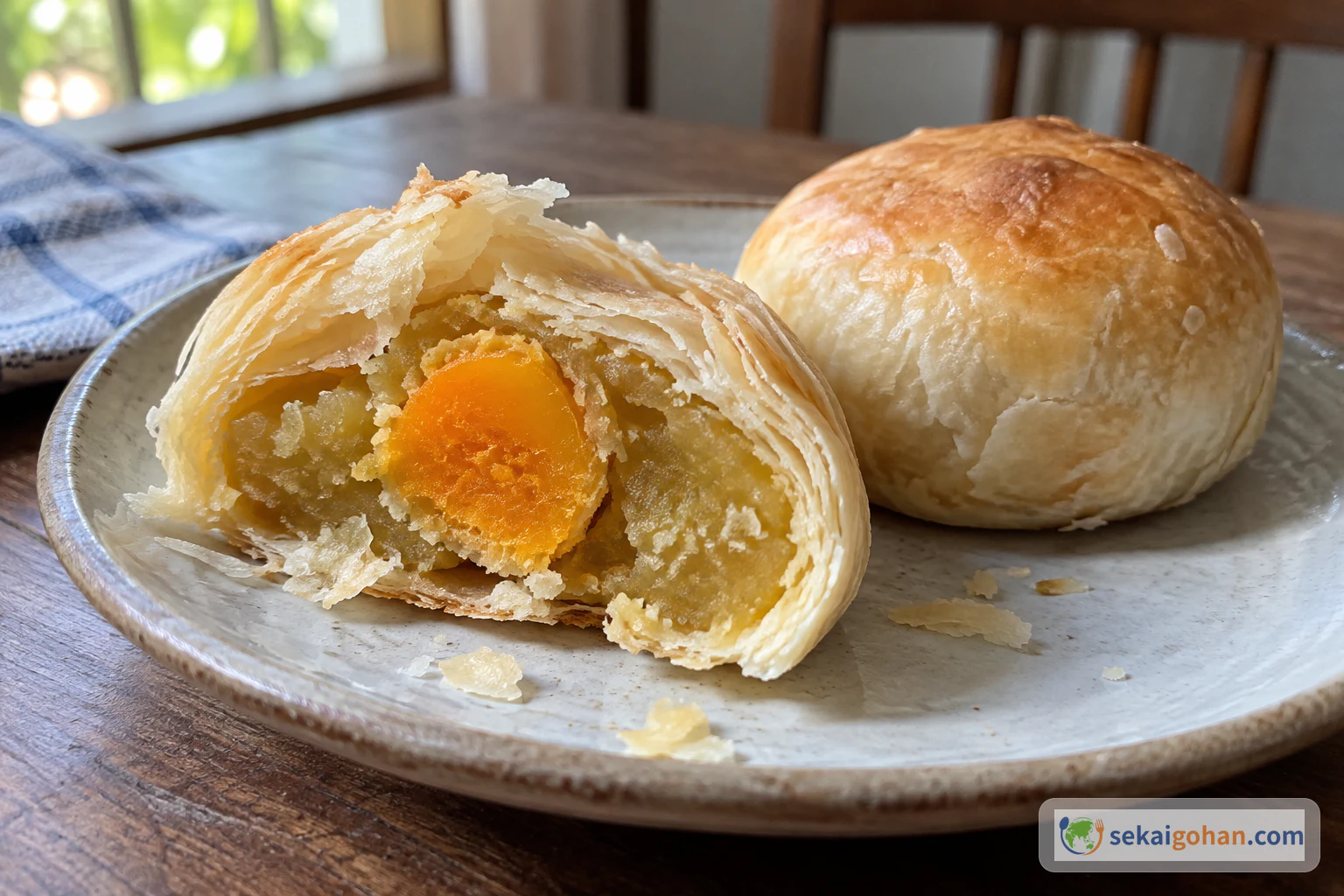
Bánh Pía: Sóc Trăng Layered Pastry with Mung Bean, Durian and Salted Egg Yolk
Ingredients
| Ingredient | Amount | Role |
|---|---|---|
| Wheat flour (bột mì) | 10.5 oz (300g) | Water dough: the outer, stretchy layer |
| Sugar | 1.5 oz (40g) | Water dough |
| Vegetable oil | 1.75 oz (50g) | Water dough; a neutral-tasting oil |
| Rendered lard (mỡ nước) | 1.75 oz (50g) | Water dough: aroma and tenderness |
| Water | 4 oz (120g) | Water dough |
| Baking powder (bột nở) | 1/2 tsp | Water dough |
| Tapioca starch (bột năng) | 3.5 oz (100g) | Oil dough |
| Wheat flour | 3.5 oz (100g) | Oil dough |
| Vegetable oil | 1.25 oz (35g) | Oil dough |
| Rendered lard | 1.25 oz (35g) | Oil dough; weigh separately from the water dough's 1.75 oz (50g) |
| Hulled split mung beans (đậu xanh không vỏ), dry | 9 oz (250g) | Filling base |
| Water for cooking the beans | as needed | Filling: about a finger's width above the beans |
| Sugar | 180–200g | Filling sweetness |
| Vegetable oil | 4 tbsp | Filling; added in several parts while cooking |
| Durian flesh (thịt sầu riêng), seeds removed | 7 oz (200g) | Filling aroma |
| Candied pork fat (mỡ đường), prepared | 3.5 oz (100g) | Filling: soft, rich pieces |
| Malt syrup (mạch nha) | 1 tbsp | Filling: binds and adds gloss |
| Roasted glutinous rice flour (bột nếp rang / bột bánh dẻo) | 1 tbsp | Filling: only if it is still loose |
| Salted duck egg yolks (lòng đỏ trứng muối) | 12 | Filling: one in the center of each ball |
| Rice wine | a little | Optional soak for the duck yolks |
| Pork backfat (mỡ phần) | as needed | For making the candied pork fat |
| Sugar | 2 tbsp | For the candied pork fat; separate from the filling sugar |
| Chicken egg yolk | 1 | Surface glaze |
| Water | a little | Thins the glaze |
| Flour for dusting | as needed | Rolling the dough |
Steps
1Make the candied pork fat
Cut the pork backfat into small dice. Boil until fully cooked, then drain well. Toss with 2 tbsp sugar and let it sit until the fat turns translucent. Keep it covered and cool rather than leaving it out in the open air, and refrigerate it if you are not using it soon. Measure out 3.5 oz (100g) of the prepared fat for the filling.
2Soak, cook and blend the mung beans
Rinse 9 oz (250g) dry hulled mung beans and soak them in water until soft, then drain. Put them in a pot with water about a finger's width above the beans and cook until soft and falling apart, skimming off any foam. Drain off the water, then blend until smooth. Draining well before the next step helps the filling come together.
3Cook the bean paste with sugar and oil
Put the mung bean paste and 180–200g (up to 7 oz) sugar into a wide pan over medium heat and stir constantly. Add the 4 tbsp oil in several parts as you go. Keep cooking until the paste looks slightly translucent and turns springy. Don't raise the heat to rush it; the paste scorches easily.
4Add the durian, candied fat and malt syrup, then cool
Add 7 oz (200g) durian flesh and the 3.5 oz (100g) candied pork fat and keep stirring them into the paste. When the filling turns clear and no longer sticks to the pan, stir in 1 tbsp malt syrup. If it is still loose, add 1 tbsp roasted glutinous rice flour, then turn off the heat. Taste with a clean spoon. Spread the filling out and let it cool completely.
5Steam the salted duck egg yolks
If using whole salted duck eggs, crack them and keep only the yolks. Rinse the yolks under running water. If you like, soak them in a little rice wine for 15 minutes. Steam until cooked all the way through, reaching 167°F (75°C) at the center for at least 1 minute. Cool them on a clean plate. Wash your hands and any tools that touched raw egg.
6Wrap each yolk in filling
Divide the cooled filling into 12 portions. Wrap one cooled yolk in each portion, keeping the yolk whole and centered, and roll into a ball. Cover the filling balls so they don't dry out.
7Make the water dough and oil dough
For the water dough, mix 10.5 oz (300g) wheat flour with 1/2 tsp baking powder. Add 1.5 oz (40g) sugar, 4 oz (120g) water, 1.75 oz (50g) vegetable oil and 1.75 oz (50g) rendered lard, and knead until the dough comes together and feels elastic; with a stand mixer, use the paddle for about 5 minutes. It will feel slightly moist from the fat, but it should hold together rather than run. Don't add lots of extra flour to stiffen it.
For the oil dough, mix 3.5 oz (100g) tapioca starch, 3.5 oz (100g) wheat flour, 1.25 oz (35g) vegetable oil and 1.25 oz (35g) rendered lard until even. It should be soft and a little oily.
Cover both doughs and rest each for 30 minutes. Divide each into 12 pieces, keeping them covered.
8Wrap the oil dough in the water dough
Flatten one piece of water dough into a disc. Set one piece of oil dough in the center, draw the edges up around it and pinch the seam closed. Repeat with the rest, keeping the finished pieces covered.
9Roll and coil twice
Roll one wrapped piece into a long, thin strip about 0.125 inch (2mm) thick and roll it up tightly. Turn the coil seam side up, roll it out lengthwise again to about 0 inch (1mm), and roll it up a second time. Do not cut the coil in half. Roll with light pressure so you don't press the layers together, and use only a little dusting flour.
10Wrap the filling and flatten
Roll each coil into a small round that is thicker in the center and thinner at the edge. Set a filling ball in the middle, gather the edges up and press them firmly closed. Place seam side down on the baking tray and press gently with your palm into a round, slightly flat cake. A seam that isn't sealed tightly can let filling escape in the oven, but don't press so hard that you crush the layers.
11First bake, then prick and glaze
Preheat the oven to 425°F (220°C) with top and bottom heat. Bake for 5–7 minutes, until the crust turns slightly opaque and starts to puff. Take the tray out and prick each pastry in a few places with a clean toothpick. Mix 1 chicken egg yolk with a little water and brush a single thin coat over the tops. A heavy coat sticks the surface layers together.
12Finish baking until golden
Return the tray to the oven and bake for about 15 minutes more, until the pastries are evenly golden. Ovens vary, so go by the color and the look of the surface layers. Let the pastries cool before breaking one open to see the layers.