Ingredients and steps on one page. Print it, or choose “Save as PDF” in the print dialog.
Sekai Gohan
Bánh Tét: Southern Vietnamese Cylindrical Sticky Rice Cake with Mung Bean and Pork
Ingredients
| Ingredient | Amount | Role |
|---|---|---|
| Glutinous rice (sticky rice, gạo nếp) | 2.25 lb (1 kg) | The outer layer and the chew of the cake. Soaked, then seasoned with 1 tsp of the salt |
| Peeled split mung beans | 9 oz (250 g) | Cooked and mashed into the yellow layer around the pork |
| Pork belly | 10.5 oz (300 g) | Cut into long bars for the center of each cake |
| Salt | 2 tsp | 1 tsp for the mung bean paste, 1 tsp for the rice |
| Ground black pepper | 2 tsp | 1 tsp for the mung bean paste, 1 tsp for the pork |
| Fried shallots | 3 tbsp | Mixed into the mung bean paste |
| Vegetable oil | 1 tbsp | Mixed into the mung bean paste |
| Shallots | 2 | Minced, for seasoning the pork |
| Fish sauce (nước mắm) | 2 tbsp | Seasons the pork |
| Banana leaves | 2.25 lb (1 kg) | The wrapper; also gives the cake its leaf aroma |
Steps
1Soak the rice and mung beans
Rinse the glutinous rice and the peeled split mung beans separately, then soak each in water for 4 hours. Drain both. Mix 1 tsp salt into the drained rice.
2Cook and season the mung bean paste
Put the drained mung beans in a pot with water just to cover and set over medium heat. When it boils, lower the heat and cook for 20–30 minutes, stirring now and then, until the beans mash easily with a spoon. Mash them, then mix in 1 tsp salt, 1 tsp black pepper, 3 tbsp fried shallots and 1 tbsp vegetable oil. The paste should be coarse and savory, not a smooth sweet filling.
3Season the pork
On a board kept for raw meat, cut the 10.5 oz (300 g) pork belly into long bars. Toss them with 2 tbsp fish sauce, 1 tsp black pepper and the 2 minced shallots. Wash your hands, board and knife after handling the raw pork.
4Wrap the pork in mung bean paste
Spread a portion of the cooked mung bean paste on a sheet of plastic wrap, lay a raw seasoned pork bar along its center, and fold the paste around the pork into a compact log. Divide the paste and pork evenly among the number of cakes you plan to make, roughly 1 cup of paste per log.
5Layer the leaves, rice and filling
Wash the banana leaves, wipe them dry, and tear them into sheets of 18–20 inches. Lay 6 overlapping pieces with their central veins running parallel and the darker upper surface of the leaf facing up. Spread a long bed of the soaked, salted rice along the leaves, set the mung bean and pork log on top lengthwise, and cover it with more rice so the filling is enclosed below and above.
6Roll into a cylinder and tie
Bring the sides of the leaves together and roll everything into a cylinder. Tie a knot around the middle first to hold the shape. Stand the cake on one end to settle the rice, fold the leaves over that end and tie it closed, then do the same with the other end. Add more ties spaced along the body. Aim for leaves with no gaps and a steady cylinder, while leaving the rice a little room to take up water as it cooks.
7Simmer fully submerged for 8–10 hours
Stand the cakes upright in a large pot, cover them completely with water, and simmer gently for 8–10 hours. As the water level drops, top it up with hot water from the kettle so the cakes stay submerged the whole time. The cakes are done when they look plump and the rice has come together. Don't cut the simmer short. Take care with the boiling water and steam when topping up and lifting the cakes out.
8Rinse, drain and slice
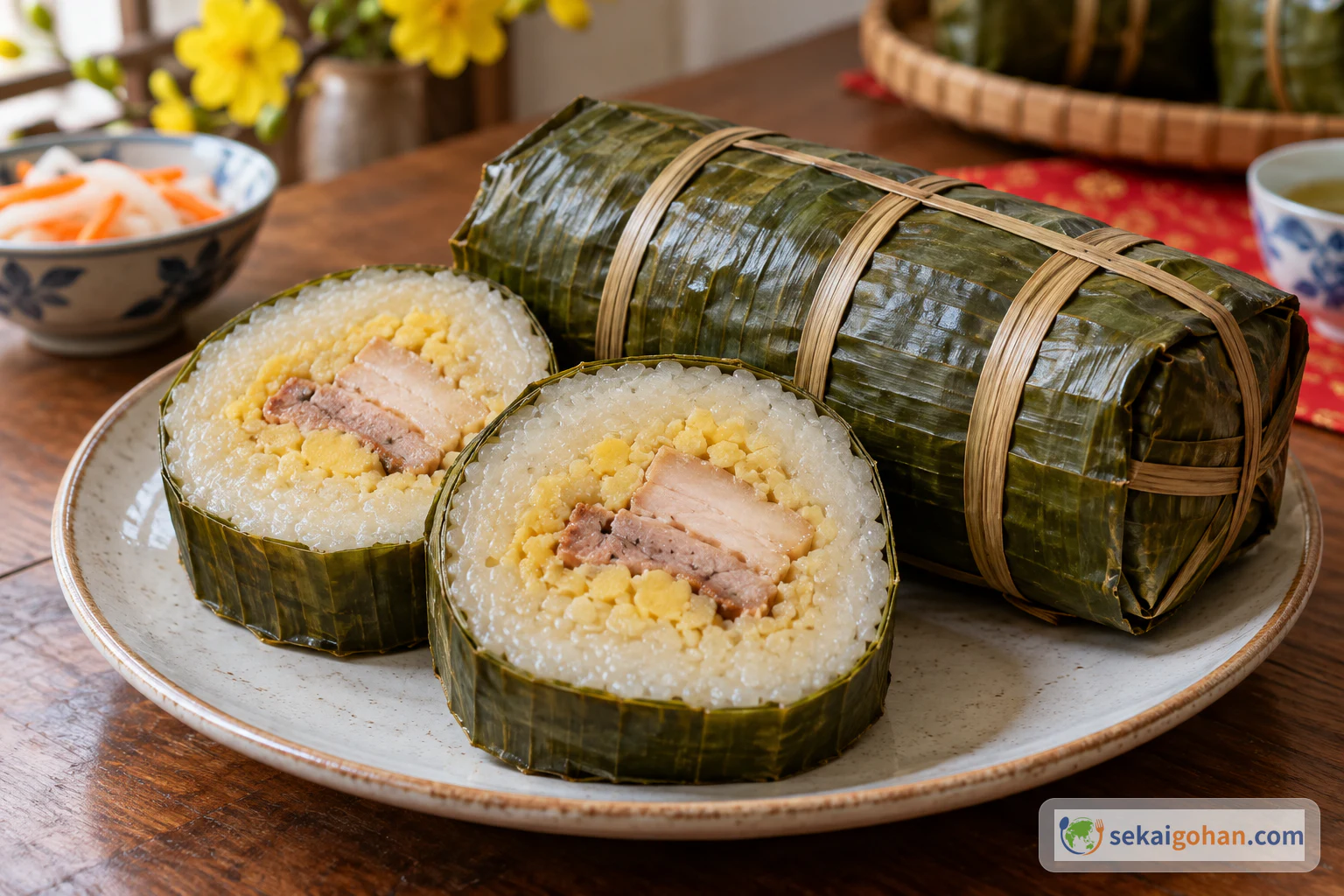
Lift the cakes out and rinse them in cold water. Hang them to drain and air-dry the surface, but this is not a way to keep the cakes at room temperature. To serve, unwrap a cake and slice it crosswise into rounds with clean thread or floss. Each wheel should show whole-grain rice around a yellow mung bean ring with pork at the center. Serve plain, or with pickles if you like.
9Optional: fry slices
To pan-fry, cook slices of cooked cake in a skillet with a little oil until both cut faces are golden. For leftover slices, use only cake that was refrigerated as described below, and heat the slices to 74°C (165°F) in the center, checked with a food thermometer.