Ingredients and steps on one page. Print it, or choose “Save as PDF” in the print dialog.
Sekai Gohan
How to Make Cha Gio: Vietnamese Fried Spring Rolls
Ingredients
Filling and wrapper
| Ingredient | Amount | Substitutes and notes |
|---|---|---|
| Dried rice paper | 24 sheets | 16–18 cm across. Avoid bags with many cracked sheets |
| Ground pork | 14 oz (400 g) | About 70 percent lean. If it is very lean, add 2 tsp vegetable oil |
| Peeled shrimp | 5.5 oz (150 g) | Devein, then chop roughly into 0.25 inch (5 mm) pieces |
| Mung bean glass noodles | 1.5 oz (40 g) | Soak in hot water and cut into 1 inches (3 cm) lengths |
| Dried wood ear mushrooms | 8 g | Rehydrate, squeeze out the water, and slice thinly |
| Carrot | 3.25 oz (90 g) | 0.125 inch (3 mm) dice or thin strips. Squeeze if it releases water |
| Lotus root | 4 oz (120 g) | 0.125 inch (4 mm) dice |
| Red onion | 2 oz (60 g) | Onion or shallot can substitute |
| Garlic | 2 cloves (about 12 g) | Minced |
| Egg | 1 | Binder. For an egg allergy, use 1 tbsp potato starch and 1 tbsp water |
| Fish sauce | 1 1/2 tbsp | The center of the saltiness |
| Sugar | 2 tsp | Rounds out the savory flavor of the filling |
| White pepper | 1/3 tsp | Black pepper also works |
| Salt | 1/4 tsp | Keep it light, depending on the moisture in the shrimp and vegetables |
Soaking water and frying oil
| Ingredient | Amount | Substitutes and notes |
|---|---|---|
| Lukewarm water | 1 cups (250 ml) | About 30 degrees C. Hot water makes the wrapper go limp at once |
| Sugar | 2 tsp | For the soaking water. Helps the wrapper take color |
| Rice vinegar | 1 tsp | For the soaking water. Slightly reduces stickiness |
| Vegetable oil | 700–900 ml | 1 inches (3 cm) deep in the pot. Rice bran or canola oil also works |
Nuoc cham and wrapping vegetables
| Ingredient | Amount | Substitutes and notes |
|---|---|---|
| Fish sauce | 3 tbsp | Where the fish sauce aroma comes forward |
| Water | ½ cup (120 ml) | Dissolves the sugar. If too strong, add 1 tbsp at a time at the table |
| Sugar | 3 tbsp | White or raw cane sugar both work |
| Rice vinegar | 2 tbsp | Supports the acidity on days with less lime |
| Lime juice | 2 tbsp | Lemon juice also works |
| Garlic | 1 clove (about 6 g) | Minced |
| Red chili | 1/2 | Seeded and sliced into rings. Leave out if you dislike heat |
| Carrot | 1.5 oz (40 g) | Thin strips. Float them in the sauce |
| Daikon | 2 oz (60 g) | Thin strips. If you have none, 2 oz (60 g) cucumber |
| Green leaf lettuce | 12 leaves | Red leaf lettuce also works |
| Mint | 15 g | It still comes together with 8 shiso leaves and 10 g cilantro as a substitute |
| Cilantro | 20 g | If you dislike it, use mitsuba, water dropwort, or scallion greens |
| Cucumber | 1 | Thin strips, 2.5 inches (6 cm) long |
Steps
1Mix the filling
8 min
Soak 1.5 oz (40 g) glass noodles in hot water for 4 minutes, drain in a colander, and cut into 1 inches (3 cm) lengths. Rehydrate 8 g wood ear, squeeze out the water, and slice thinly. In a bowl, combine 14 oz (400 g) ground pork, 5.5 oz (150 g) chopped shrimp, the glass noodles, wood ear, 3.25 oz (90 g) carrot, 4 oz (120 g) lotus root, 2 oz (60 g) red onion, the garlic, egg, fish sauce, sugar, white pepper, and salt, and mix by hand for 2 minutes. You want the meat mixture slightly sticky, the vegetables evenly scattered, and no liquid collecting at the bottom. Overmixing makes it bouncy and moves away from a light texture.
2Make the nuoc cham
7 min + 10 min to rest
Put ½ cup (120 ml) water and 3 tbsp sugar in a small pan and warm over low heat for 1 minute to dissolve the sugar. Turn off the heat before it comes to a simmer, then add 3 tbsp fish sauce, 2 tbsp rice vinegar, 2 tbsp lime juice, the garlic, the chili, and the thinly sliced 1.5 oz (40 g) carrot and 2 oz (60 g) daikon. Taste, and if saltiness arrives first, add 1 tbsp water. After 10 minutes, the edges of the vegetables soften slightly and cling better to the fried rolls.
3Moisten the rice paper and roll
18 min
In a shallow dish, mix 1 cups (250 ml) lukewarm water, 2 tsp sugar, and 1 tsp rice vinegar until no sugar grains remain and the water is thin and smooth. Dip just one sheet of rice paper and lift it out after 5 seconds. Lay it on the counter while it is still stiff, and put 25 g of filling in a bar 4 inches (10 cm) long on the near side. Fold the near edge over, fold in the left and right sides, and roll into a roll about 0.5 inches (1.5 cm) thick, pressing out the air. Over-soaked wrappers stick to the counter and tear in the oil, so do not extend the soaking time.
4Let them dry and heat the oil
10 min
Place the rolls seam side down on parchment paper, at least 1 inches (2 cm) apart so they do not touch. If the surface is wet, press it gently with a dry paper towel. While they rest for 8 minutes, pour oil 1 inches (3 cm) deep into a heavy pot and bring it to 165 degrees C over medium heat in 5–6 minutes. You can start frying when the wrapper surface is no longer a glossy water film and feels just slightly tacky to the finger.
5Cook through in lower-temperature oil
8 min
When the oil reaches 165–170 degrees C, add 5–6 rolls at a time, keeping about 0.5 inches (1 cm) between each in the pot. Right after they go in, the wrappers stick to each other easily, so do not touch them for 30 seconds; once a thin film forms, separate them with chopsticks. Hold medium heat and take about 4 minutes to color them a pale gold all over. The first stage is enough when the bubbles stay fine, the whiteness of the wrapper is gone, and the seam stays closed so each roll sets in a slim stick. If you push it to a deep brown, the wrapper turns bitter before the filling is cooked.
6Raise the temperature and firm up the wrapper
4 min
Take the rolls out onto a rack, raise the oil from medium to medium-high, to 175–180 degrees C. Return the cha gio to the pot and fry for 1 minute 30 seconds to 2 minutes. Take them out when the bubbles on the wrapper get small, a chopstick tap makes a crisp, hard sound, and the color is a deep gold. Cut one of the thicker rolls in half on a 45 degree diagonal and check that the center is not whitish and raw. If you use a thermometer, confirm the center reads 75 degrees C or more and holds it for 1 minute.
7Rest on a rack and plate
5 min
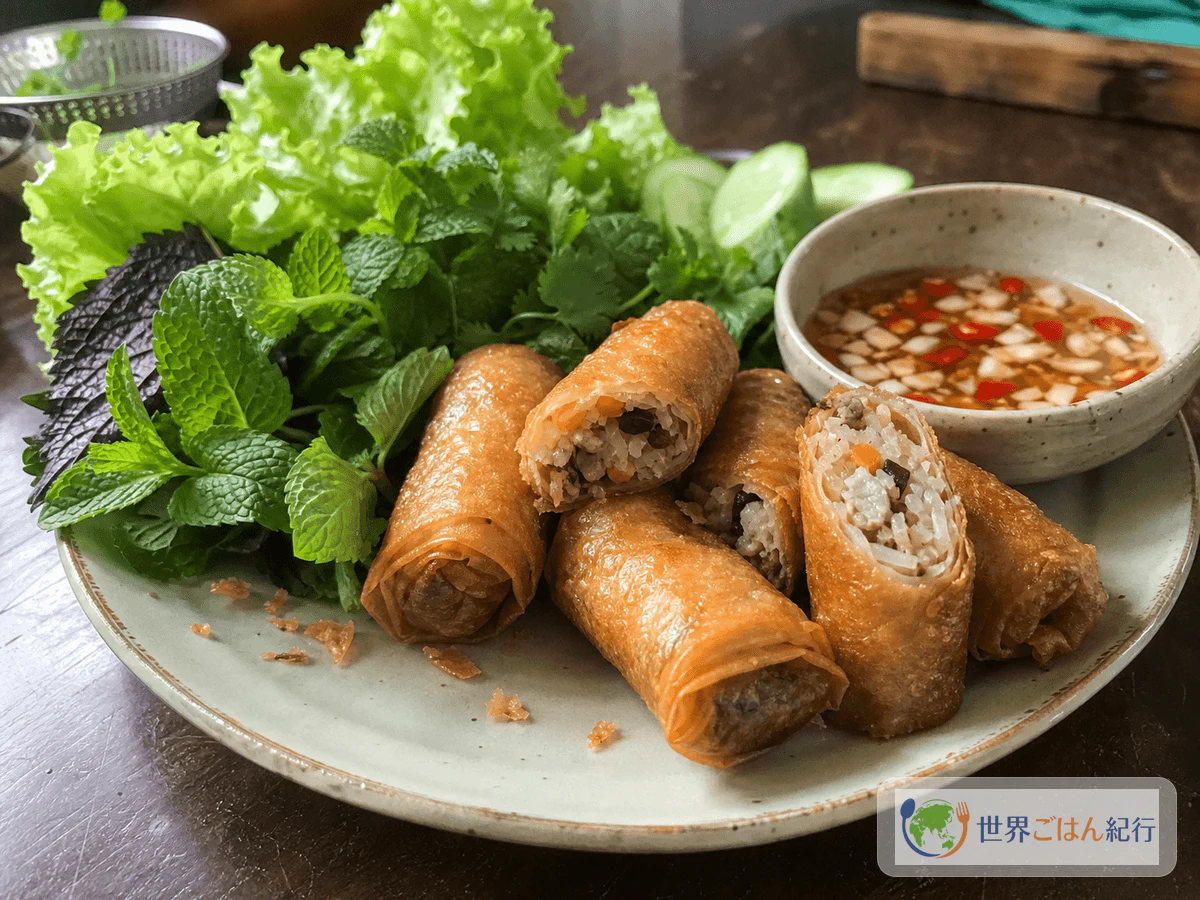
With the heat off, rest the fried cha gio on a rack for 3 minutes, without piling them directly on paper. On paper alone, the bottoms steam, and the wrapper you worked for goes soft again. When the wrapper is crisp and hard and the bottom does not go limp when lifted, cut them in half on the diagonal if you like. Serve with green leaf lettuce, mint, cilantro, cucumber, and nuoc cham. At the table, put a cha gio on a lettuce leaf, add herbs, dip lightly in nuoc cham, and eat it in one bite.