Ingredients and steps on one page. Print it, or choose “Save as PDF” in the print dialog.
Sekai Gohan
Gỏi Cuốn: Vietnamese Fresh Rice Paper Rolls with Shrimp and Pork
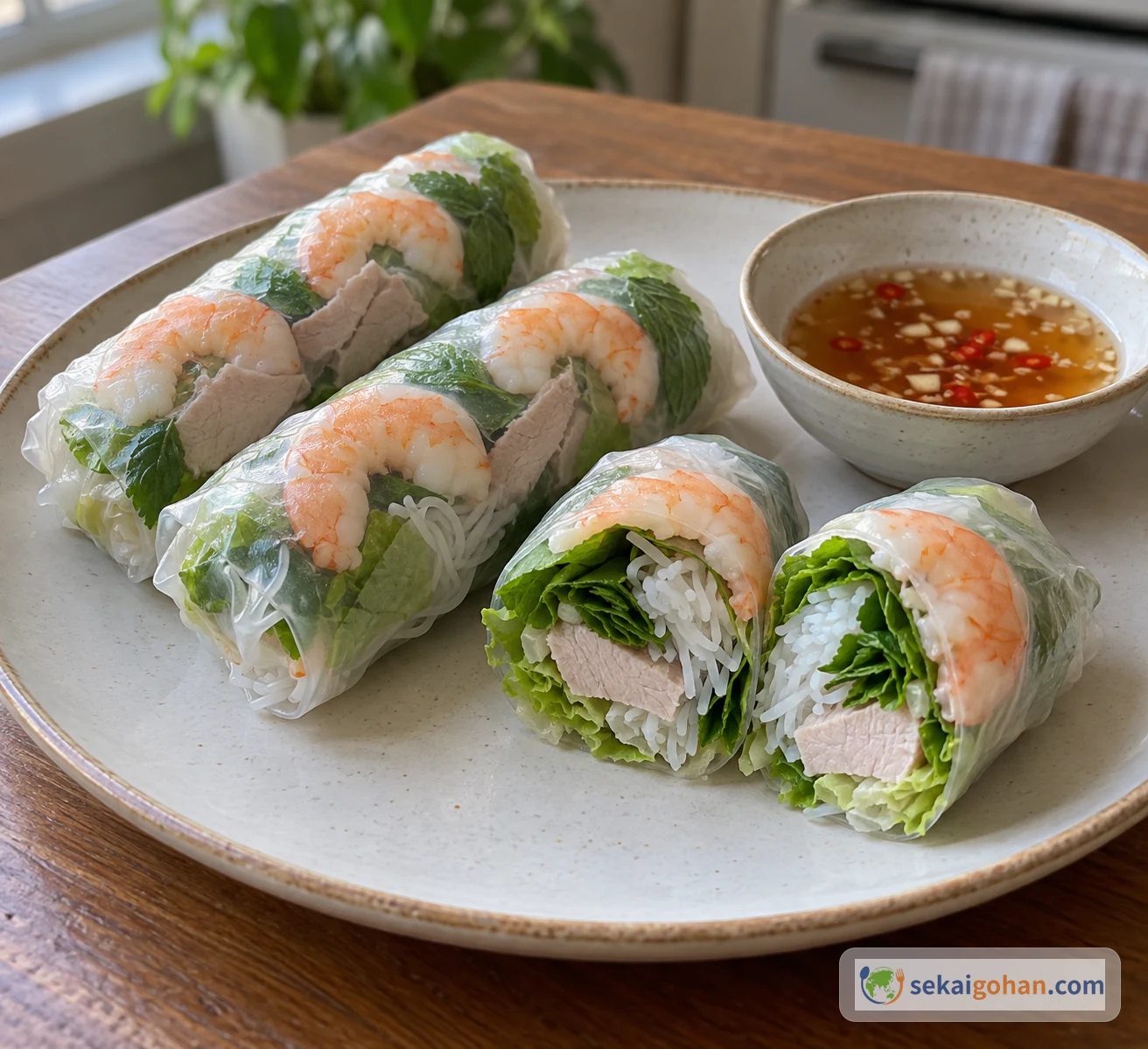
Ingredients
For the rolls
| Ingredient | Amount | Role and notes |
|---|---|---|
| Round rice paper (bánh tráng) | 12 sheets, about 22 cm across | If your sheets are smaller, use less filling |
| Small shrimp (tôm) | 12 (if buying raw, shell-on: about 180–220g as a shopping guide) | Cooked, peeled and halved lengthwise: one shrimp gives two halves for one roll |
| Pork neck | About 76g cooked, thinly sliced | Cook it as a piece, then slice |
| Dried thin rice vermicelli (bún) | About 57g dry | Cook following the package directions |
| Lettuce | About 2/3 cup, enough for 12 rolls | Pat dry and remove thick ribs |
| Mint | 12–24 leaves | Adjust the leaf count to your bunch |
| Perilla | Enough for 12 rolls | Use alongside mint. See the notes below for substitutes |
| Garlic chives (hẹ) | 12 stalks, about 10 cm each | Tucked in at the end so one tip shows. Adjust the length to the roll |
Fish-sauce dip
| Ingredient | Amount | Notes |
|---|---|---|
| Fish sauce (nước mắm) | 2 tbsp | Two-thirds of the original 3 tbsp. Made from fish |
| White vinegar | 2 tbsp | Rice vinegar gives a milder sourness |
| Sugar | 1 tbsp + 1 tsp | Rounds off the salt and acid |
| Water | About 80ml | Two-thirds of the original 4 oz (1/2 cup) |
| Garlic | 1⅓ cloves' worth | Two-thirds of the original 2 cloves. Finely chopped |
| Red chili | About 2/3 of one, to taste | Two-thirds of the original 1 chili. Leave out if you avoid heat |
| Lime juice | 1 tbsp + 1 tsp | Two-thirds of the original 2 tbsp |
Steps
1Prepare the vegetables and set up separate tools
Wash the lettuce well, pat it dry and tear it into pieces that suit the wrapper. Pick the mint and other herbs into individual leaves. Trim the garlic chives so they will stick out a little beyond the width of the wrapper.
Keep the boards, knives and plates used for raw pork and raw shrimp separate from those used for washed vegetables and cooked fillings. Cooked meat and shrimp never go back onto a plate or board that held them raw.
2Cook the pork through and let it cool
Cook the pork as a single piece in gently simmering water until it is cooked to the center. The time depends on the thickness of the piece, so don't judge doneness by the clock alone. Use a food thermometer and cook until the center reaches 167°F (75°C) and stays there for at least 1 minute.
Move the pork to a clean plate and let it cool. Once cool, slice it thinly across the grain. Rolling it while hot makes the wrapper absorb moisture faster and wilts the greens.
3Cook the shrimp, and cook and drain the noodles
Cook the shrimp until the flesh is white and opaque all the way to the center. Let them cool, peel them, and cut each one in half lengthwise along the back. Each roll gets the two halves of one shrimp.
Cook the rice vermicelli following the package directions, rinse it under cold water if the package says to, and drain it well in a colander. Water left in the noodles makes the wrapper soggy and weak.
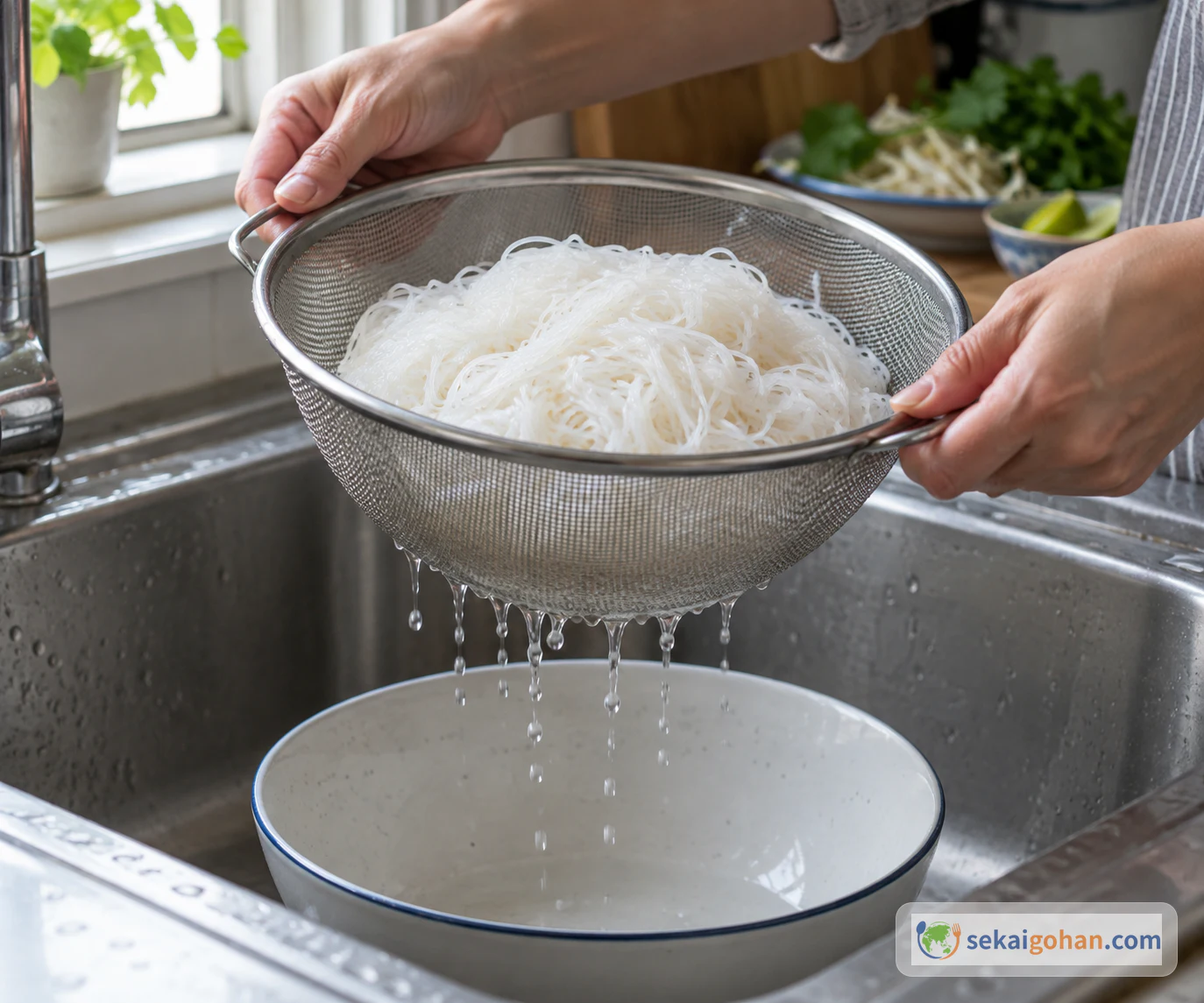
Drain the noodles thoroughly so no water pools on the wrapper 4Make the dip: warm, cool, then add the aromatics
Put the fish sauce, vinegar, sugar and water in a small saucepan and stir over medium heat, warming it until just before it boils so the sugar dissolves. Take it off the heat and let it cool. Once cool, stir in the chopped garlic, chili and lime juice. Don't pour the hot sauce over herbs or aromatics.
5Wet the rice paper briefly
Pour lukewarm water into a large flat plate or shallow tray. Pass one wrapper through the water once, starting from the edge, and lay it on a clean flat surface while it still has a little stiffness left. The wrapper keeps softening after you set it down, so don't leave it in the water until it goes completely limp.
Follow the package directions for soaking time, and aim for a sheet that folds easily but doesn't stick to your fingers.
6Arrange the filling
On the half of the wrapper nearest you, lay lettuce, herbs, a small amount of noodles and pork in a horizontal line. Place the two shrimp halves in a row closer to the far edge, so their color will show through the wrapper after rolling.
Keep the filling within the middle of the wrapper, and use only as much as one turn of the wrapper can cover. Piling it high stretches the wrapper to its limit, and the end won't close.
7Fold in the sides and roll from the near edge
Fold the left and right sides inward. Bring the near edge of the wrapper up over the filling and, gathering the filling lightly with your fingers, roll it over once. Keep rolling the rest of the way, and tuck a garlic chive in near the end so a tip shows. Don't pull the wrapper hard; stop tightening once the wrapper is snug against the filling.
If the wrapper tears a little, don't stretch it to cover the gap. Wrap the roll again in a second, freshly wetted sheet instead. Layering many patches makes the roll thick and chewy.
8Plate seam-side down and serve with the dip
Place each roll seam-side down on a plate, leaving a little space between them so they don't stick together. Serve with the dip, and eat them before the wrappers dry out. Moisture keeps moving into the wrapper, so the rolls are not meant to be made far ahead.
Refrigerate any leftover cooked pork, shrimp and other perishable fillings promptly; cooling them in shallow containers helps. Don't leave them at room temperature for more than 2 hours, or more than 1 hour if the room is above 90°F (32°C).