Ingredients and steps on one page. Print it, or choose “Save as PDF” in the print dialog.
Sekai Gohan
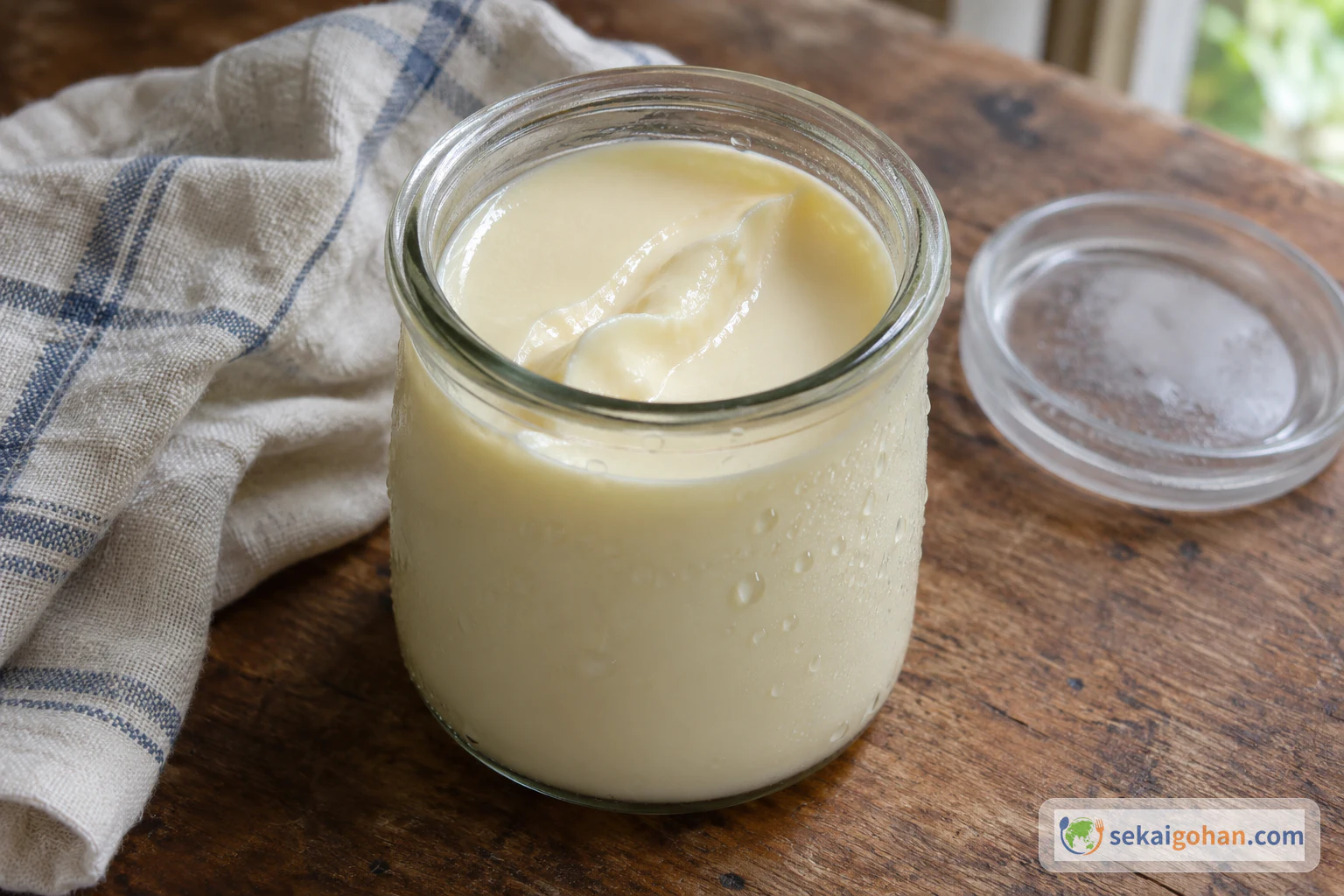
Sữa Chua: Vietnamese Condensed Milk Yogurt Set in Jars
Ingredients
| Ingredient | Amount | Role |
|---|---|---|
| Sweetened condensed milk (sữa đặc có đường) | 13½ oz (380 g) | All of the sweetness and much of the richness |
| Unsweetened whole milk (sữa tươi không đường), pasteurized | 4¼ cups (1 L), divided: 2½ cups (600 ml) cold + 1⅔ cups (400 ml) to boil | The base that sets; its fat decides the body |
| Plain unsweetened yogurt with live cultures (sữa chua cái) | 3½ oz (100 g) | The starter culture |
Steps
1Boil the jars and lids
Put the jars and lids in a pot, cover them with water and bring it to a boil. Let them boil for 10 minutes. The same warmth that suits the yogurt cultures also suits unwanted microbes. Lift everything out with tongs or long chopsticks and set it upside down on a clean cloth to drain and dry. The jars are ready when the insides are dry, with no droplets left to water down the milk.
2Dissolve the condensed milk in cold milk
Put the condensed milk in a saucepan or large bowl. Pour in the 2½ cups (600 ml) of cold milk and whisk until the condensed milk is completely dissolved. Any lumps left behind become pockets of extra sweetness, and the yogurt sets unevenly around them. Drag the whisk across the bottom of the pan to check. It is done when the bottom feels smooth and the milk is one even pale cream color.
3Boil the rest of the milk and combine at 104°F
Heat the remaining 1⅔ cups (400 ml) of milk in a second pan over medium heat until it boils. Take it off the heat and pour it straight into the condensed milk mixture, stirring as you pour. Boiling this milk is about temperature: the hot milk and the cold mixture meet at about 104°F (40°C), which is where the cultures work. Do not add water to cool it down, because that changes the balance of the yogurt. Check with the thermometer. You are ready for the starter when it reads about 104°F (40°C).
Use a thermometer, not your fingerAt 115°F (46°C) the cultures die, and the yogurt never sets. Your finger cannot tell 104°F from 115°F. If the thermometer reads above 113°F (45°C), set the pan in a bowl of cold water and stir until it drops to about 104°F (40°C).
4Stir in the starter and skim the foam
Let the 3½ oz (100 g) of yogurt come to room temperature and stir it smooth. Add it to the warm milk a little at a time. Then stir slowly in one direction for about 30 seconds. Skim off the foam on the surface; left there, it sets into holes on top of the yogurt. For an extra-smooth result, pour the mixture through a fine strainer. Do not put the pan back on the heat after this point. Move on when the surface is calm and free of foam.
5Fill the jars
Pour the mixture into the jars until they are about four-fifths full. The yogurt rises a little as it sets, and a full jar lets milk touch the lid and seep out. Wipe the rims and the outside of each jar with a clean cloth, then screw the lids on. The jars are ready when the rims are clean and the milk sits level just below the shoulder of the glass.
6Set up the warm water bath
Stand the closed jars upright in a styrofoam cooler box or a deep pot. Mix boiling water and cold water 1 to 1. That gives water at about 122°F (50°C), which feels hot when you put your hand in. Pour it around the jars until it comes two-thirds of the way up their sides. Close the box or pot, lay a cloth over the top, and leave it at room temperature. The bath is right when the water line sits at two-thirds and the water feels hot, not scalding.
Never use a rice cooker's warm settingA rice cooker only works as an insulated box: put the jars and the warm water in it with the power off. The warm setting runs at 140°F (60°C) and above, which kills the cultures, and the milk will not set.
7Leave the jars completely still for 6 to 8 hours
Leave the box closed and do not move it, lift it or check the jars by shaking them. Movement while the milk is setting breaks the curd and lets the whey run out. At 6 hours, open the box and tilt one jar gently. If the yogurt stays in place, it has set. If it is still soft but a spoon leaves a trail, it is getting there. Leave it longer for more tang, up to 8 hours in total.
Hands off, then check at 6 hoursStillness decides the texture. Checking at 6 hours lets you stop at the sourness you like. The longer the jars stay warm, the sharper the yogurt gets and the more whey separates.
8Chill the jars
Move the jars straight to the fridge with their lids on, at 36–43°F (2–6°C), on the upper shelf. Chilling them quickly stops the yogurt from getting more sour. Eat it only once it is fully cold. Warm, it tastes sharper and feels looser. The yogurt is ready when the glass is cold and beaded with condensation and the yogurt holds together in a soft spoonful.