Ingredients and steps on one page. Print it, or choose “Save as PDF” in the print dialog.
Sekai Gohan
Bánh Tráng Phơi Sương: Trảng Bàng Dew-Softened Rice Paper with Boiled Pork
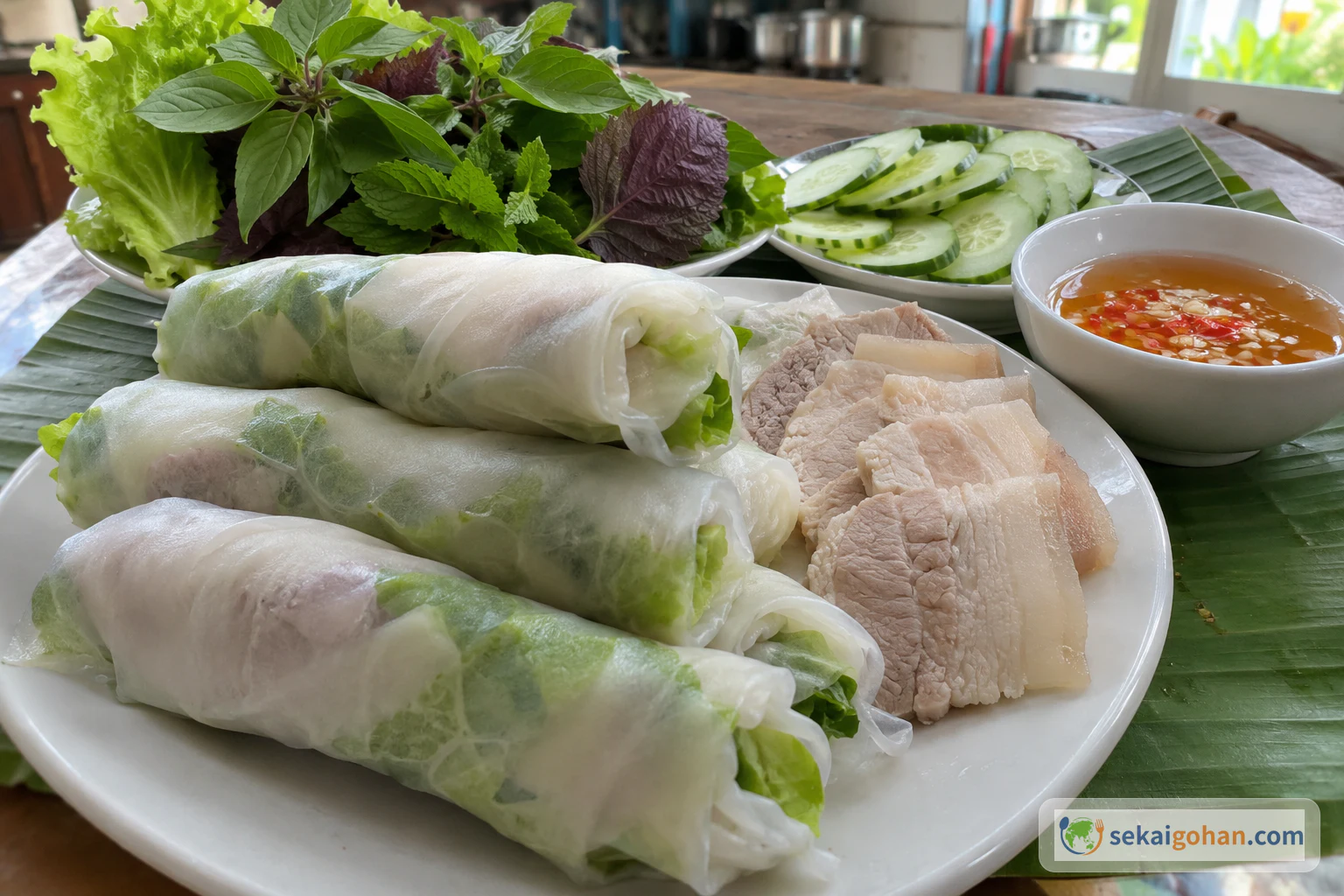
Ingredients
| Ingredient | Amount | Role |
|---|---|---|
| Pork belly in one piece, skin on if possible, or pork shank (thịt ba chỉ / thịt chân giò) | 2¼ lb (1 kg) | The center of the roll: fat for sweetness, meat for chew |
| Shallots (hành tím) | 2 | Crushed into the cooking water to take off the porky smell |
| Ginger (gừng) | 1 knob | Sliced into the cooking water, with some grated for rubbing the pork |
| Salt (muối) | a little | For rubbing the pork and seasoning the water |
| Fresh rice vermicelli (bún tươi) | 2¼ lb (1 kg) | Bulk and a soft mouthfeel |
| Trảng Bàng dew-softened rice paper (bánh tráng phơi sương) | 1 bundle | The wrapper, and the dish's name |
| Lettuce (xà lách) | about 1 lb (500 g) | Cushion, crunch and moisture |
| Herbs: Thai basil (húng quế), perilla (tía tô), fish mint (diếp cá), Vietnamese balm (kinh giới) | a little of each | Layers of fragrance and bitterness |
| Cucumbers (dưa leo) | 2–3 | Crunch and freshness |
| Green unripe bananas (chuối xanh), optional | 1–2 | Astringent, slightly sticky bite |
| Sour star fruit or pineapple (khế chua / dứa), optional | 1 | Sourness inside the roll |
| Salt or lemon juice for soaking the fruit | a little | Keeps the banana and star fruit from browning |
| Fish sauce (nước mắm) | 3–4 tbsp | Salt and savory depth in the dip |
| Sugar (đường) | 3–4 tbsp | Sweetness in the dip |
| Warm water | as needed | Dissolves the sugar and sets the strength of the dip |
| Lime or calamansi juice (nước cốt chanh / tắc) | 2–3 tbsp | Sourness in the dip |
| Garlic (tỏi), minced | 3–4 cloves | Aroma |
| Fresh red chilies (ớt), sliced | 1–2 | Heat |
Steps
1Rub and rinse the pork
Rub the pork all over with salt or grated ginger, working it into the skin and the cut sides. Rinse it under running water to take off the slick surface and the smell. Pat it dry with paper towels, then wash your hands and the board. The pork is ready when the surface feels clean rather than slippery and the skin is dry to the touch.
2Bring it up from cold water
Put the pork in a large pot and pour in cold water to cover it completely. Add the crushed shallots, sliced ginger and a little salt, and bring it to a boil. Skim off the gray scum that rises, then turn the heat to low and simmer for 20–30 minutes. The water is right when small bubbles rise steadily at the edges and the surface barely moves.
3Check that it is cooked through
Thickness changes the time, so check the meat, not the clock. Push a chopstick into the thickest part. The juice that comes up must be clear, with no red. Then check with a thermometer: the center reaches 167°F (75°C) and holds there for at least 1 minute. If either check fails, simmer longer and test again in the same spot.
4Chill in ice water
Lift the pork into a large bowl of ice water and leave it for 10–15 minutes. Do not leave it much longer, or the meat starts to dry. Lift it out and pat it dry all over. It is ready when the fat feels firm and pale and the meat is cold and springy when you press it.
5Slice thin across the grain
Set the cold pork on a clean board and cut thin slices across the grain. Wipe the blade if strands of meat cling to it. Fan the slices out on a plate. Each slice is right when it shows pale meat, a band of fat and a strip of skin, and is thin enough to bend over your finger.
6Mix the nước chấm in order
Stir the sugar into a little warm water until no grains are left. Add the fish sauce, then the lime or calamansi juice. Use juice only and add it after the fish sauce: oil from the peel turns the dip bitter. Stir in the garlic and chili last, and loosen the dip with more warm water a spoonful at a time. It is ready when you taste sweetness first, then salt, then sourness, with heat at the end.
7Prepare the greens and fruit
Wash the lettuce and herbs under running water and leave them in a colander to drain well. Slice the cucumber thin. Slice the green banana and star fruit thin and drop them into water with a little salt or lemon. Water left on the fillings is what tears the paper. Everything is ready when the leaves are dry to the touch, no water pools under the colander, and the fruit is still pale, not brown.
8Set the table
Lay out separate plates of pork, noodles, lettuce and herbs, cucumber and fruit, and the rice paper. Put the nước chấm in small bowls within everyone's reach. Do not roll ahead: a finished roll keeps absorbing moisture and falls apart as it sits. Keep the rice paper bag closed until people sit down. The table is set when every plate is within reach and the top sheet still bends softly.
9Roll at the table
Take one sheet straight from the bundle and lay it on your plate or palm. Layer the lettuce, then herbs, then cucumber, banana and star fruit, then a little bundle of noodles, with pork on top. Fold the near edge over the filling, tuck in both sides and roll away from you. Keep the roll snug but not tight. It is right when the roll holds its shape and the paper stretches over the filling without splitting.
10Dip deep and eat
Hold the roll by the middle and push one end down into the nước chấm, letting the sauce run between the layers. Eat it right away, then roll the next one. Add more pork or herbs to the plates as they empty. You have it right when the sauce clings to the paper and the wrapper stays whole as you bite.