Ingredients and steps on one page. Print it, or choose “Save as PDF” in the print dialog.
Sekai Gohan
Griot: Haiti's National Dish of Spicy Fried Pork
Ingredients
Main ingredients
| Ingredient | Amount | Substitutes & notes |
|---|---|---|
| Pork shoulder (in a block) | 1.75 lb (800 g) | A cut with a moderate amount of fat is ideal. Pork belly also works |
| Juice of bitter orange (naranja agria) | ½ cup (120 ml) | Can be replaced with ¼ cup (60 ml) orange juice plus ¼ cup (60 ml) lime juice |
| Limes | 2 (juice) | — |
| Salt | 2 tsp | — |
| Black pepper | 1 tsp | — |
| Vegetable oil (for pan-frying) | 4 tbsp | — |
Bitter orange (Seville orange / naranja agria) is a key citrus in Haitian cooking, with a sourness and bitterness between an ordinary orange and a lime. In Japan the closest variety is daidai. If you can't find it, mixing sweet orange juice and lime juice 1:1 gives a close match. A small amount of grapefruit juice added will also bring back the characteristic bitterness of bitter orange.
Epis (Haitian spice paste)
| Ingredient | Amount | Substitutes & notes |
|---|---|---|
| Parsley | 1 bunch (1 oz (30 g)) | — |
| Scallions | 4 | — |
| Garlic | 6 cloves | — |
| Onion | 1/2 | — |
| Thyme (fresh) | 2 tsp | 1 tsp if dried |
| Scotch bonnet | 1 (seeded) | Habanero can be used. Half for less heat |
| Cloves (ground) | 1/4 tsp | — |
| Black pepper | 1/2 tsp | — |
| Vinegar | 1 tbsp | Apple cider vinegar recommended |
| Vegetable oil | 1 tbsp | — |
It means "spices" in Haitian Creole. It is the all-purpose marinade paste of Haitian cooking, a kind of Haitian sofrito. It is built around parsley, scallions, garlic, thyme, and Scotch bonnet. Make plenty and keep it refrigerated (1 week) or frozen (3 months) so you can use it in everyday cooking. Compared with the jerk seasoning of jerk chicken, it has a higher proportion of herbs and a more delicate, complex flavor.
Side dish: bannann peze (fried plantain)
| Ingredient | Amount | Substitutes & notes |
|---|---|---|
| Plantains | 2 | Unripe green bananas can be used |
| Salt | 1/2 tsp | — |
| Vegetable oil (for frying) | As needed | — |
Side dish: pikliz (pickled vegetables)
| Ingredient | Amount | Substitutes & notes |
|---|---|---|
| Cabbage | 1/4 head (shredded) | — |
| Carrot | 1 (shredded) | — |
| Onion | 1/2 (thinly sliced) | — |
| Scotch bonnet | 1/2 (minced) | 1 dried red chile can stand in |
| Lime juice | 3 tbsp | — |
| White wine vinegar | 3 tbsp | — |
| Salt | 1/2 tsp | — |
Steps
1Make the epis
10 min
This is the spice paste that is the foundation of Haitian cooking. Put the parsley, scallions, garlic, onion, thyme, Scotch bonnet (seeded), cloves, black pepper, vinegar, and vegetable oil all into a food processor and blend until it becomes a smooth paste. In about 30 seconds you get a uniform green paste.
Put what is left over in an airtight container and it keeps for 1 week in the refrigerator; freeze it in an ice cube tray and it keeps for 3 months.
2Marinate the pork
15 min (plus at least 1 hour)
Cut the pork shoulder into 1.5 inches (3–4 cm) cubes. Do not trim the fat; leave it on. This fat later produces the crisp texture.
Put the pork in a bowl, add 4–5 tbsp of the epis, ½ cup (120 ml) bitter orange juice (or orange plus lime), the juice of 2 limes, 2 tsp salt, and 1 tsp black pepper, and rub it in thoroughly by hand. Cover with plastic wrap and marinate in the refrigerator for at least 1 hour, ideally overnight (12 hours).
Marinating time decides most of the flavorIf you have time, marinate it the evening before and cook it the next day. A short marinade gives flavor only on the surface; the longer time lets the citrus acid loosen the fibers of the pork and carries the epis spices to the center.
3Simmer the pork
45 min
Move the marinated pork, with its marinade, to a heavy pot and add ¾ cup (200 ml) water. Bring to a boil over high heat, then lower to low, cover, and simmer for 45 minutes. Turn the pieces over once along the way.
This simmering step is the secret of griot. As the pork cooks slowly together with the marinade, the spice flavor penetrates completely and the meat becomes so tender it comes away from the bone. At the same time the fat turns soft and creamy, setting up the dramatic crisping in the pan-frying that follows.
When the liquid has reduced by about half, take the pork out onto a tray. Do not throw this liquid away; you will use it to finish.
4Pan-fry the pork
15 min
From here is the real heart of griot, the "second cooking." Put 4 tbsp vegetable oil in a skillet and heat over medium-high heat. Blot the simmered pork lightly with paper towels and arrange it in the pan.
Pan-fry for 3–4 minutes per side, until every side is golden and crisp. Do not cover. Covering traps steam and loses the crispness. The fatty parts brown especially fragrantly.
A tip for maximizing crispnessPork that has finished simmering is soft, so after taking it out onto a tray, let it rest for 15–20 minutes so the surface dries. Putting pork with a dry surface into hot oil lets the Maillard reaction proceed efficiently and makes a thin, crackling crust.
5Finish with the cooking liquid
3 min
Take the pan-fried pork out onto a tray and spoon over 3–4 tbsp of the cooking liquid set aside in step 3. This last touch layers more spice flavor onto the crisp surface and completes the "coat of spice" characteristic of griot. After spooning on the liquid, do not fry it again; go straight to plating.
6Make the pikliz
10 min (plus 30 min to pickle)
In a bowl put the shredded cabbage, carrot, and onion, add the minced Scotch bonnet, lime juice, white wine vinegar, and salt, and mix well until the pickling liquid has reached all of the vegetables evenly. Let it pickle for at least 30 minutes. The longer it sits, the mellower the acidity becomes while the vegetables keep their crunch.
Pikliz is Haiti's version of "coleslaw plus pickles," and it is indispensable in cutting the richness of griot with sourness and heat.
7Make the bannann peze
15 min
Peel the plantains (or green bananas) and cut them into 1 inches (2 cm) rounds. Fry in 350°F (170°C) oil for 2 minutes per side and take them out once. The point is to take them out while they are still yellow.
Press the fried rounds firmly against a flat surface (a cutting board or the bottom of a plate) until 0.5 inches (1 cm) thick. The more even the thickness, the more evenly crisp they will be after the second frying. Fry again in 350°F (180°C) oil for 1–2 minutes per side until golden. Sprinkle with salt. Crisp outside, fluffy inside: that is bannann peze.
8Plate
5 min
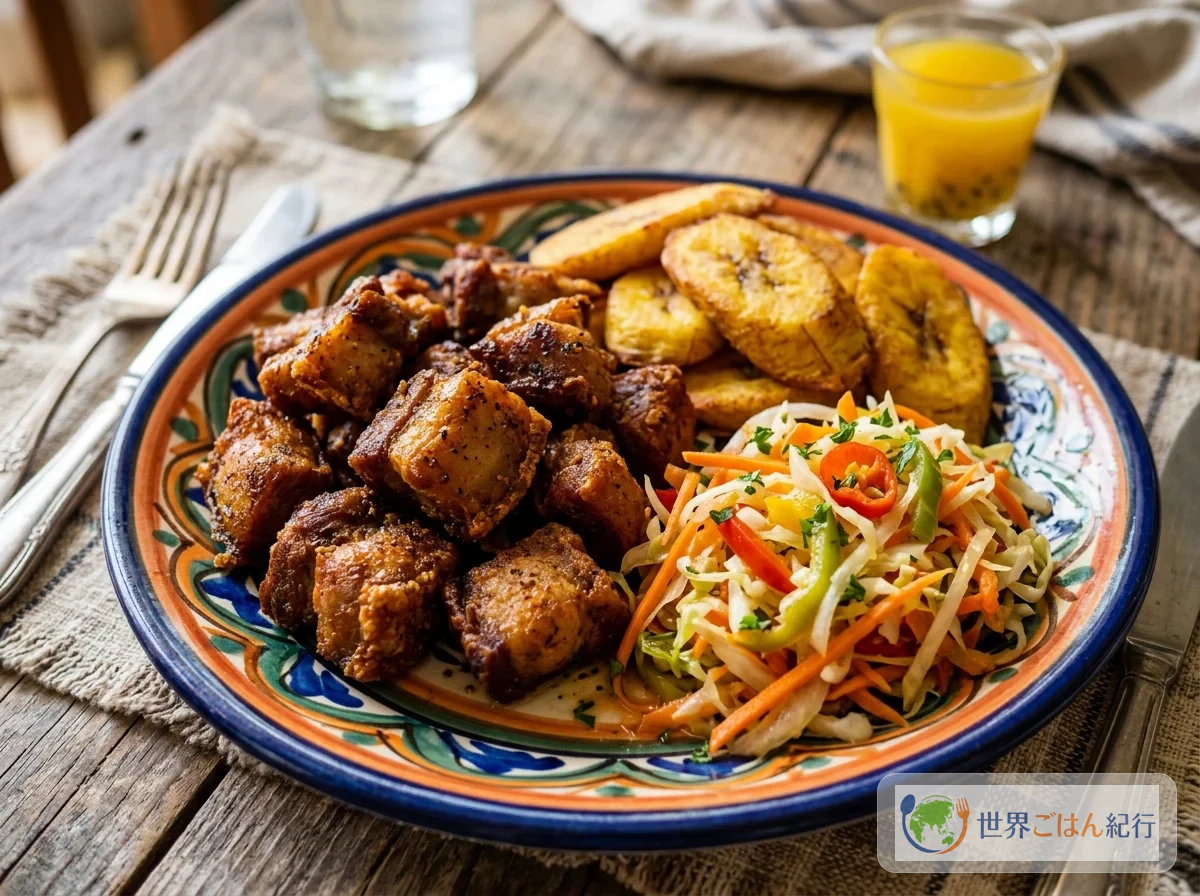
Heap the griot on a large platter, line the bannann peze alongside, and add the pikliz. In Haitian homes it is often served with diri kole (rice and beans cooked together, a red-rice-like dish), but white rice is also delicious.
The Haitian way of eating is to alternate bites of griot and bannann peze and refresh the mouth with pikliz in between. Fat, sweetness, sourness, and heat travel around the mouth in exquisite balance.