From Kingston to Montego Bay on the north coast, smoke rises from grills made out of halved oil drums, carrying the scent of pimento wood on the Caribbean breeze and drawing travelers in. At the end of that smoke is jerk chicken. Jamaica's national grilled dish is chicken marinated in a paste of Scotch bonnet, allspice and thyme, then smoke-roasted over charcoal or pimento wood. Allspice's sweet fragrance sinks deep into the meat, and the Scotch bonnet's fierce heat sears the surface. That collision of sweet and hot is what jerk chicken tastes like.

Jerk Chicken Method and History
In Jamaica, "jerk" is a method: you rub a spice paste into the meat and cook it slowly over low heat in smoke. Nobody is sure where the word comes from. It may come from the Spanish "charqui" (dried meat), or from the English verb for poking meat. The technique itself goes back to the mountains of 17th-century Jamaica, and it has since influenced barbecue culture around the world.
The Maroons in the 17th century
The story begins with the Maroons, escaped enslaved people who fled into Jamaica's Blue Mountains. In 1655, when the English took Jamaica from the Spanish, the people the Spanish had enslaved escaped into the mountains. There they combined food-preservation techniques learned from the island's indigenous Taíno with spice knowledge brought from Africa. Rubbing meat with spices and smoking it over pimento wood made it keep longer, and that is the earliest form of jerk.
Cooking smoke in the mountains could give away a camp's position. So the Maroons dug pits in the ground and smoldered pimento wood inside to smoke the meat. Jerk cooking started in these "underground grills."
Boston Bay from the 1930s
Between the late 19th and the 20th century, jerk spread from the mountains to the coastal towns. Portland Parish in northeastern Jamaica, and Boston Bay in particular, became known as the home of jerk. Jerk pork stands were already operating there in the 1930s, and the area is still famous for its rows of jerk stands.
Reggae and the world stage
Jamaican independence (1962) and the worldwide reggae boom were a turning point. Around the time Bob Marley was taking reggae around the world, Jamaican immigrants began opening specialty shops called "jerk joints" in London, New York and Toronto.
London's Brixton and Notting Hill are centers of the Jamaican community. Every August at the Notting Hill Carnival, Europe's biggest Caribbean festival, drum grills line the streets and jerk smoke fills the London sky. In the United States, Brooklyn is known as "Little Jamaica," with excellent jerk spots all along Flatbush Avenue. Since the 2000s, jerk chicken has been a staple at barbecue festivals across the country.
By the 2010s jerk had moved past the "Caribbean cuisine" label and become global street food. Upscale London restaurants put "jerk-style" dishes on their menus, and jerk is a popular category in American food-truck culture.
Ingredients (serves 4)
This dish uses coconut milk. It contains no dairy, but avoid it if you are allergic to coconut. Soy sauce also contains wheat; a gluten-free tamari can replace it.

Choosing Ingredients for Jerk Chicken
Scotch bonnet
The Scotch bonnet is a chile native to the Caribbean. It gets its name from its shape, which looks like a Scottish bonnet (a tam o' shanter). At 100,000–350,000 SHU it is about as hot as a habanero. What sets it apart is the fruity, sweet aroma inside the intense heat, a tropical fragrance that recalls mango and papaya and carries much of jerk's complex flavor.

Fresh Scotch bonnets are often hard to find in regular supermarkets. Try Caribbean, Latin American or Asian grocers, or order them online. For bottled sauce, Grace Scotch Bonnet Pepper Sauce is the standard choice. If you can't find the peppers, these substitutes work:
- Habanero: the closest in both heat and aroma, and the best substitute. Use the same amount. Dried habanero powder also works
- Dried red chiles plus paprika: the chiles give heat and the paprika gives a sweet fragrance. Use this one in a pinch
The heat holds on in the finished chicken for a reason. Capsaicin is fat-soluble, so the oil in the marinade dissolves it and carries it into the fat layer of the meat. If capsaicin dissolved in water, the heat would stay only on the surface.
Allspice (pimento)
The other pillar of jerk is allspice. In Jamaica it is called "pimento," and it is a cornerstone of the island's cooking. The name "all spice" comes from the way a single berry holds the aromas of cinnamon, clove and nutmeg. Its botanical name is Pimenta dioica. It is native to the Caribbean region and has long been grown in Jamaica. One of its main aromatic compounds is eugenol, the same compound behind the sweet, spicy scent of cloves.

In Boston Bay, cooks burn both allspice berries and branches of the pimento tree as smoking wood, and that smoke gives the chicken its distinctive sweet aroma. Pimento wood is hard to find outside Jamaica. You can get a similar fragrance by wrapping a few whole allspice berries in foil and setting them on the coals.
Allspice itself is easy to find:
- Supermarket spice aisle: ground allspice is widely available
- Specialty grocers: whole berries are often sold, and their aroma is stronger, so buy them if you can
Middle Eastern grocers also carry allspice as a staple. You can pick it up along with what you need for shawarma or kofte.
Soy sauce and brown sugar
Many modern jerk marinades include soy sauce or browning (a burnt-sugar sauce). Soy sauce brings umami, salt and color, and it helps the spice aroma cling to the meat.
Brown sugar is what creates the char. Over high heat, its sugar reacts with amino acids in the meat (the Maillard reaction), and that produces the black crust and the sweet, savory flavor on the surface of jerk chicken. Leave the sugar out and the marinade won't develop that complexity.
Scotch bonnets are as hot as habaneros (100,000–350,000 SHU). Always wear rubber gloves. If you rub your eyes after handling them bare-handed, the pain is intense. The seeds and pith are the hottest part, so remove the seeds if you want less heat.
Grind the spices in a mortar, finely chop the Scotch bonnets and scallions, and mix everything together. The texture will be a little coarser, but the flavor is just as good. In fact, this is the usual method at Jamaican roadside stands.
The depth of jerk chicken depends on marinating time. Aim for at least 4 hours. A 30-minute soak flavors only the surface. Preparing it the night before and cooking the next day is the surest way.
How to make rice and peas
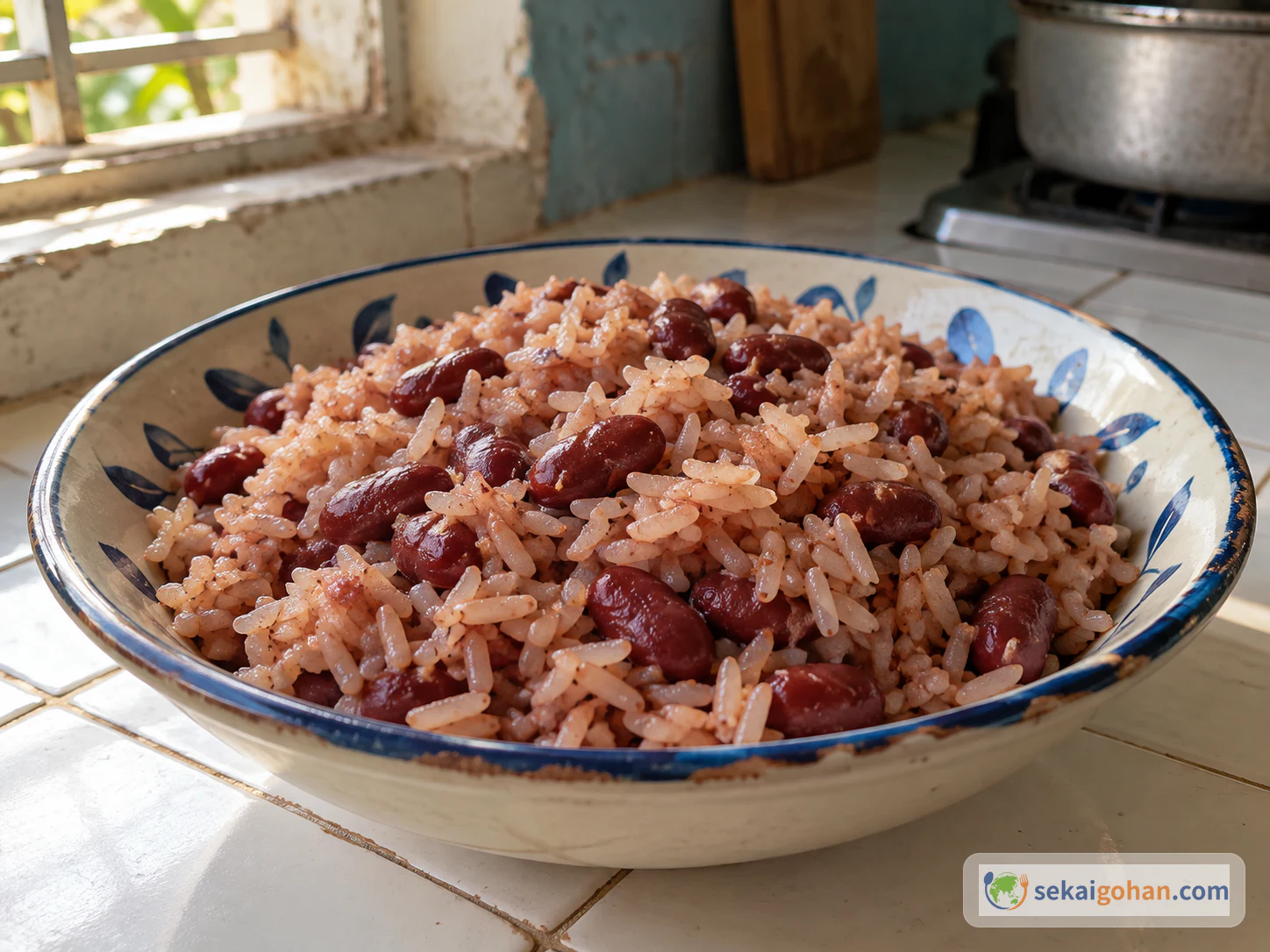
In Jamaica, jerk chicken always arrives with rice and peas on the side. The "peas" are not green peas but red kidney beans or gungo peas (pigeon peas), cooked into a sweet, creamy rice with coconut milk. If you want to dial in the liquid ratio and the canned-bean method, follow the standalone rice and peas recipe, which is also easy to time alongside the chicken. And if you'd rather serve a slow-simmered, bone-in meat dish than a grilled one, the same rice and peas goes well on a plate of curry goat, where you can compare another way of using allspice and thyme.
- Warm the coconut liquid
Put 200 ml coconut milk and 2 cups water in a pot and warm over medium heat for about 3 minutes. Stop when small bubbles form at the edge and steam rises; boiling hard can make the fat separate.

- Add the aromatics
Add 1 clove garlic (smashed with the flat of a knife), 2 sprigs thyme and 1 scallion tied in a knot, and warm over medium-low heat for about 1 minute. Tying the scallion makes it easy to remove after cooking. Move on when the thyme and garlic fragrance rises from the pot and fine bubbles remain on the surface.

- Warm the beans
Add the kidney beans and simmer over medium heat for 5 minutes. Keep the liquid at a gentle, small-bubble simmer until the beans are heated through. Turn once from the bottom with a wooden spoon; the beans should stay round and unbroken, with a thin coat of coconut liquid on the surface. Boiling hard tears the bean skins.

- Add the rice
Add 2 cups washed long-grain rice and season with 1 tsp salt. Spend about 1 minute leveling the surface, pressing the rice under the liquid so none sticks out; this prevents uneven cooking and hard centers. The target is liquid 2–3 mm above the rice, with the beans and rice evenly spread across the pot.

- Cook on low heat
Once it boils, reduce the heat to low, cover, and cook for 15 minutes. Turn off the heat and steam, lid on, for 10 minutes without lifting it, until the rice has absorbed the liquid and is fluffy with no watery liquid left at the bottom.

- Fluff and finish
Remove the thyme and scallion and gently fluff with a fork for about 1 minute. Stirring hard with a rice paddle crushes the beans, so lift the grains to let air in. When it's fluffy throughout, mound it on one side of the plate. If it's sticky, leave the lid off for 2 minutes to let off excess steam.

Grilling Tips for Jerk Chicken
Two things matter most. Give the marinade plenty of time. When grilling, cook it through patiently over gentle heat, and use strong direct flame only for the last few minutes. Get those right, and your jerk chicken can hold its own against Jamaica's.
Many jerk stands in Jamaica use a grill made from a halved oil drum. They close the lid and let the smoke circulate while cooking, so at home you can get close to the same result with a covered grill or an oven.

Jerk Variations and Dishes to Cook Next
Jerk pork
Jerk pork is about as popular as the chicken. Wild boar was the main game in the Maroon era, so historically pork is older. Cooks use pork shoulder or bone-in ribs and smoke them longer than chicken, for 2–3 hours.
Jerk fish
Fresh Caribbean fish such as red snapper or mahi-mahi gets a coat of jerk spices and goes on the grill. Fish is more delicate than chicken, so the marinating time is short, 30 minutes to 1 hour. In one version, the fish is wrapped in banana leaves and steamed over the fire.
Jerk tofu
For a vegetarian version, brush jerk marinade onto thick fried tofu and grill it. It may surprise you, but allspice's sweet aroma goes very well with tofu.
More Jamaican and spiced dishes
If you'd like to try fish next, escovitch fish also uses allspice. It's fried and topped with hot pickled vegetables, which shows a side of Jamaican flavor that's different from jerk's smoky heat. Jamaica's national dish, ackee and saltfish, is sautéed ackee fruit with salt cod.
To explore more Latin American and Caribbean cooking, start with the guide to South American cuisine (in Japanese). For more spice-driven cooking, try mole poblano or feijoada, along with ceviche and empanadas (both in Japanese). Among dishes with African roots, jollof rice and thieboudienne are interesting to compare. For other grilled dishes, there's Middle Eastern kebab or shawarma. If you want another spiced dish that leans on thyme, try tagine.
FAQ
Q1. Can I make jerk chicken without Scotch bonnet?
Yes. Habanero is the closest substitute. If you can't find either one, combine 3–4 dried red chiles with 1/2 a red bell pepper. You lose some heat, but the allspice keeps it recognizably jerk.
Q2. What if I can't marinate for 4 hours?
Two hours works, though the flavor stays closer to the surface, and after only 30 minutes just the outside is seasoned. Cut the slits deeper so the paste gets in faster, and press the air out of the zip-top bag so the marinade clings tightly to the meat.
Q3. What if I have neither a grill nor an oven?
Use a skillet. Heat a heavy one (cast iron is best) over medium heat and cook skin side down for 8–10 minutes. Flip, cover, and cook over low heat for 15 minutes, then finish over high heat to crisp the skin.
Q4. How do I make it milder for kids?
Leave out the Scotch bonnet entirely and add 1 tbsp paprika instead. The allspice, thyme and soy sauce are still there, so it tastes Jamaican with no heat.
Q5. What can I do with leftover jerk chicken?
It keeps 3 days in the refrigerator or 1 month in the freezer. Reheat it in a 180°C (350°F) oven for 10 minutes. Shredded jerk chicken in a sandwich is a classic, and it's also good in pasta sauce or on a salad.