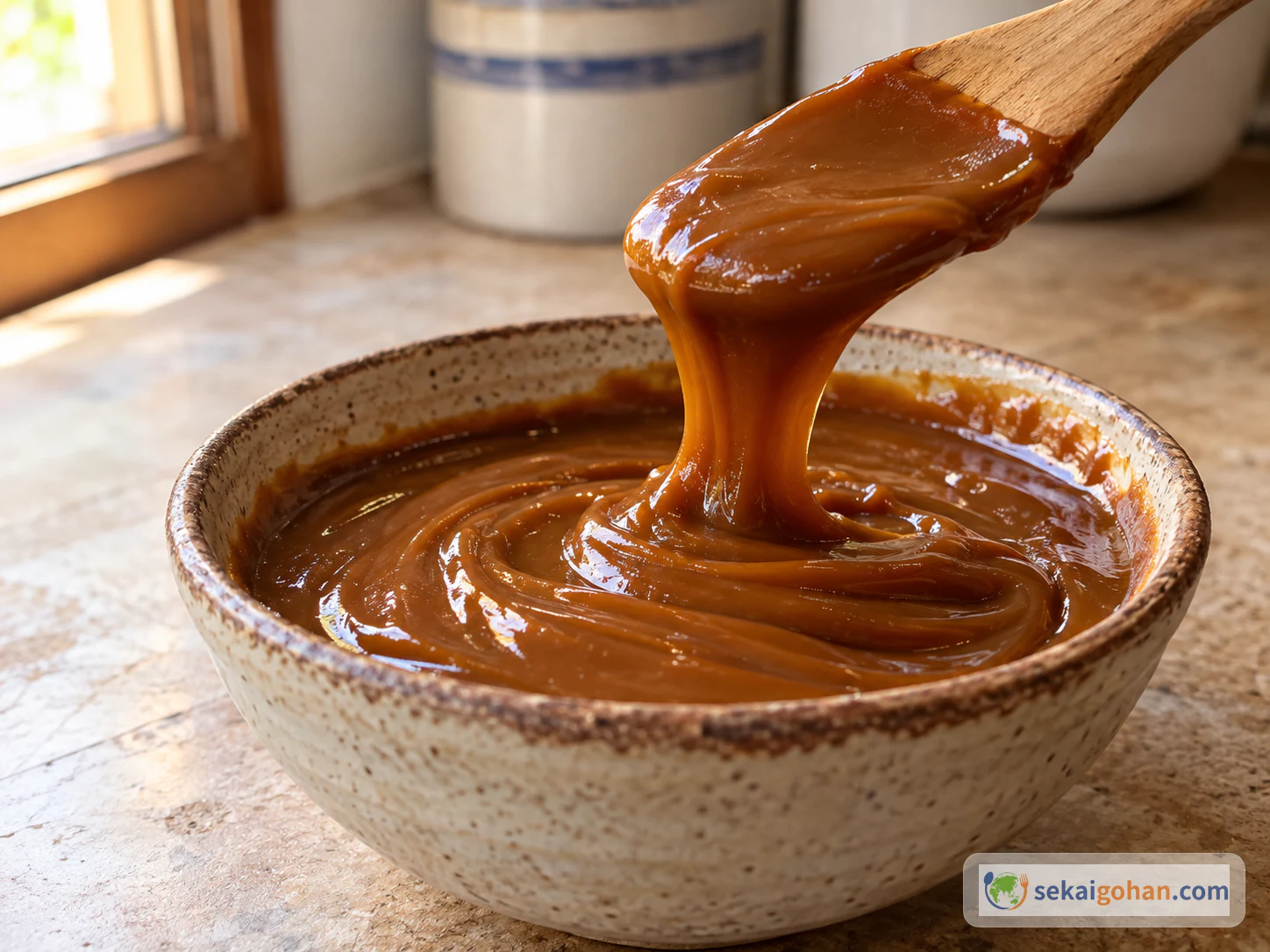
Spooned generously over chicken and scattered with sesame seeds, the sauce is thick and nearly black. The first bite brings the heat of the chiles, then the bittersweet note of chocolate, then the richness of nuts and a layered aroma of spices, with a faint tartness lingering at the end. Sweet, spicy, bitter, sour and savory all at once: that is mole poblano, the signature celebration dish of Puebla in central Mexico. This is a simplified version you can make at home. Traditional versions often use even more ingredients, but this one is built around ingredients that are easy to find.

About mole poblano
"Mole" comes from the Nahuatl word molli, meaning sauce. Several kinds of dried chile, chocolate, nuts, spices, dried fruit and more, over 20 ingredients in all, are cooked and blended into one dense sauce. Legend places its beginnings in a colonial-era convent kitchen, where nuns ground dried chiles, chocolate, almonds, raisins, cumin and cloves on a metate, the traditional grinding stone, working them together over a long time.
Mole for celebrations
In Mexico, mole is a dish for special occasions, served at holidays, weddings, baptisms and festivals. On the Day of the Dead (Día de los Muertos), families place the favorite foods of the departed on home altars, and mole sometimes appears among them. Preparing the ingredients as a family and taking time to work the sauce is part of the pleasure of this dish.
In 2010, "Traditional Mexican cuisine – ancestral, ongoing community culture, the Michoacán paradigm" was inscribed on the Intangible Cultural Heritage list. It was recognized as a food culture built on corn, beans and chiles and carried on by communities from farming and cooking through to rituals at the table. Dishes like mole, made with great effort and together, are part of that culture.

The legend of the Convent of Santa Rosa
The best-known origin story is set in the late 17th century at the Convent of Santa Rosa in Puebla. A nun, flustered by a visit from the archbishop, gathered whatever was in the kitchen, made a sauce, and moved her guest deeply. This is a legend told by later generations, though. Mole most likely took shape gradually as Indigenous food culture met the cooking of colonial Spain.
Chiles, cacao and tomatoes were in use in Mesoamerica long before the Spanish arrived. Cacao was made into drinks, and cacao beans were a precious commodity also used in trade. Almonds, cinnamon, cloves, raisins and more then arrived from Spain and mingled in convent and household kitchens. Colonial Puebla was a city of many convents with flourishing traditions of sweets and cooking, and the craft of making mole was passed down in family kitchens as well.
Moles around Mexico
Mexico has many kinds of mole, and Oaxaca in particular is known as "the land of the seven moles." Mole poblano, from the state of Puebla, is the most famous of them all. Oaxaca's mole negro, or "black mole," uses charred chiles, so it is more bitter and an even deeper black.
Mole rojo, the red mole, is built mainly on ancho and guajillo chiles, with a bright tomato tartness, and it is lighter than mole poblano. Mole verde, the green mole, is made with tomatillos, jalapeños and cilantro and is known for its fresh, lively heat.
Mole travels, too: Mexican communities in the United States make it for celebrations. Born where Indigenous ingredients met ingredients from Europe, it shares a mixed character with Brazilian feijoada (in Japanese) and Peruvian ceviche (in Japanese).

Why chocolate and chiles work together
The heat of the chiles lingers in the mouth as warmth, while the cacao adds bitterness and depth, and the nuts and raisins add sweetness and roundness. Instead of the heat taking the lead, bitterness and sweetness soften its edges, and you end up with a sauce you want to keep eating.
In fact, mole poblano carries all five tastes: heat from the chiles, sweetness from chocolate and raisins, bitterness from cacao and toasted chiles, sourness from tomatoes, and savoriness from nuts and chicken broth. Melted together, they give a depth no single flavor could reach.
Ingredients (serves 4)

Choosing ingredients for mole poblano
Dried chiles are the biggest hurdle; everything else is at an ordinary supermarket. Mexican and Latin American grocery stores usually have the widest range.
| Where to look | What you'll likely find |
|---|---|
| Online | Ancho, pasilla, guajillo and other varieties |
| International grocery stores | Some types, such as ancho |
| Mexican and Latin American grocery stores | A wide range of dried chiles |
Mixing 1 tbsp ground red chile, 2 tbsp paprika, 1 tbsp unsweetened cocoa powder and 1 tsp smoked paprika gives you a flavor close to dried chiles.
Swapping chicken thighs for skinless chicken breast lowers the fat. Keep the full amount of nuts, though; they are essential to the sauce's richness.
Common mole poblano problems and fixes
(1) Don't burn the chiles. (2) Blend everything until completely smooth. (3) Simmer slowly over low heat. Follow these three and you can make excellent mole at home.
If your mole didn't turn dark, check which chiles you used and how much you toasted them. Pasilla chiles are the main source of the dark color, and lightly toasting the chiles deepens it. A little extra bittersweet chocolate also darkens the sauce.
Serving, storing and using mole poblano
Side dishes
| Side | Description |
|---|---|
| Mexican rice | Red rice cooked with tomato. A perfect match for mole |
| Tortillas | Warm corn tortillas for wiping up the sauce. Essential |
| Frijoles | Mashed cooked beans, a staple of the Mexican table |
| Avocado salad | A guacamole-style salad that balances mole's richness |
Sauté 360 ml (about 1 1/2 cups) of rice in oil, then cook it in a rice cooker with 300 ml tomato juice, 100 ml chicken broth and 1 tsp salt. Its red color makes a beautiful contrast with the dark mole. Add 1/4 tsp cumin for an even more Mexican flavor.
Menu ideas
For a Mexican dinner, serve mole poblano with Mexican rice, frijoles and tortillas, and start with ceviche (in Japanese) to make it a full Latin American meal.
For a party, set it out with empanadas (in Japanese), ceviche (in Japanese) and feijoada (in Japanese), a feast that spans the continent. Our introduction to South American cuisine (in Japanese) will help you build a colorful menu.
More ways to use mole
For mole enchiladas, a Mexican home-cooking classic, roll chicken and cheese in tortillas and arrange them in a baking dish. Pour plenty of mole over the top, scatter with cheese and bake at 200°C (400°F) for 15 minutes. Tucking mole inside tamales (steamed corn-dough parcels) is another traditional Mexican use.
For mole tacos, shred chicken simmered in mole sauce and pile it onto warm tortillas, then top with sliced avocado, red onion and cilantro and a squeeze of lime. Mole also makes an unexpected pasta sauce: toss it with cooked fusilli or penne, sprinkle with Parmesan and sesame seeds, and add a splash of cream if you like it mellower. Spread thinly on pizza, it adds a distinctive flavor.
It's delicious over fish, pork or tofu as well, and spooned over grilled vegetables it makes a vegetarian dish.
Storing and reheating
Making mole in large batches and keeping it is a Mexican tradition, and it pays off on busy weeknights.
Store the sauce and the chicken separately. Chicken stored in the sauce loses its texture.
Put the sauce alone in an airtight container, keep it in the refrigerator and eat it within 3 days. Reheat it in a pot over low heat, thinning with water or chicken broth as it warms. In zip-top bags, it freezes for up to 3 months. Mole loses very little flavor in the freezer, and it can taste even better once the flavors have melded.
Nutrition per serving (1 chicken thigh + sauce)
| Nutrient | Amount | Notes |
|---|---|---|
| Energy | 520 kcal | — |
| Protein | 1.25 oz (38 g) | High-quality protein from chicken |
| Fat | 26 g | Includes unsaturated fats from nuts |
| Carbohydrates | 1.25 oz (35 g) | — |
| Dietary fiber | 6 g | From chiles and nuts |
The nuts and sesame make it fairly high in fat, but the plate gives you protein from the chicken along with vegetables in the form of chiles and tomatoes.
Dishes to make next
- Pozole rojo (in Japanese): more cooking from the Mexican table.
- Chile relleno (in Japanese): a whole chile stuffed with cheese, which shows how differently Mexican cooking uses chiles.
- Introduction to South American cuisine (in Japanese): an overview of the whole region's food culture.
- Chimichurri (in Japanese): ingredients and aromas you can carry across the region.
If you like mole poblano, try Peruvian ceviche (in Japanese), Brazilian feijoada (in Japanese) and Argentine empanadas (in Japanese).
Frequently asked questions
Q1. Does a chocolate sauce really go with chicken?
Surprisingly well. The chocolate in mole melds with the chiles and spices and works as part of the savory depth. When you taste it, it comes across as a deep richness, and sweetness never takes the lead.
Q2. Can I adjust the heat?
Remove all the chile seeds and the heat will be fairly mild. Leave out the chipotles for an even milder sauce. For kids, use half the dried chiles and make up the color and flavor with paprika.
Q3. It takes too long to make.
This recipe is already simplified for home cooks. Traditional methods take much longer; this one is done in about 100 minutes. For an even faster route, dissolve store-bought mole paste in hot water or broth.