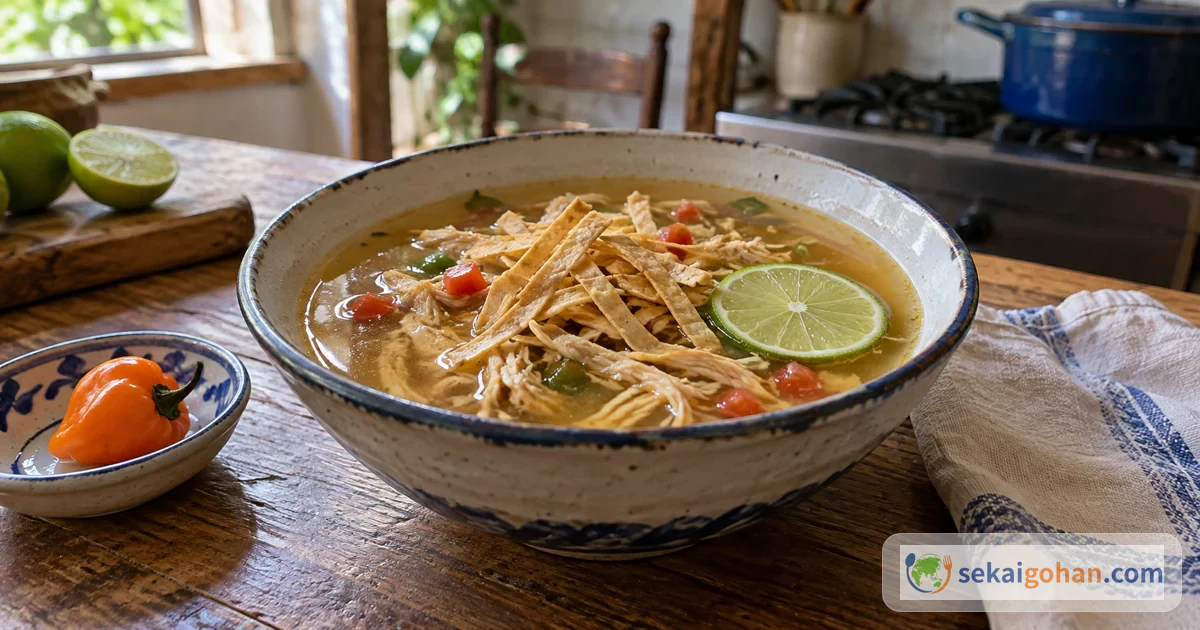
On a cold night, lifting the lid on this pot changes the air in the kitchen: pork broth, the sweet scent of dried chilies, the round smell of corn. Then come the shredded cabbage, radishes, and a squeeze of lime, and the deep red soup suddenly brightens. Pozole rojo is Mexico's big festive pot, a pork soup reddened with dried chilies, but the real star is the corn. Those plump kernels of hominy soak up the broth, while the raw vegetables and lime keep every spoonful light.

What Pozole Rojo Is
The name and the corn
Pozole's name comes from Nahuatl and means "to foam, to swell," which is exactly what cacahuazintle corn does as it cooks: the kernels open like flowers. In English it is sometimes called "hominy stew," and that's a fair hint, because pozole is a corn dish before it is a meat dish. In Mexico, the white, large-kernelled maíz cacahuazintle is treated with limewater to remove the hulls and then simmered until plump. The same starchy corn is used for elote.
The texture nixtamalization makes
Hominy is not simply boiled dried corn. Nixtamalization, the treatment with alkaline limewater, takes off the outer hull, swells the kernels, and gives them their distinctive aroma and chew. Traditionally the treated corn is washed and then also ground into flour and dough. At home the process is hard work: it needs food-grade lime, a long soak, washing, and parboiling. That's why pre-treated canned hominy is the practical choice outside Mexico.
A pot finished at the table
Pozole is both a festive dish around Independence Day and an everyday treat. Every household has its pot, every region its color, and everywhere the bowl is finished with toppings at the table. One person piles on radishes, another squeezes the lime hard, someone adds extra oregano, someone else reaches for hot salsa. The pot is the same, yet each bowl turns out a little different. If churrasco makes an occasion by carving meat, pozole makes one by passing the toppings around.
That is also what sets it apart from mole poblano, a complex sauce of chocolate and chilies. Pozole rojo is closer to home cooking: simmer pork in a big pot, turn rehydrated dried chilies into a red sauce, add the hominy, and let everyone top their own bowl. It suits days when family and friends gather. For something closer to weeknight ingredients, tinga de pollo, chicken simmered with tomato and chipotle, is also easy to make ahead.
Pozole comes as white pozole blanco, red pozole rojo, and green pozole verde. Red is linked to the Jalisco area, and green to Guerrero.
Ingredients (serves 4)
This amount is for home cooking in a deep pot. If you want to eat it again the next day, you can increase the meat and hominy by 1.5 times. But cut the finishing vegetables just before eating.

This dish contains pork. Check the labels: some canned hominy and tostadas contain wheat, milk, or soy. Cook the pork thoroughly to the center, and do not leave the finished soup at room temperature for long.
The things that most often trip people up on a first pozole are the hominy and the dried chilies. Neither is easy to come across in everyday shopping, so securing them online before you cook keeps you from scrambling in the kitchen. The pork, cabbage, radishes, and onion can be bought at a nearby supermarket. What is worth looking for online is the hominy that decides the texture of the kernels, the paprika and dried chilies that form the base of the red sauce, and the oregano that gives the aroma at the finish.
Without dried chilies, paprika with a little heat still gives you a red soup. If you cook Mexican food often, add guajillo, ancho, and oregano in that order.
Cumin supplements the earthy aroma of the chile sauce a little. Since you use only 1 tsp, choosing a size that can also go into home curries or locro makes it easier not to have leftovers.
Even a small amount of finishing oregano brings aroma. Besides pozole, it can go to chimichurri, ropa vieja, and empanadas.
Choosing Ingredients for Pozole Rojo
The ingredient list looks daunting, but pozole rojo has only four core parts: hominy, a pork broth, dried chilies, and fresh vegetables to finish. Get those four right and you come very close to the original. Of the four, choose the hominy most carefully. It does more for the outline of the dish than adding extra meat.

| Core of the dish | Ingredient in Mexico | Realistic option elsewhere | Substitution caution |
|---|---|---|---|
| Corn | Cacahuazintle, nixtamalized | Canned hominy, dried hominy | Canned sweet corn is sweet and small, so it becomes a different dish |
| Meat | Pork shoulder, trotters, head, bone-in cuts | Pork shoulder, spare ribs, a little pork belly | You need the broth from bones and lean meat, not just fat |
| Red sauce | Guajillo, ancho, chile de árbol | Imported dried chilies; if unavailable, paprika plus a little chili flakes | Paprika alone has a weak aroma |
| Aroma | Mexican oregano | Dried oregano | Mediterranean oregano also works; use sparingly |
| Finish | Lettuce, radishes, onion, lime | Cabbage, thinly sliced daikon, onion, lemon | Keep the raw crunch and acidity |
The kernels in pozole are not sweet corn but large corn with the hulls removed by limewater treatment. Made with canned sweet corn, sweetness comes forward and the texture is small. If you really cannot get hominy, it is more honest to make a "red bean soup" with white beans or chickpeas and enjoy it as something separate from pozole.
The red of pozole rojo is not a fiery red. Guajillo and ancho give aroma, color, and fruitiness rather than heat: guajillo brings the color and a light sourness, ancho a raisin-like sweetness. Chili flakes on their own give you a red soup that is thin and just hot, while rehydrating dried chilies and lightly waking them up in oil gives it roundness. Neither chili is common at ordinary supermarkets, so an import grocer or online shop is the quickest route; if you can't find them, a paprika-based mix will stand in (see the FAQ).
Method: Keep the Meat Broth, the Red Sauce, and the Hominy Separate
Pozole is three stages: "simmer the meat until tender," "make the red sauce," and "bring in the hominy." If you put everything in the pot from the start as for a curry, the aroma of the chilies blurs and the hominy breaks down easily.
If the family is eating, keep the pot mild. Take the red color from the guajillo and ancho, and add heat at the table with chile de árbol, chili oil, or salsa; this is less likely to fail. If you make the whole pot hot, children and people who dislike heat have nowhere to go.
Pozole Rojo Failures and Fixes
When pozole rojo goes wrong, it's usually one of four things: it tastes bitter, it turns into sweet corn soup, the meat is tough, or the finish is heavy. Most of these trace back to the chilies and the kernels.

Don't burn the chilies
Dried chilies don't get better the longer you fry them; warm them lightly in a skillet and stop. Once black scorch appears, rehydrating won't remove the bitterness, and a scorched chile sauce makes the whole pot heavy no matter how much meat and hominy you add.
Taste the soaking liquid first
The chili soaking liquid carries aroma but can be bitter. If it tastes strongly bitter, use only half of it and replace the rest with water.
Add the hominy late
Canned hominy is already cooked. Simmer it as long as the meat and the kernels open too far and their surface breaks down; around 30 minutes of soaking up the soup is enough. If you use dried hominy, soften it in a separate pot first and then add it to the meat, so the two finish cooking together.
Prepare the finishing vegetables as part of the dish
The soup is deep red, yet the finished bowl isn't heavy, because the flavor gets adjusted at the table with raw vegetables, lime, oregano, and tostadas. Leave out the cabbage and radishes and it drifts toward plain meat soup. They do the job condiments do for a hot pot.
It is more like pozole to leave bite-size chunks of pork than to shred it fully into fibers. Unlike shredded-meat dishes such as ropa vieja, in pozole you eat the kernels of hominy and the pieces of meat together.
Serving, Storing, and Varying Pozole Rojo
Pozole looks finished in the pot, but it's really finished in the bowl. Ladle the hot soup, top it with cold vegetables, squeeze the lime, and in those last 30 seconds the whole weight of the flavor changes.

A topping bar at the table
Set out cabbage, radishes, onion, cilantro, lime, and oregano in separate dishes, with chile de árbol salsa or chili flakes on another plate for those who like heat. With just that, one pot becomes an adult version, a kid version, an extra-sour bowl, and an extra-vegetable bowl.

What to serve with it
Pozole makes a meal on its own, but for a light starter, a sour fish dish like ceviche or a corn-based staple such as arepas works well. Compared with mole poblano, pozole is better suited to a big pot and easier to dish out for guests. Other big-pot dishes of Latin America pair naturally with it too: feijoada of beans and pork, pastel de choclo with its sweet corn, and the wrapped salteña.
Storage and leftovers
The soup keeps 2–3 days in the refrigerator and 2 weeks in the freezer; to freeze, let it cool a little and pack it one serving per container. Don't store the cabbage, radishes, onion, and lime. Cut them fresh just before eating. The hominy absorbs liquid as it sits, so when reheating add 100 ml–¾ cup (200 ml) water or chicken stock and warm it slowly over low heat.
Next day, pozole simmered down a little and poured over rice is delicious, though not traditional in Mexico. Shred the meat and mash the hominy a bit and it turns into something like a red chile rice porridge. Crumble any leftover tostadas on top and squeeze on lime to keep it from feeling heavy.
Pozole blanco

Pozole blanco skips the chile sauce and lets the broth of pork and hominy speak for itself. Chile sauce, lime, and oregano go on at the table, so it's easy for a family to divide up the heat. If you want to learn the taste of hominy first, white is a good place to start.
Pozole verde

In some regions, pozole is finished green with tomatillos, green chilies, epazote, and pumpkin seeds. Tomatillos are hard to find in many places, so look for green tomatoes or canned green tomatoes instead. On a weeknight, red is easier to pull together.
Chicken and vegetable versions
If pork feels heavy, chicken thighs and drumettes work well (see the FAQ). The red sauce and hominy stay the same, but with less pork fat, a little olive oil at the finish makes it feel more cohesive in the mouth. A vegetable-heavy pozole with mushrooms, zucchini, and beans isn't traditional, but it's easy at home. Without meat broth, fry the garlic, onion, and dried chilies carefully and let the hominy's aroma lead. Keep the hominy, even when you go meatless, and it stays true to the name.
Which pozole to start with
| Direction you want | Suitable pozole | Difficulty | A start that is hard to fail |
|---|---|---|---|
| Authentic Mexican look and aroma | Pozole rojo | Getting dried guajillo and ancho | Secure canned hominy and dried chilies online first |
| Dividing the heat among the family | Pozole blanco | The weak broth tends to stand out | Add spare ribs and serve red salsa at the table |
| Stronger vegetable and herb aroma | Pozole verde | Tomatillos are hard to get | Try canned green tomatoes or bottled salsa verde |
| Lighter for a weeknight dinner | Chicken version | Not as rich as pork | Use drumettes and take broth from the bones |
A realistic order is red the first time, white on days when you want fewer ingredients, and green once you can get tomatillos or green chilies. Succeed with one red pot first, and the others come easily.
FAQ

Q1. What can I use if I don't have canned hominy?
To make it as pozole, canned or dried hominy is the top priority; canned sweet corn is sweet and small-kernelled, with a different texture. If you have none, make a red soup with white beans or chickpeas and call it "pozole-style."
Q2. I can't get dried guajillo.
For a first try, substitute 1 tbsp smoked paprika, 1 tbsp ordinary paprika, 1/4 tsp chili flakes, and 1 tsp cumin. You'll miss the light sourness of guajillo and the sweetness of ancho, so next time pick up dried chilies from an import grocer or online.
Q3. Can I make it without heat?
Yes. Leave out the chile de árbol and get the red color from guajillo and ancho alone; carefully removing the seeds and white veins keeps the heat well down. Let the adults add hot salsa at the table.
Q4. Can I make it with chicken instead of pork?
Yes. Use 1.25 lb (600 g) chicken thighs and 6 drumettes, and simmer for around 60 minutes. The broth won't be as rich as with pork shoulder, but it makes a light pozole, and a little more lime and oregano at the finish tightens the flavor.