As noon approaches at Peru's seaside eateries, the sound of squeezing limes and the smell of red onion spill out of the kitchen. What comes out is ceviche: raw white fish tossed with lime, chili and onion, sitting in a cloudy, tangy pool of its own juices. It is Peru's signature dish, from a coast where people have eaten seafood with acid since ancient times. In Lima today it is mixed moments before it reaches the table, so the fish stays fresh and tender under the bright sour heat.

Peruvian Ceviche and Its Story
Tiger's milk

What sets ceviche apart from other dishes is "leche de tigre," commonly called tiger's milk. As the fish marinates, its protein reacts with the citric acid of the lime and denatures, and the juices turn milky white.
That cloudy liquid is a dressing in which the savor of the fish, the acidity of the lime, the heat of chili and the aroma of herbs are concentrated. Many Peruvians swear it helps with a hangover, and it is sometimes drunk from a small glass. High-end Peruvian restaurants even serve it on its own as an appetizer.
Styles of ceviche
Ceviche travels well, and every country along the Pacific coast has its own take.
| Style | Features | State of the fish |
|---|---|---|
| Peruvian (classic) | The most orthodox. White fish only. Defined by tiger's milk | Raw, short marinade (10–15 minutes) |
| Nikkei (Japanese-Peruvian fusion) | Uses soy sauce, sesame oil and ginger. Japanese precision | Raw, very short marinade (5 minutes or less) |
| Ecuadorian | Uses tomato, peanuts and shrimp | Cooked shrimp |
| Mexican | Includes avocado, tomato and olives. Street-food feel | Mostly raw shrimp |
| Tiradito | Close to Peruvian sashimi. Almost no marinade | Nearly raw |
Ancient roots and Spanish limes
People on the Pacific coast of South America ate seafood with local sour juices and salt long before Europeans arrived. Seafood was an important food as far back as the Moche (around the 1st to 8th centuries), who flourished on Peru's northern coast, though how they seasoned it is still debated.
The present form of ceviche took shape in the 16th century, when the Spanish conquest brought limes and onions to Peru. The seafood and chilies of the Americas met the citrus and onions of the Old World, and that combination is still the backbone of the dish.
Japanese-Peruvian cooks and the short marinade
Japanese immigration to Peru began from the end of the 19th century into the early 20th, and Japanese-Peruvian eateries multiplied in Lima. Ceviche used to be fish steeped in lime for several hours. In the latter half of the 20th century, partly through the influence of Japanese-Peruvian cooks raised on sashimi, the habit of tossing it briefly just before eating spread across Lima.
The cooking that grew out of this meeting of Japanese and Peruvian food is called Nikkei cuisine, and ceviche with soy sauce and ginger is one of the dishes that brought it to the world's attention. The Nikkei style is now an important part of Peruvian cooking, in restaurants at home and abroad. The short marinade rules in Lima, while the northern coast makes spicier versions.

National heritage and the Day of Ceviche
In 2004 the Peruvian government formally declared ceviche "National Heritage of Peru." In 2023, "the practices and meanings associated with the preparation and consumption of ceviche" were inscribed on UNESCO's Intangible Cultural Heritage list. Every June 28 the country celebrates the Day of Ceviche (Día del Ceviche), with festivals across Peru where cooks compete to show off their skills.
Ingredients (serves 2)

Choosing Fish and Ingredients for Ceviche
Safe fish
The most important decision in ceviche is the fish. Lime acid denatures protein but does not kill parasites, so a longer soak in lime will not make questionable fish safe. Treat it exactly as you would sashimi.
To guard against parasites such as Anisakis, fish must be frozen at -20°C for at least 24 hours, which a home freezer or ordinary frozen fish can't be relied on to do. Buy fish labeled for raw consumption (sushi or sashimi grade) and handle it as the label says.
| Fish | Character | Suitability for ceviche |
|---|---|---|
| Flounder (sashimi grade) | Mild white fish. Firm bite | Excellent |
| Sea bass (sashimi grade) | Refined savor. Fine fibers | Excellent |
| Tuna (lean or medium fatty) | Open-ocean fish with low parasite risk | Good |
| Farmed salmon (sashimi grade) | Farmed, so low parasite risk | Good |
| Sea bream (sashimi grade) | The easiest to find in many markets | Good |
River fish (trout, sweetfish and the like) carry a high parasite risk and must never be used for ceviche. Fish of the cod family also carry a high parasite risk.
Where to buy the rest
| Ingredient | Where to buy |
|---|---|
| Limes | Supermarket citrus section, or a specialty grocer |
| Cilantro | Supermarket herb section |
| White fish (sashimi grade) | Fish counter (flounder, sea bream, sea bass fillets for sashimi) |
| Aji amarillo | Latin American and Peruvian food shops, or Asian grocers. If you can't get it, substitute dried red chili plus red bell pepper |
Stand-ins for aji amarillo
Aji amarillo, the yellow chili at the heart of Peruvian ceviche, is both sweet and hot. If you can't find it, try one of these:
- 1 habanero (seeds removed) + 2 red bell peppers, blended to a paste
- Or 1 dried red chili + 1/4 yellow bell pepper
Neither is an exact match, but both get close to that sweet-hot balance.
Method
STEP 1: Prepare the fish (15 min)
Cut the sashimi-grade white fish into 1.5–2 cm cubes. If you cut them too small they lose their texture once the lime firms them, so cut pieces large enough that you feel the thickness of the fish in one bite. Blot the surface of the cut fish well with paper towels. Leftover moisture dilutes the tiger's milk and blurs the flavor. Put it in a large bowl and keep it chilled in the refrigerator while you prepare the other ingredients.

STEP 2: Prepare the onion (10 min)
Slice the red onion with the grain into slices 0.125 inch (2 mm) thick or less. Sprinkle with a little salt and leave 5 minutes to draw out the pungency and make the fibers slightly supple. Wash the salt and pungency off thoroughly in cold water and pat dry with paper towels. If water is left here, the surface of the fish will turn watery at the finish, so bring the onion to a state that is crisp but not wet.

STEP 3: Make the tiger's milk (5 min)
Squeeze about 8–10 limes to get ½ cup (120 ml) of lime juice. Cut fish trimmings, about 10 percent of the total, into 0.5–1 inches (1–2 cm) pieces and put them in a blender with the lime juice, grated ginger, 1 clove of garlic and a little salt, and run it for about 1 minute. When the liquid turns cloudy white and the savor of the fish and the acidity of the citrus become one smooth liquid, strain through a fine sieve. Pushing too hard on the fibers left in the sieve makes it gritty, so press only lightly.

If you don't have a blender, soaking fish trimmings in the lime juice for 10 minutes and just squeezing them out is enough. You can't strain it completely, but the flavor of ceviche comes through.
STEP 4: Marinate (10–15 min)
Put the chilled fish in a large bowl and pour the tiger's milk over all of it. Add the salt and chili cut 0.125 inch (2–3 mm) wide, and fold gently from the bottom so the edges of the fish do not break. The ideal is that the surface turns whitish while some translucency remains in the center. Marinate in the refrigerator for only 10 to 15 minutes, and do not leave it longer. Steeping too long firms the fish too much and loses its sashimi-like juiciness.

This is important: 10 to 15 minutes is the ideal marinating time. Beyond this the fish is over-"cooked" and turns dry. Freshness is life.
STEP 5: Finish and plate
Add the drained onion to the marinated fish and mix in cilantro chopped 0.25 inch (5 mm) wide. So as not to break the fish, it is enough to turn it over from the bottom with a spoon in big motions. Plate the fish, set sweet potato and corn alongside, and spoon a little of the remaining tiger's milk over the top. Finally garnish with cilantro leaves and serve with a lime if you like. If the acidity is too strong, eating the sweet potato with it rounds off the flavor.

How to Make Nikkei (Japanese-Peruvian Fusion) Ceviche
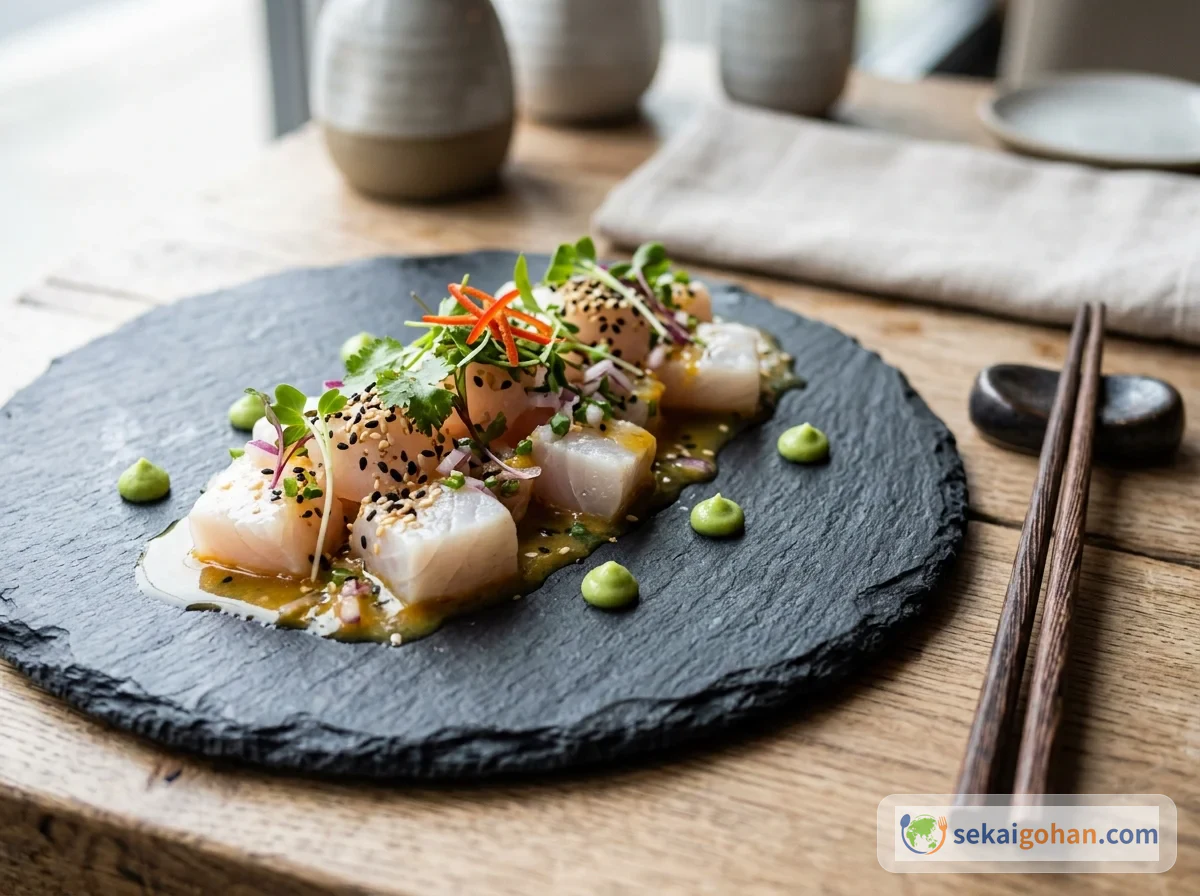
Here is also the modern style influenced by Japanese immigrants.
Additional ingredients
| Ingredient | Amount |
|---|---|
| Soy sauce | 1 tsp |
| Sesame oil | 1/2 tsp |
| Ginger (grated) | 1 tsp |
| Sesame seeds | a little |
Changes to the method:
- Add soy sauce and sesame oil to the tiger's milk
- Shorten the marinade to 5 minutes or less (to keep the raw freshness at its best)
- Scatter sesame seeds to finish
- Serve with herbs and aromatics (shiso, thin scallions) in the Japanese manner
Common Ceviche Failures and Fixes
Failure 1: The fish turns dry
Cause: The marinade went too long (over 30 minutes).
Remedy: Set a timer and eat within 15 minutes. Plate it quickly and finish it at the table.
Failure 2: Too acidic
Cause: Too much lime, or too long a marinade.
Remedy: Serve extra sweet potato; its sweetness softens the acid. Next time, use a little less lime and shorten the marinade.
Failure 3: Watery
Cause: The fish wasn't blotted, or the onion held too much water.
Remedy: Blot the fish carefully with paper towels. Rinse the onion well after salting and squeeze it hard with both hands.
Failure 4: Weak flavor
Cause: The tiger's milk was left out, or there was too little ginger or garlic.
Remedy: Keep the tiger's milk. More ginger and a little garlic add depth.
Serving Ceviche and Variations
Ceviche wants its accompaniments: sweet potato and corn balance the acidity and round out the plate. Serve it as soon as it's mixed, while the fish is still fresh and firm.

Salmon ceviche (for beginners)
An easy starter version with tuna or salmon, all from the supermarket. Ordinary onion can stand in for the red onion, and seven-spice chili blend for the chili. With sashimi salmon, you can make it right away.
Shrimp ceviche (Ecuadorian style)
Toss boiled shrimp, chopped tomato, onion and cilantro with lime juice and salt. It's a good choice for anyone allergic to raw fish, and a splash of tomato juice makes it Ecuadorian style.
Octopus ceviche
Slice boiled octopus thin and marinate it in lime. Tender octopus and lime go beautifully together, a pairing that points toward Spain's escabeche.
Tofu ceviche (vegetarian)
Marinate silken tofu in lime juice and salt, then combine it with avocado, tomato and onion. Plenty of cilantro adds savor. Like hummus, it puts plant-based ingredients at the center.
Ceviche mixto (seafood mix)
A luxurious mix of shrimp, octopus and scallops, each with its own texture, that's made for a party. Finish it with avocado for a contemporary Lima touch.
For more dishes born where cultures meet, try banh mi (Vietnam) and kebab (Turkey), or the Middle Eastern staple hummus.
Frequently Asked Questions
Can I substitute lemon if I have no lime?
Yes, though the aroma and acidity will change, so use lime if you can get it. Mixing in a little shikuwasa or sudachi, small Asian citrus fruits, brings the aroma closer to lime.
Can I make it ahead?
No. Ceviche is best right after it's made, and after several hours the fish is over-marinated and loses its texture. Prep the ingredients beforehand and start the marinade 15 to 20 minutes before eating.
How can I reduce the heat for children?
Omit the chili and use only yellow bell pepper; you keep the color and flavor with zero heat. Extra sweet potato on the side also makes it easier for children to eat.
What do I do with leftover tiger's milk?
Use it as a soup or a dressing. It keeps 1 day in the refrigerator or 1 month frozen. In Peru some people drink it the next morning for breakfast as a "leche de tigre soup."