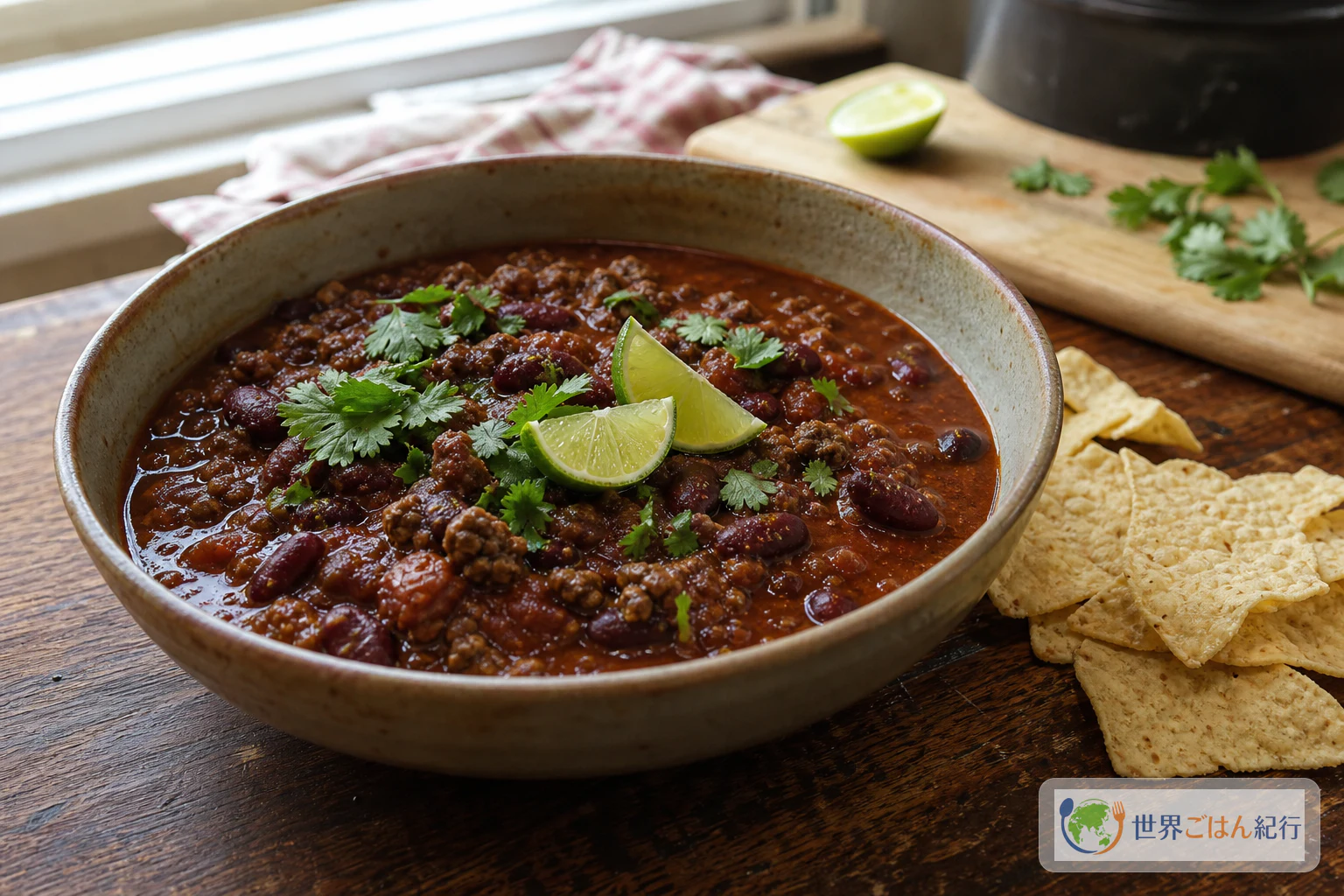
Slide the pot lid aside a little and the sweet smell of red beans rises, mixed with onion, celery, bell pepper and the savor of smoked sausage. This is red beans and rice, Louisiana's bean-and-rice dish, eaten especially in and around New Orleans. Some of the beans are mashed right in the pot until they turn into a creamy sauce, rich with smoke and aromatics, and that sauce is ladled over plain white rice.
Red beans and rice in New Orleans
The name suggests beans mixed into cooked rice, but on the local plate the two are served separately. The rice stays white and distinct, and the beans go on top. Keep them apart, and your plate is closer to what you'd get at a New Orleans diner than to a home pot of simmered beans.
In old New Orleans households, the ham bone and leftover meat from Sunday went into the bean pot and simmered low on Monday, which was wash day and busy. It is still a Monday standard, rooted in the rhythm of city life rather than in showy party food.
A Monday dish
Nobody stands over the pot. It gives off its aroma from a corner of the kitchen while the laundry and chores get done, and the beans soften slowly on their own. The habit carried over into restaurants, where red beans and rice is still served on Mondays as "a plate to start the week." If you want that rhythm at home, soak the beans on Sunday afternoon and finish them for Monday dinner or lunch boxes rather than rushing it all on Monday.
Roots and local variations
New Orleans is a port city where several things overlapped: the bean-and-rice habits of people from the French-speaking Caribbean, a household knack for cooking with smoked meat, and the culture of city diners. People eat beans and rice together all over the world, but here smoked meat, onion, celery, bell pepper, chili and herbs build the aroma in layers, and the rice stays white so it can take the sauce. Treat the bean pot as one rich sauce and you'll be much closer to the dish than if you simmer the beans mildly and stir them into rice.
Every household's pot smells a little different. Around New Orleans, some cooks use andouille, some get their saltiness from ham hock or bacon, and some leave the final heat to hot sauce at the table. The core stays the same: cook the beans until soft and keep them separate from the rice.
How it differs from similar dishes
Among Louisiana rice dishes, jambalaya cooks the rice in the pot, and gumbo pours a dark roux-based soup over rice. Further afield, Jamaican rice and peas cooks rice with coconut milk, and Ghanaian waakye transfers the color of the beans to the rice. Red beans and rice keeps the bean pot and the white rice apart to the end: beans rich, rice white.
Ingredients (serves 4)

Ingredients that are hard to choose
The meat is the first thing to get right in red beans and rice, more than the beans. Around New Orleans, many recipes use smoked or cured pork such as andouille, ham hock and pickled pork. Gathering those every time is hard, so build the aroma with thick smoked sausage and bacon, and make up the missing smokiness with smoked paprika. At the sausage counter, choose one with a large cross-section that can take a sear, not thin cocktail sausages.
Beans can be dried or canned, but the results differ. Dried beans need soaking, but they slowly break down in the pot and give a thickness that clings to rice without any flour or roux. Canned beans suit weeknights. Because they are already soft, shorten the simmer and mash fewer at the end so the skins don't fall apart.
When choosing meat, look first at the smoky aroma rather than the heat. Many sausages are sweet and mildly smoked, so sear the cut faces before putting them in the pot and transfer the fat to the vegetables. If you start simmering without browning, the sweetness of the beans comes through but the depth characteristic of Louisiana cooking is weak. If you use bacon, too much fat makes the result heavy, so if more than 2 tbsp of fat remains on the bottom of the pot after frying, blot some with paper towels. Smoke aroma yes, greasiness no: that is the difference between success and failure with ordinary ingredients.
| Shopping decision | Best use | Watch out |
|---|---|---|
| Dried red kidney beans | Soaking on the weekend for a firmly thick bean sauce | Soak 8 hours. Old beans take longer to soften |
| Canned red kidney beans | Weeknight dinner, a first trial, small batches for lunch | Reduce the liquid and don't mash too much |
| Thick smoked sausage | When you want meat aroma quickly | If very salty, leave the salt for last |
| Bacon | To build the base of the pot in place of ham hock | If fatty, blot a little oil after frying |
| Smoked paprika | When the smoked meat is weak | Too much tilts toward barbecue flavor, so start with 1 tsp |

If you can't find them nearby, get the red beans, smoked paprika and strongly aromatic oregano first, and the rest falls into place. Rice, onion, celery, bell pepper and sausage are easy to find on any regular shopping trip. Only three items are worth tracking down: red beans, which are not always in stock; herbs that shift the flavor with small amounts; and spices that supply the smokiness.
Choosing ingredients for red beans and rice
Dried beans take time, but the starch from the beans that break down gives the pot a natural thickness. Canned beans can be made after work, though they're already soft, so stirring hard makes the pot heavy fast. Either way, cook the rice separately.
| Question | Closer to local | Easier option elsewhere | Reason |
|---|---|---|---|
| Beans | Dried red beans | Dried or canned red kidney beans | Dried gives thickness easily. Canned saves time |
| Meat | Andouille, ham hock | Smoked sausage, bacon | Smokiness and saltiness can be supplied separately |
| Aromatics | Onion, celery, bell pepper | Onion, celery, green bell pepper | The pepper is slightly bitter, so sauté until sweet |
| Rice | Long-grain rice | Jasmine, basmati, short-grain rice | Long-grain doesn't get heavy with the bean sauce |
| Heat | Add hot sauce at the table | Hot sauce per plate | A milder pot is easier to eat |
| Smoke aroma | From the meat | 1 tsp smoked paprika | Many commercial sausages have weak smoke aroma |
Method
This is the dried-bean version. If using canned beans, skip the soak in step 1 and shorten the simmering in step 4 to 30 minutes. Don't add too much water at once; keeping the beans moving slowly in the pot makes it easier to build thickness at the end.
Dried red kidney beans can cause food poisoning if they are undercooked. Discard the soaking water, bring the beans to a firm boil over medium-high heat, and then cook until tender.
Common failures with red beans and rice

| State | Cause | Fix |
|---|---|---|
| Beans are hard | Not soaked enough, old beans, heat too low | Add ½ cup (100 ml) water, set the lid ajar and simmer 20 minutes more |
| Watery | Beans not mashed, not reduced enough | Mash a third of the beans and reduce over low heat for 10 minutes |
| Too salty | Salted without accounting for the sausage and bacon | Dilute with 3.5 tbsp–½ cup (50–100 ml) water and unsalted beans or rice |
| Rice is heavy | Mixed the rice with the beans in the pot | Combine on the plate next time. Store leftover beans and rice separately |
| Flat aroma | Weak smoked meat aroma | Sear the sausage and add 1 tsp smoked paprika |
A pot of beans changes quickly in the last 15 minutes. Don't stop at a thin soup. Mash the beans until a trail stays on the side of the pot, and you get the thickness that clings to rice.
Variations, storage and serving
Weeknight version with canned beans
An 8-hour soak doesn't fit a weekday evening, so here's how to make it with canned beans. Drain 2 cans of red kidney beans and rinse them lightly. The aromatics, sausage, bacon and spices stay the same as in the main recipe; what changes is the liquid and the heat.
Start with 2½ cups (600 ml) of water or stock instead of the full amount. Simmer for 30 minutes over low heat in step 4, keeping small bubbles rising on the surface, and don't stir hard at first. In step 5, mash only a quarter of the beans with a wooden spatula and reduce for 10 minutes. It's ready when the spatula leaves a trail on the pot side for about 1 second; chase the full thickness of the dried version and the skins fall apart, making the beans feel heavy.
Canned beans vary in saltiness, so add only 1 tsp salt at first, then 1/4 tsp at a time at the end. If the smoke aroma is weak, add another 1/4 tsp smoked paprika, and leave the heat to hot sauce on the plate.
The real trick is to build flavor before the beans go in. If you rush the onion, celery and pepper while they're still half-translucent, the canned "boiled bean" taste comes forward. Cook them about 8 minutes, until a thin sweet aroma rises from the bottom of the pot, and even a short simmer will taste like one dish rather than warmed beans. On days you cook after work, slice the sausage into rounds and refrigerate it ahead of time. That helps more than chopping vegetables in the morning.
Storage and reheating

Beans keep about 3 days in the refrigerator and 3 weeks in the freezer. Rice hardens in the refrigerator, so it's easier to freeze in single portions. To reheat, add 1 tbsp water to 5.5 oz (150 g) beans, microwave at 600 W for 2 minutes, stir, and heat another 30 seconds if needed. In a pot, use low heat and add a little water if it threatens to scorch.
Always store beans and rice separately; mixed, the rice soaks up all the liquid and turns heavy, like cold porridge. The next day, reheat the beans a little thicker and pour them over freshly cooked rice, and you'll find the aroma has come together better than on the first day. For a lunch box, heat the beans well, pack them in their own container, and pour them over the rice just before eating to keep the grains distinct.
What to serve with it
Coleslaw, boiled greens, cornbread and a light salad all go well. Beans and rice are filling, so reach for acidity or green vegetables rather than another meat dish. Small dishes of pickles and hot sauce let everyone adjust their own plate from the same pot.
If you want to cook more of Louisiana, dirty rice, which coats rice in the savor of meat and liver, has a similar kitchen feel. Shrimp Creole brings the same New Orleans aroma with a tomato and shrimp sauce, and gumbo, thickened with roux and okra, shows how differently thickness can be built over the same rice. For other American home cooking, try Michigan pasties, which spread from mining town lunches, or spaghetti and meatballs from the red-sauce culture of immigrant households. And for more bean-and-rice combinations, Nigerian jollof rice and Trinidadian pelau are enjoyable too.
FAQ
Can I make it with short-grain rice?
Yes. Short-grain rice absorbs the bean sauce easily and tends to get heavy on the plate, so cook it a little firm and pour the beans over just before serving. Long-grain rice keeps the grains distinct and is closer to the local texture.
Can I make it without sausage?
You can, but the aroma changes a lot. Use 2.75 oz (80 g) bacon and 1 1/2 tsp smoked paprika to bring back the smokiness. For a completely meatless version, increase the oil to 2 tbsp and brown 3.5 oz (100 g) mushrooms to add savor.
Is it spicy?
The pot is not strongly spicy. Starting with 1/4 tsp cayenne and adding hot sauce at the table is the safest approach. If children or people who dislike heat are eating, leave out the cayenne and let each plate be adjusted.
How much can I prepare the day before?
You can soak the beans, chop the vegetables and cut the sausage, or even finish the simmering; reheating over low heat the next day lets the flavors meld. Only the rice is better cooked just before eating, or reheated from frozen, to keep its texture.