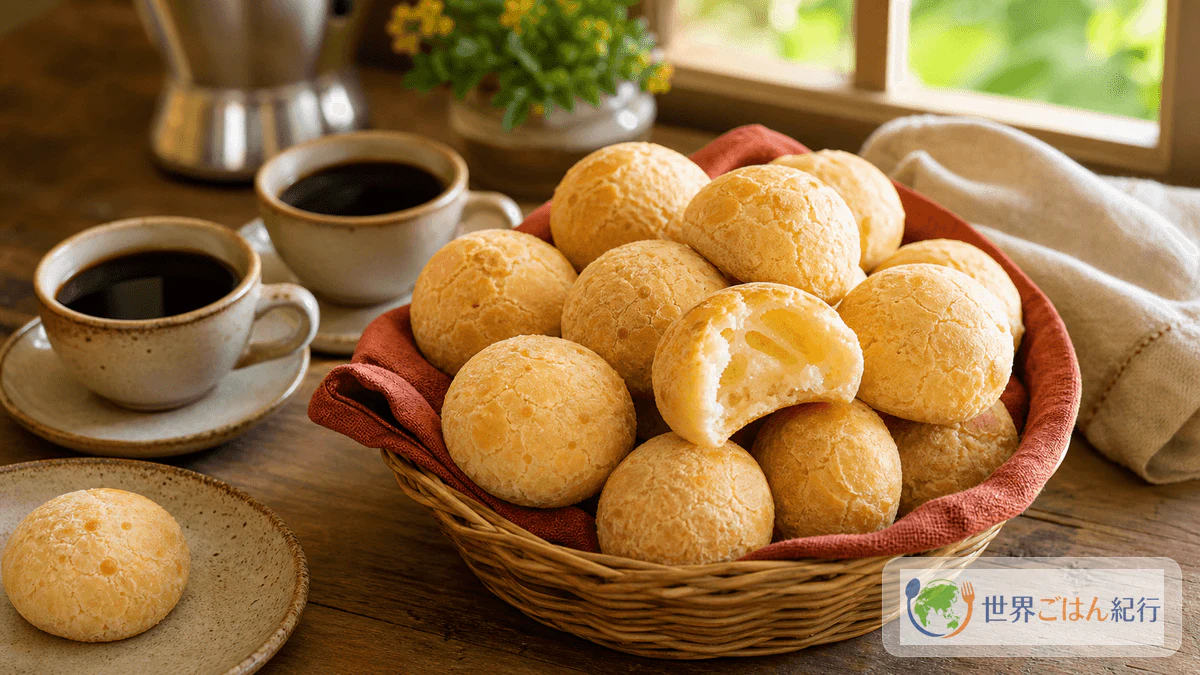
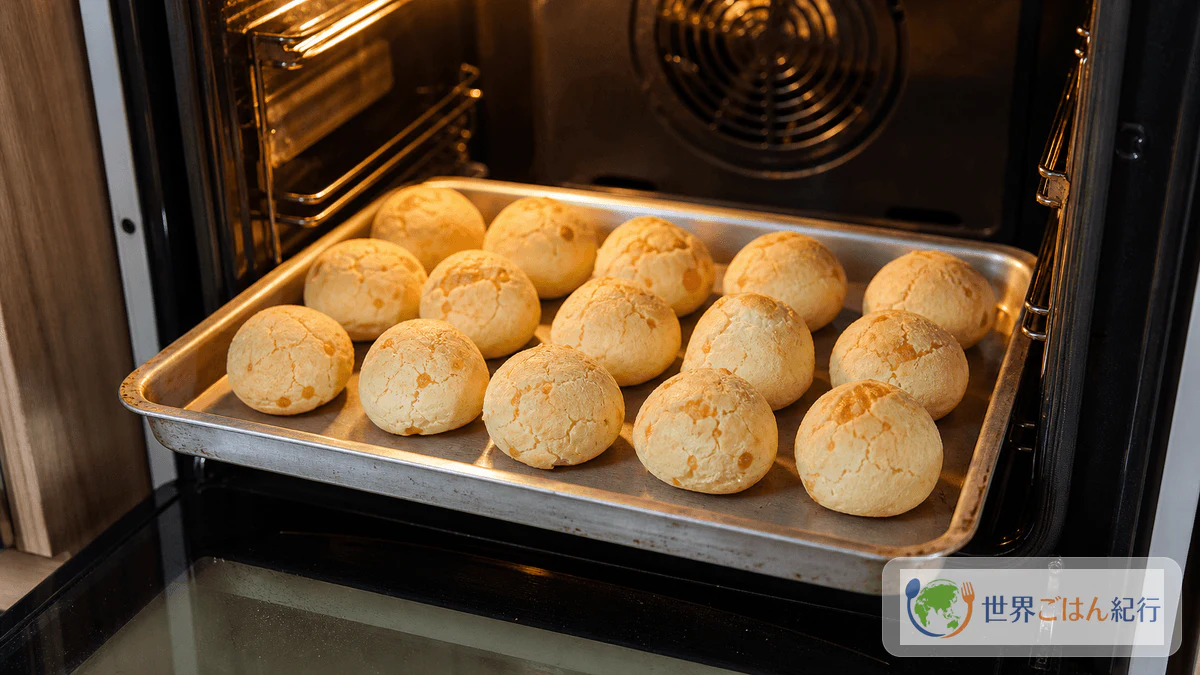
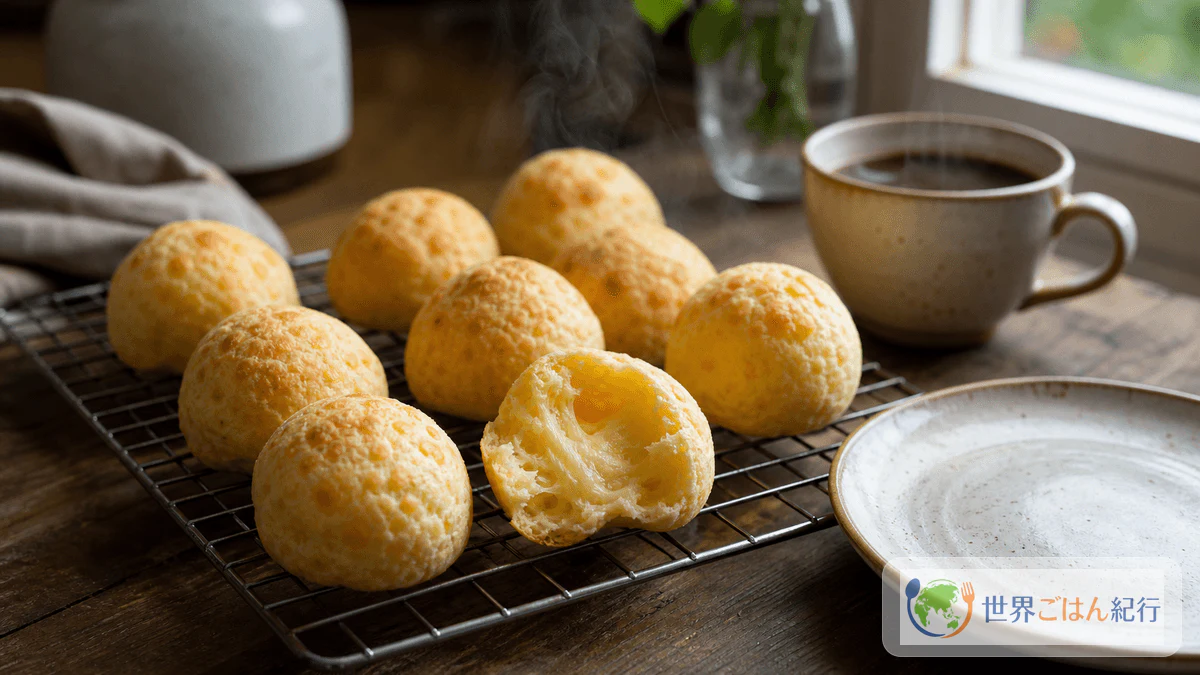
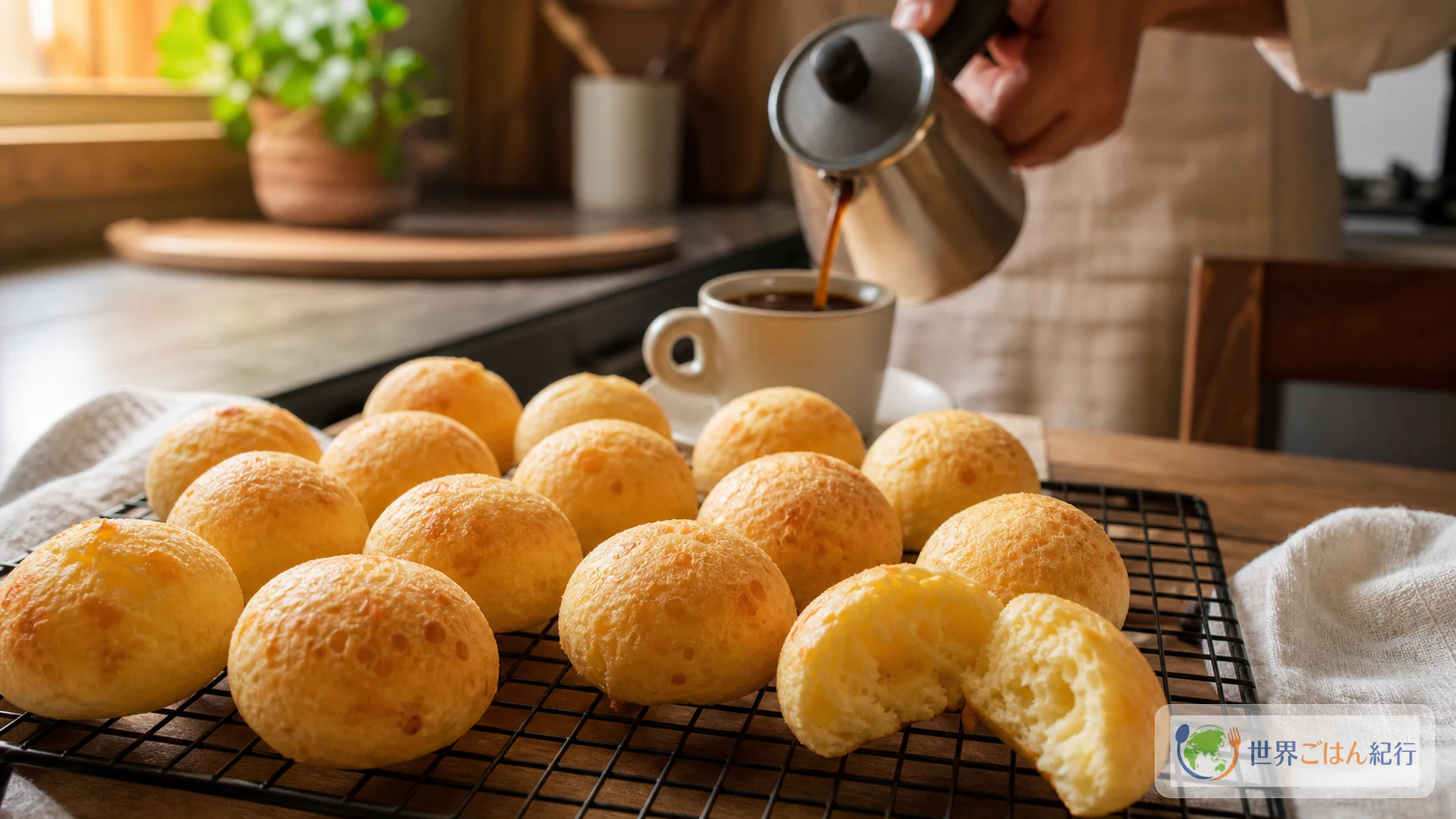
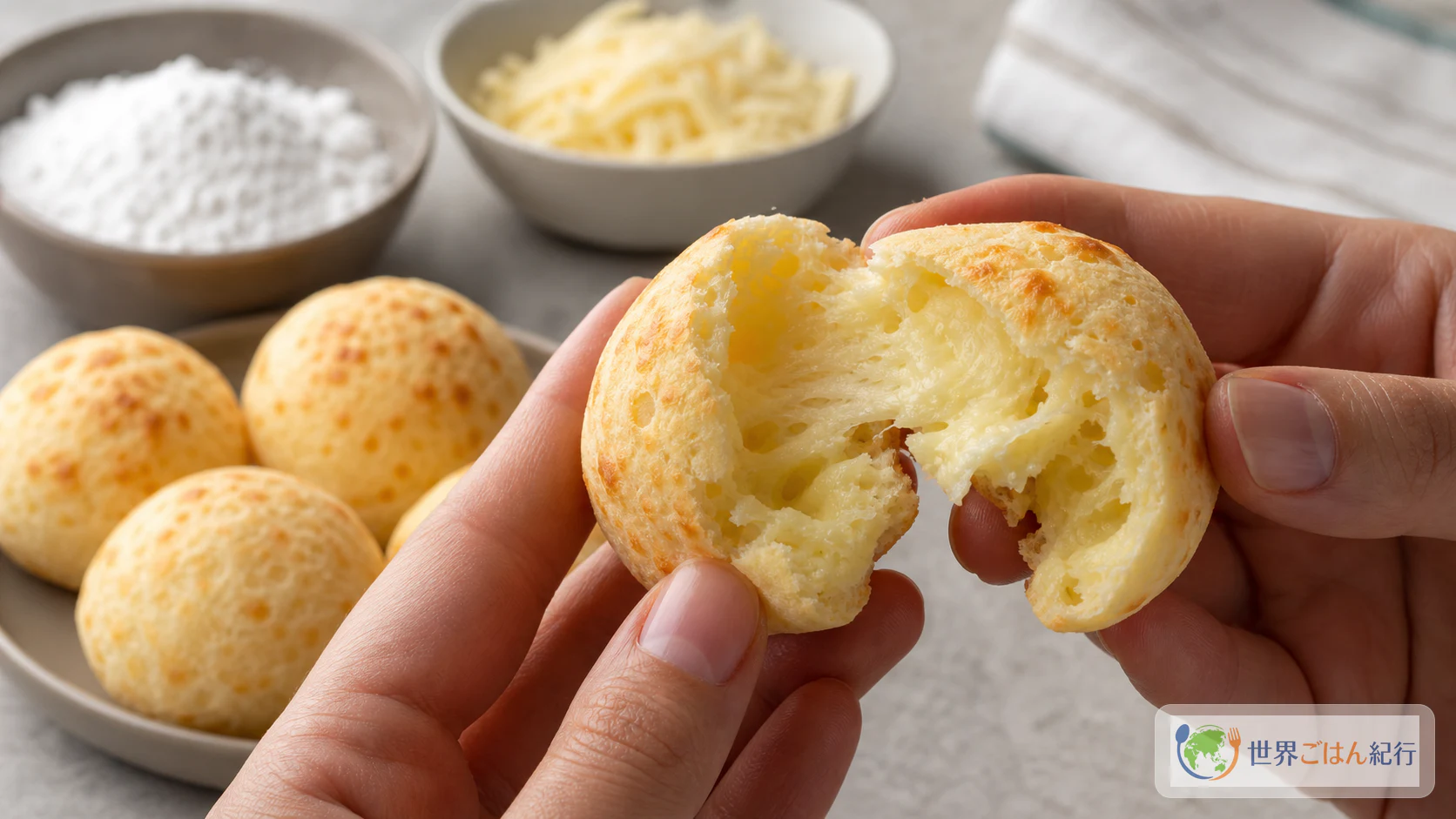
Inside the oven, round balls of dough puff up and small cracks open across their surfaces. Open the door and the first smell isn't a bakery's wheat. It's cheese, with the faintly sweet smell of starch behind it, and when you break one open fresh, out comes steam, not crumbs. Pão de queijo is Brazil's small cheese bread, eaten at breakfast and as a snack, and it's made with manioc starch instead of wheat flour. The outside is thin and toasty, the inside airy and a little stretchy, and the salt of the cheese runs all the way through.
Pão de queijo in Minas Gerais and beyond
People often call it a "chewy cheese ball," but in Brazil it has a more specific outline. It's made with polvilho, a starch extracted from manioc (cassava). It's served next to a cup of coffee and eaten several at a time while hot.
In Portuguese it is written pão de queijo, pronounced roughly "pown jee KAY-zhoo." It means simply "cheese bread."
Origins in Minas Gerais
The place name you hear most with pão de queijo is Minas Gerais, a region in Brazil's interior with a deep dairy and cheese culture. Nobody can pin its origin to a single year. It's best seen as a dish that spread where Minas cheese, manioc starch, home ovens and coffee time overlapped. Today it's eaten all over Brazil, and it's an everyday item both as frozen dough and as a café snack.
How pão de queijo rises
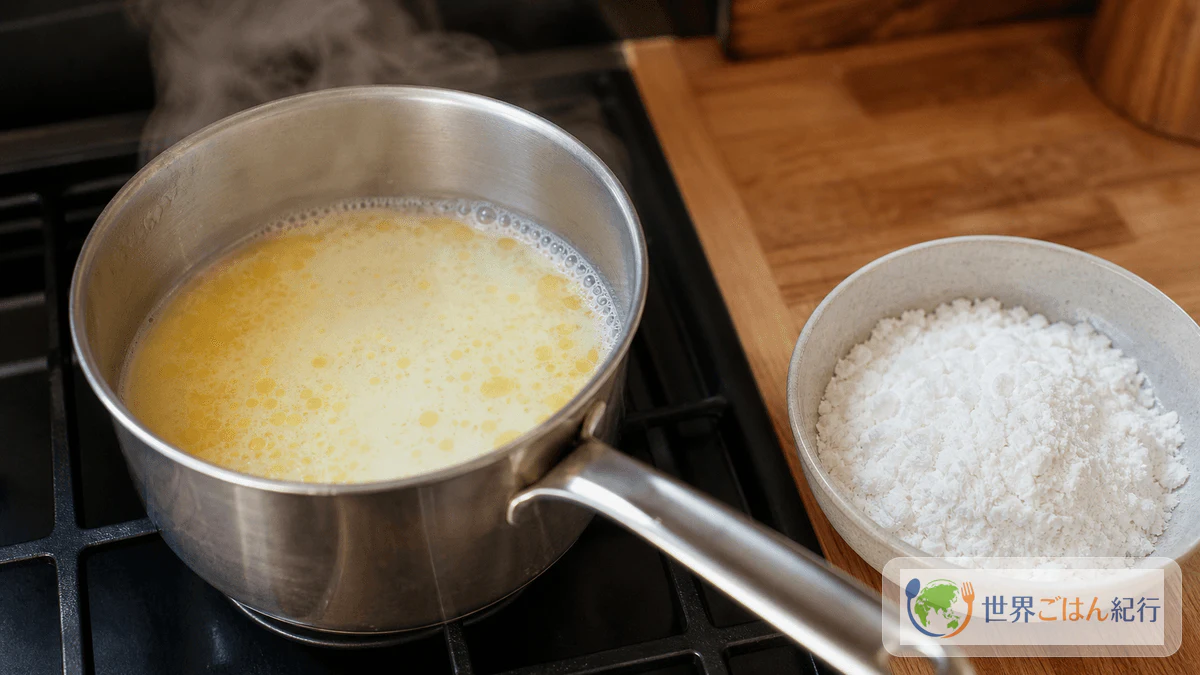
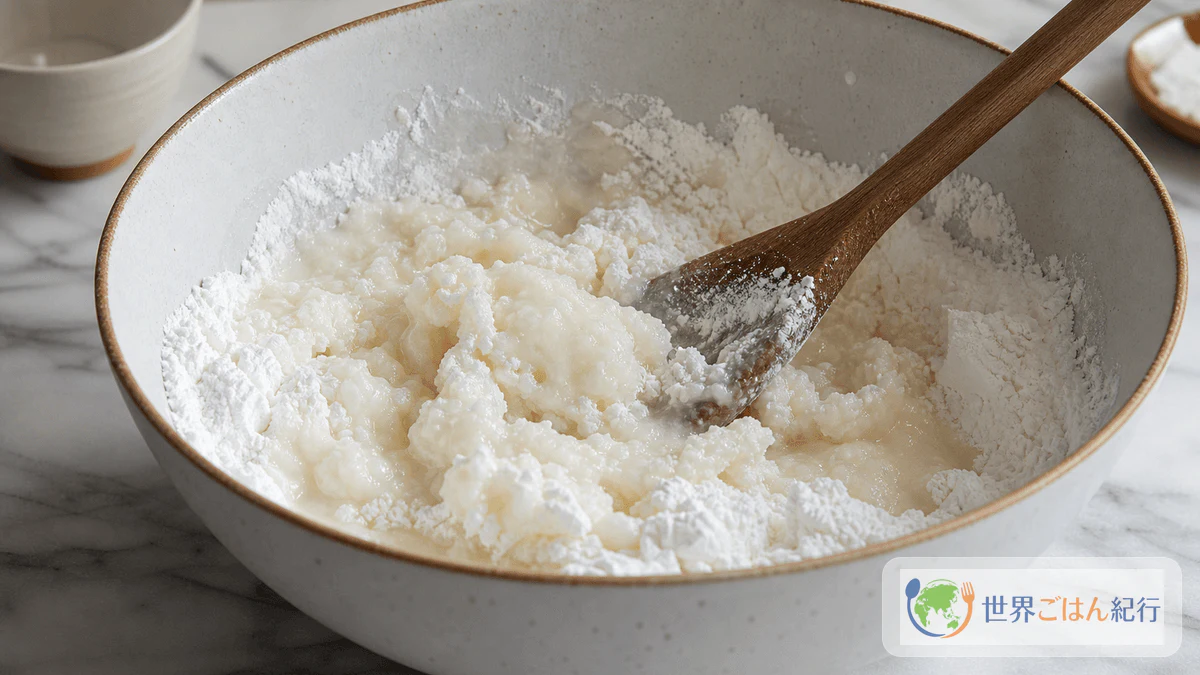
In a home kitchen, the interesting part is that pão de queijo rises on completely different logic from wheat bread. There's no yeast and no gluten. Instead, hot liquid gelatinizes the starch, and eggs and cheese support the rise and flavor. It forms a hollow inside as it bakes, so it comes out chewy but not heavy.
It's also an easy way into a Brazilian menu. Grilled-meat churrasco, black-bean feijoada and fried coxinha all take more work. Pão de queijo needs no fermentation and no frying oil: heat binds the starch and liquid, and the cheese provides the flavor.
Similar South American starch breads
| Dish | Region | Main ingredients | How it differs |
|---|---|---|---|
| Pão de queijo | Brazil | Cassava starch, cheese, eggs | Rolled into balls and baked. Light, often hollow inside |
| Chipa | Paraguay, northern Argentina and elsewhere | Cassava starch, cheese, eggs | Often ring- or stick-shaped; closer to a biscuit |
| Mbejú | Paraguay | Cassava starch, cheese, fat | Not made into a dough; the damp starch is cooked in a skillet |
| Pandebono | Colombia | Cassava starch, cheese, cornmeal and more | Baked in rounds, but the proportions and texture are different |
Ingredients: think about the starch and the cheese separately
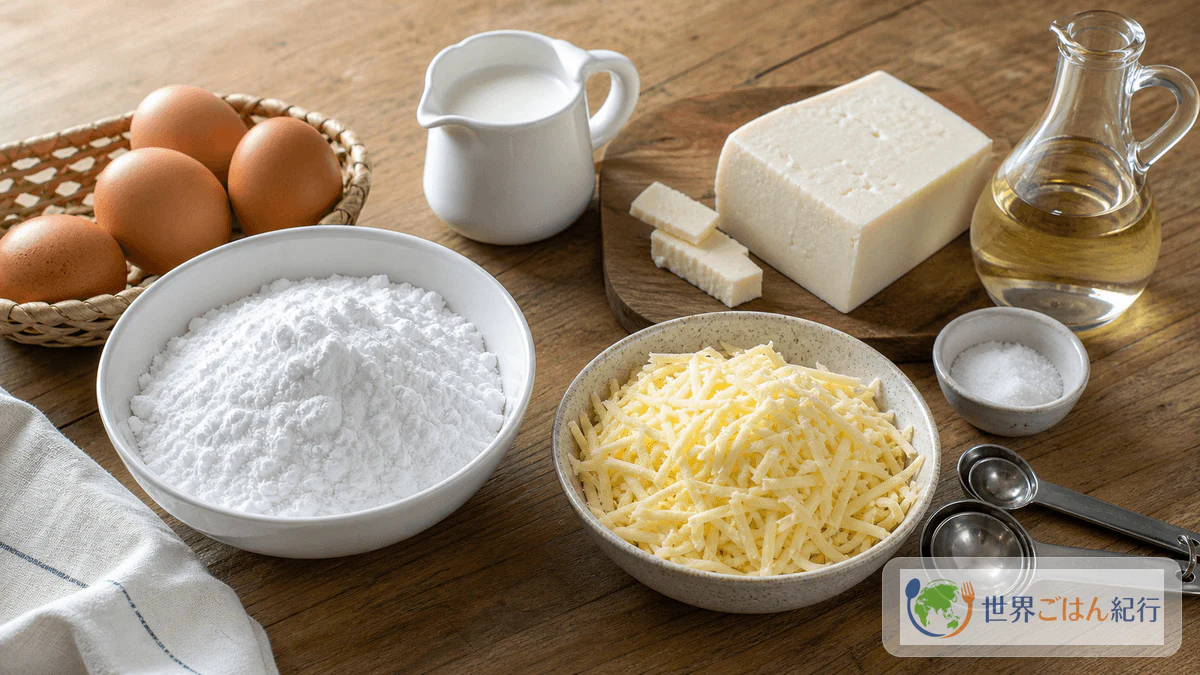
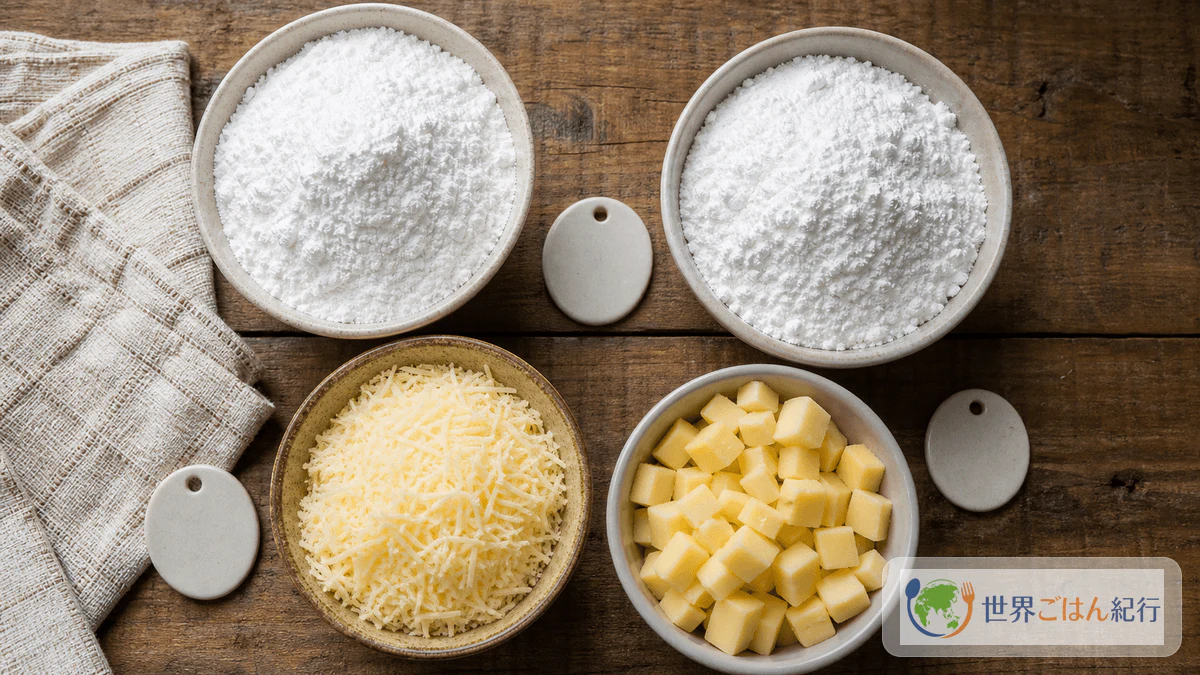
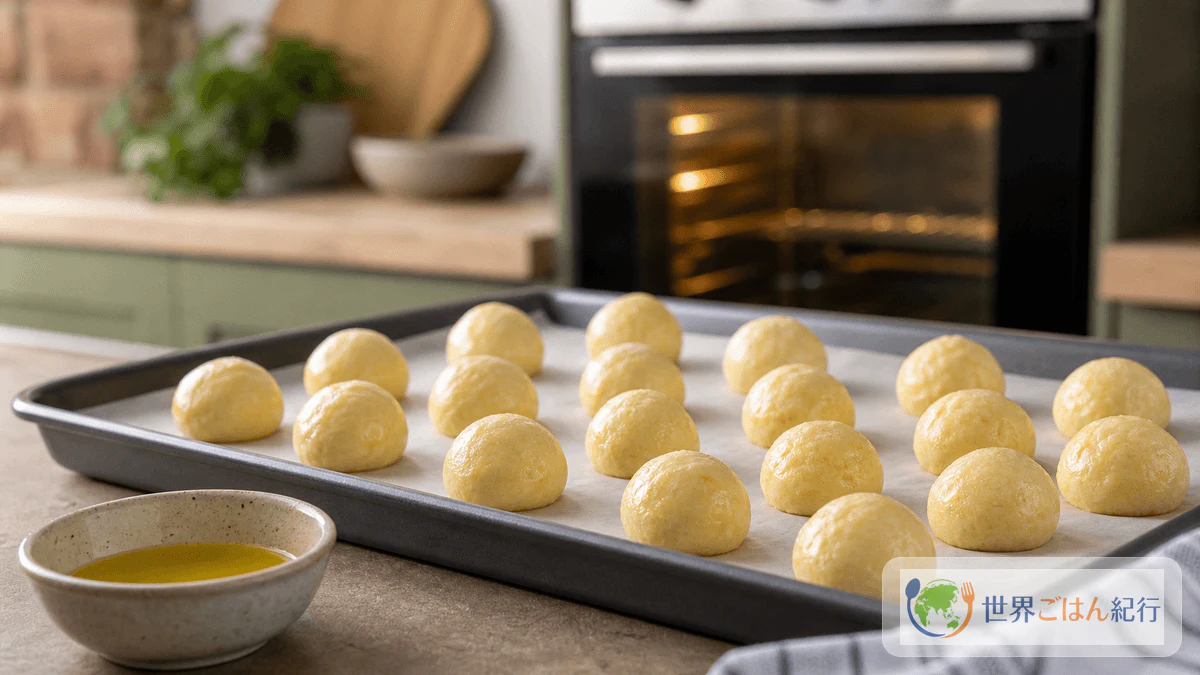
These amounts make 18 pão de queijo about 1.5 inches (4 cm) across. That's 4 servings for breakfast or a snack, or enough for 6 as an appetizer before a Brazilian meal. The first time, don't make them too big; about 1 oz (30 g) of dough each makes it easier to bake them through.
This recipe uses eggs and dairy. Tapioca starch itself is not wheat flour, but production lines and grated-cheese labels differ by product. If you must strictly avoid gluten, read every ingredient label and make sure your equipment has no leftover wheat flour.
Brazilian ingredients and substitutes
| Brazilian ingredient | Substitute | Verdict |
|---|---|---|
| Polvilho doce | Tapioca starch, cassava starch | The most important. Don't replace it with only wheat flour, rice flour or potato starch |
| Polvilho azedo | Imported sour cassava starch | Adds lightness if you have it. Otherwise use all tapioca starch |
| Queijo meia-cura | Mozzarella + grated Parmesan | Covers stretch and salt separately |
| Queijo Minas | Queijo fresco, a little feta | Use less of a very moist cheese |
| Óleo | Rice bran oil, vegetable oil | Used not for flavor but to keep the dough light |
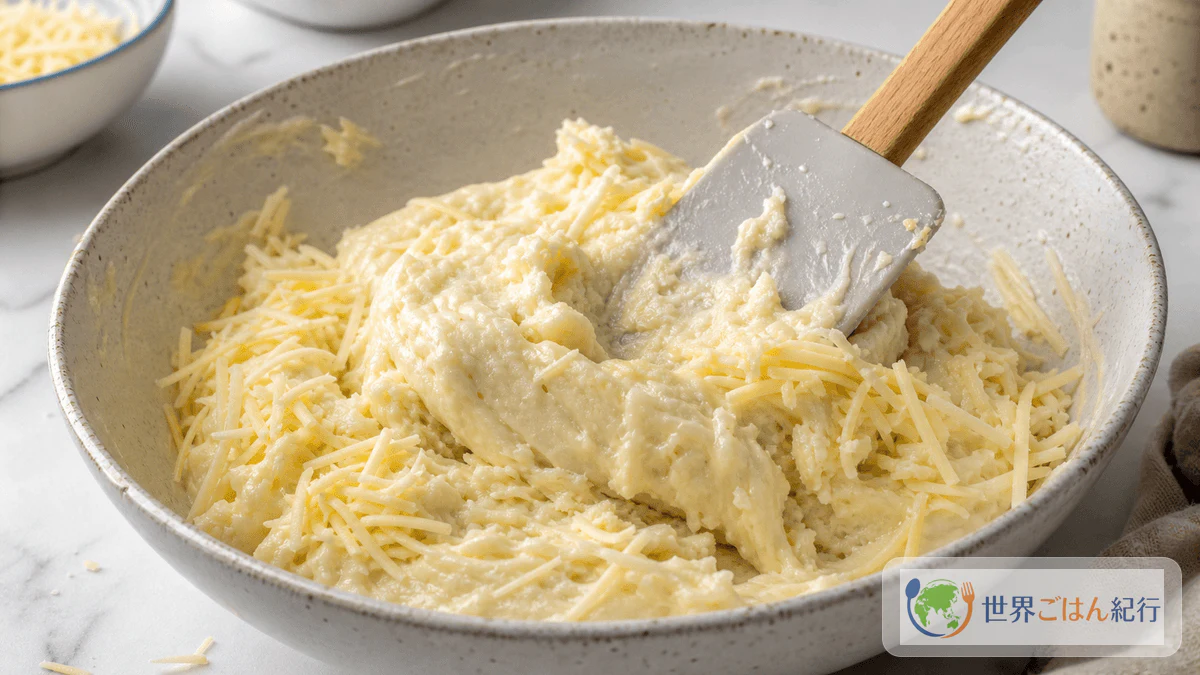
If you're unsure what to buy, secure the tapioca starch first. Rather than chasing an exact cheese match, you'll get steadier results by combining a cheese that stretches with one that brings salt. Shredded pizza cheese alone will make something, but the salt and dairy aroma come out flat, so add grated Parmesan.
Choose a product clearly labeled "tapioca starch" or "cassava starch." Products aimed at bubble tea are often pearls or flavored, so always check that it's a fine powder. Since wheat flour or potato starch changes the backbone of the dish, having tapioca starch on hand before you start cuts down on failures.
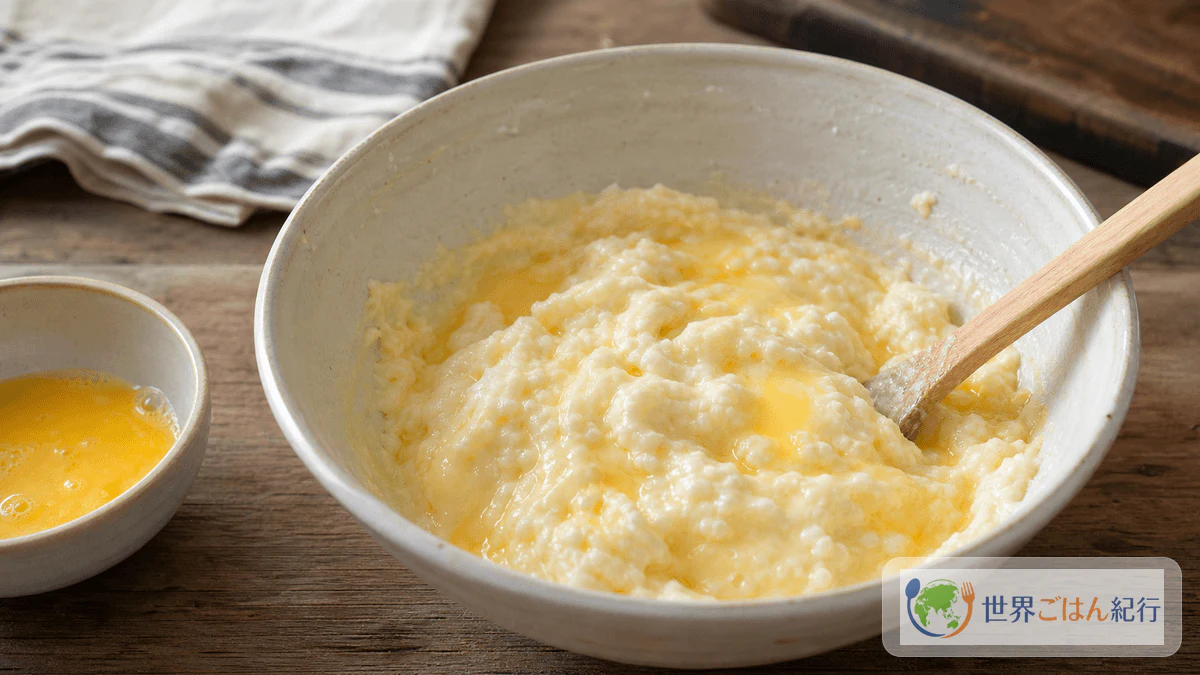
If the dough is too hot when the eggs go in, the eggs alone set into small bits. You can judge it by touch.
Mix the basic recipe by hand. Reach for a blender only if you make these often or want to try the blender method, in which the eggs and liquid are blended evenly first.
Choosing starch and cheese for pão de queijo
Outside Brazil, the hard part is choosing the starch and cheese. Brazilian cooks combine polvilho doce and polvilho azedo, and they use meia-cura, Canastra or other Minas-style cheeses. Those are hard to find in ordinary supermarkets elsewhere, so tapioca starch does the work here. Mozzarella and grated Parmesan carry the cheese, plus a salty white cheese if you can find one to round out the flavor.
Like its neighbors in the table above, pão de queijo depends on cassava starch. You can make something with wheat flour, but the bounce when you bite, the hollow that forms in baking and the way it firms up as it cools all change. Make it with tapioca starch at least once first.
When shopping, it's easy to confuse cassava flour with cassava starch. The farinha de mandioca used for farofa is ground cassava with a granular texture, suited to dishes where it gets toasted. Pão de queijo needs polvilho, the extracted starch. On the label, look for tapioca flour, tapioca starch or cassava starch, and skip tapioca pearls and seasoned mixes.
Method: bind the starch with hot liquid, then bake hot and fast
Pão de queijo isn't a kneaded bread. Hot liquid poured over the starch gelatinizes it; then eggs and cheese are mixed in, and the dough is rolled and baked. A dough that sticks a little to your hands is correct. If you add starch to make it easier to handle, it bakes up hard.
Freeze the shaped dough on the baking sheet, then transfer to a freezer bag once firm. To bake, put them still frozen into an oven preheated to 180°C (355°F) and bake for 25–30 minutes. Frozen dough takes a while to heat through to the center, so don't roll the balls too large.
Common pão de queijo problems and fixes
With so few ingredients, pão de queijo leaves nowhere to hide. Failures can look alike but have different causes. If you try to fix everything with one move, the next batch fails in a new way. Adding starch because the dough is sticky is one such move. Baking longer because the rolls are pale is another.
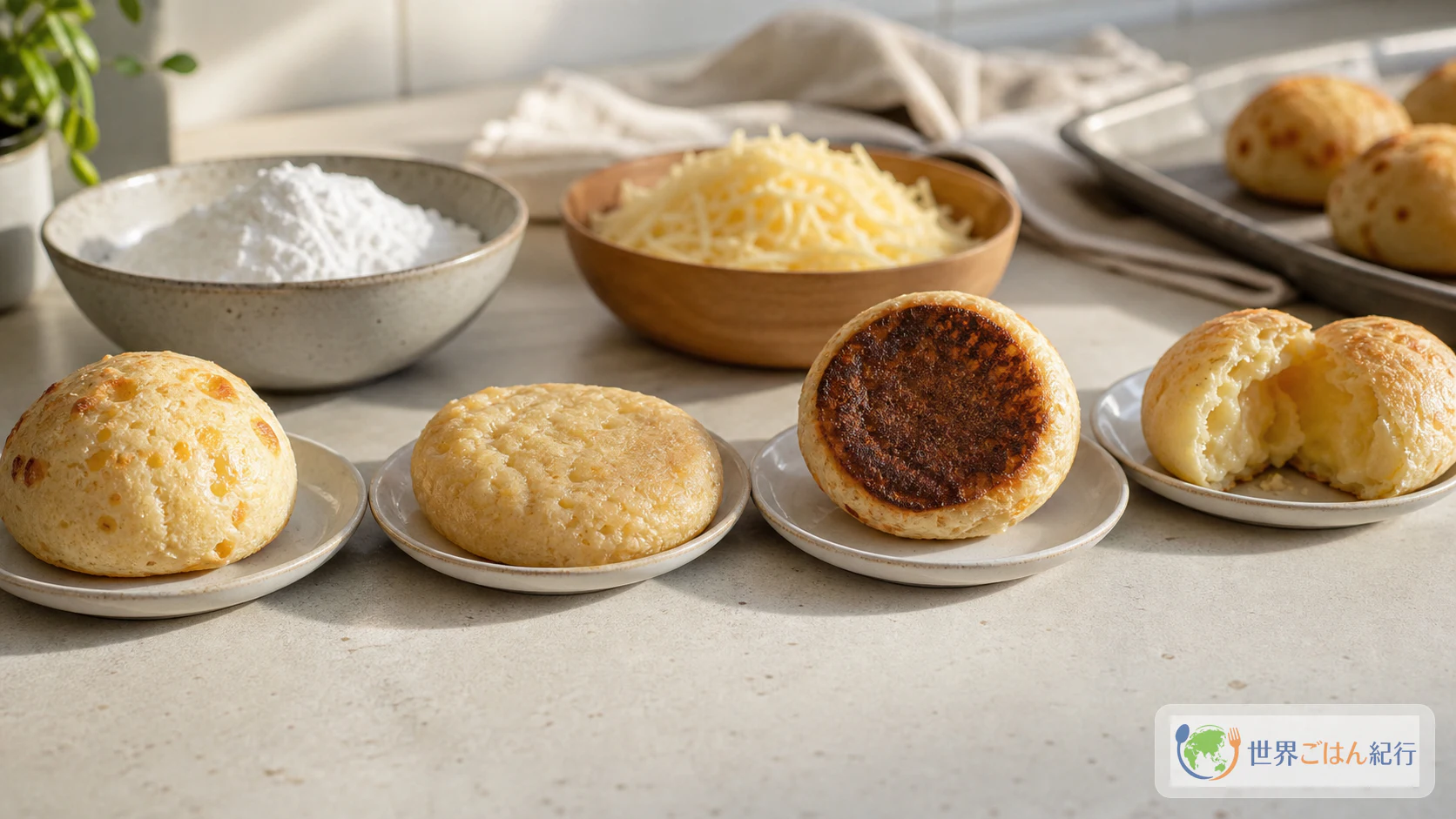
When you look at a batch, sort the cause into one of three: the dough, the heat or the size. A dry, white, badly cracked surface points to the dough. Burnt bottoms alone point to the heat, and a heavy center points to the size. Change only one thing next time. If you add 2 tbsp of starch, lower the temperature and lengthen the baking time all at once, you won't know what worked.
| Symptom | Main cause | Fix |
|---|---|---|
| Too loose to roll | Large eggs, too much liquid, not rested enough | Rest for 10 minutes. If still loose, add just 1 tbsp tapioca starch |
| Doesn't puff in the oven | The liquid cooled and the starch didn't gelatinize; eggs not mixed in enough | Pour the liquid in right after it bubbles, and mix in each egg completely |
| Surface cracks too much | Dough dried out, too much starch added | Oil your hands and smooth the surface before baking |
| Heavy and dense inside | Baked too long at too low a temperature; balls too big | Bake briefly at 400°F (210°C) and keep each one around 1 oz (30 g) |
| Only the bottoms turn dark | Thin baking sheet, strong bottom heat | Double the baking sheets, or lower to 400°F (200°C) and bake a little longer |
| Weak cheese flavor | Made with mozzarella only | Add grated Parmesan, a salty white cheese and a little aged cheese |
Adding starch is the last resort. Pão de queijo dough never comes cleanly off your hands the way bread dough does, so if you can roll it with oiled hands, leave it alone. More starch makes shaping easier, but the rolls bake up hard and turn heavy once they cool. Add the eggs only once the hot dough has cooled a little.
Large hollows aren't a problem. Pão de queijo puffs up with steam as it bakes, so some hollow inside with chewy dough around it is normal. They're done when the outer part is chewy, the bottoms are dry and they feel light in your hand. If the center is pasty, heavy and doesn't spring back when pressed, rethink the temperature or the size.
Serving, storing and varying pão de queijo
Serving pão de queijo
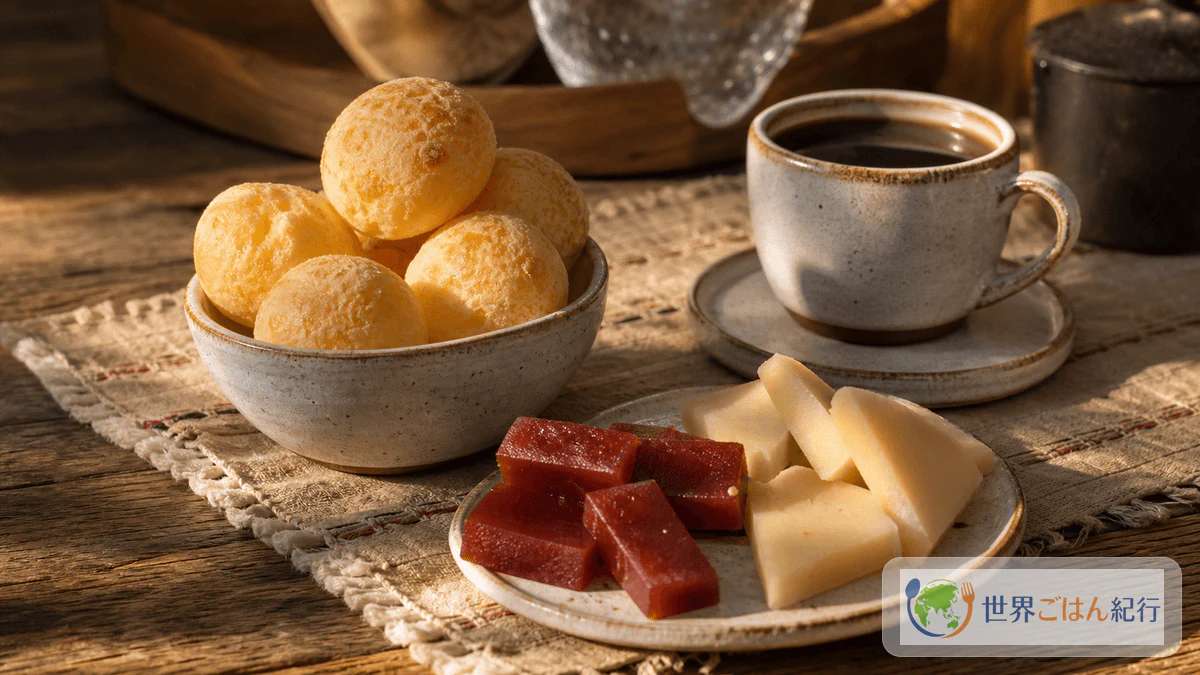
Pão de queijo is best fresh from the oven. In the morning, coffee alone is plenty. For a snack, a little white cheese or fruit brings a hint of a Minas table. Brazilians pair guava paste with cheese for something sweet, and at home a small spoonful of not-too-sweet jam does the job.
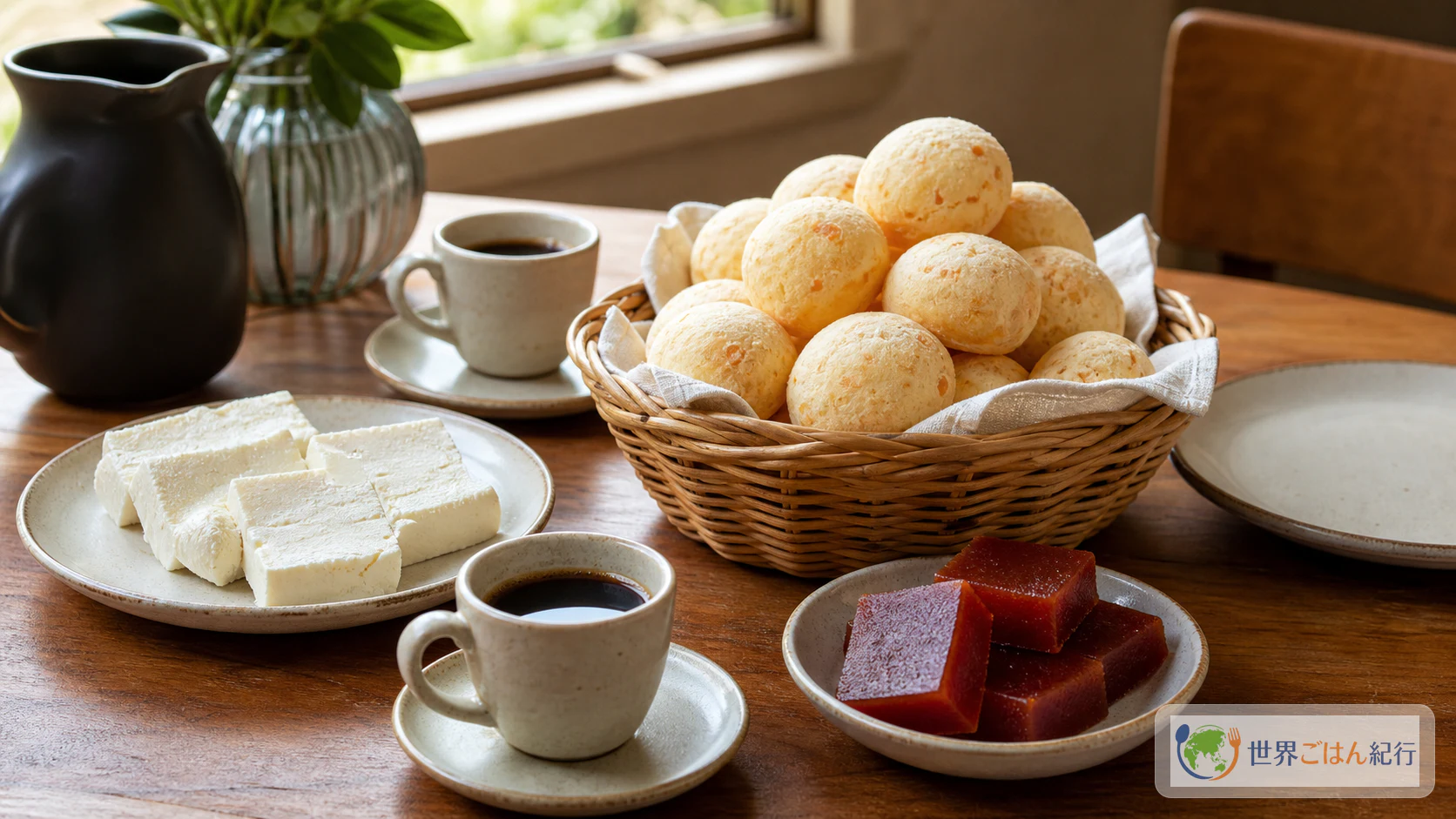
To eat it the Brazilian way, make small cups of strong coffee. Café au lait works too, but this isn't a sweet bread, and a bitter drink brings out the salt of the cheese. Two or three in the morning, one or two for an afternoon lanche (snack). They're meant to be nibbled hot, not piled up as a main course.
On a Brazilian menu, pão de queijo works best as an opener. Serve 2–3 on a small plate before feijoada or moqueca baiana. On a churrasco day, set them out while the meat is grilling. Then move on to meat, beans or seafood rather than another starchy dish, and the meal stays lighter.
For young children, break a fresh one open and let it sit for 2–3 minutes, because the inside is very hot. With no heat or strong herbs, pão de queijo is an easy fit for a family table.
| Occasion | How to serve | Pair with |
|---|---|---|
| Breakfast | 2–3 per person, hot | Black coffee, café com leite, fruit |
| Afternoon snack | 1–2 on a small plate | White cheese, guava jam, strong black tea |
| Appetizer for a Brazilian meal | 2 each before meat or bean dishes | Vinagrete, salad, cold drinks |
| Potluck | Bake smaller, at 20 g | Best where a toaster oven is available for reheating |
Variations with cheese, not starch
| Direction | Add / change | Watch out for |
|---|---|---|
| Closer to Brazil | Mix in 2.75 oz (80 g) polvilho azedo | Adds tang and lightness. Using it for all the starch makes them crack easily |
| Saltier | Increase grated Parmesan to 2 oz (60 g) | Reduce salt to 1/3 tsp |
| More stretch | Increase mozzarella to 5 oz (140 g) | It can release oil, so don't overbake |
| Light breakfast | Make each 20 g | Bake at 400°F (210°C) for about 14–16 minutes |
| Sweet-salty snack | A little guava jam on the baked rolls | Don't mix sugar into the dough; it burns less easily without |
Storing and reheating pão de queijo
Keep baked pão de queijo in a container once it has cooled. The fridge firms up the starch and the fresh-baked lightness fades, and the toaster oven is what brings back the aroma and some of the crisp outside. Don't rely on the microwave alone.
| Storage | Guideline | Reheating / baking |
|---|---|---|
| Baked, same day | Room temperature, same day | 2–3 minutes in a 350°F (180°C) toaster oven |
| Baked, next day | Refrigerated, until the next day | Warm at 600 W for 10–15 seconds, then 2–3 minutes in a 350°F (180°C) toaster oven |
| Baked, frozen | 2 weeks | From frozen at 325°F (160°C) for 6–8 minutes. Texture firms up slightly |
| Shaped, frozen | 2–3 weeks | Without thawing, at 350°F (180°C) for 25–30 minutes |
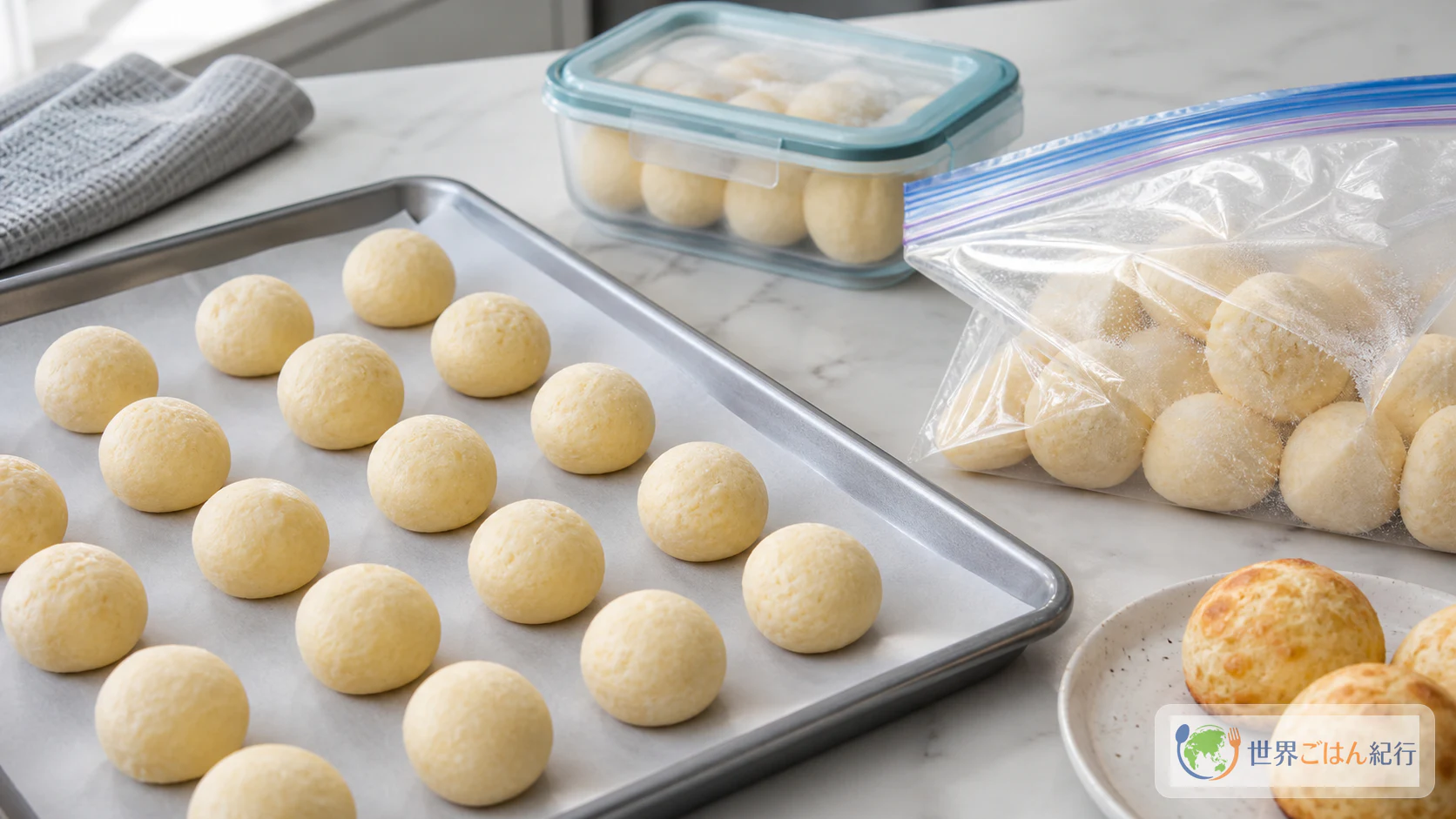
To make ahead, freeze the dough before baking. Arrange the shaped balls on a baking sheet with space between them and freeze for 2–3 hours. Move them to a freezer bag only once they're firm. If they're stacked while still soft, they stick together and the surfaces tear in the oven. Freezer odors transfer easily, so double-bag them or put the bag in an airtight container.
Bake frozen dough straight from the freezer, without thawing. Thawing makes the surface damp and more likely to stick to the sheet. Frozen dough bakes at a lower temperature for longer than fresh dough, which keeps the outside from browning while the center is still cold. Take the rolls out once the surface has puffed and the bottoms are dry. Large balls are harder to heat through, so if you plan to freeze, keep each at 25–30 g.
The first time, make the batch of 18, eat half fresh from the oven and freeze the rest. The next morning, put the frozen dough in the oven and brew some coffee. The smell of cheese and starch fills the kitchen again.
Frequently asked questions
Can I use potato starch instead of tapioca starch?
We don't recommend it. Potato starch is very sticky and hardens as it cools. You can shape it, but you'll barely get the light hollow and chewy bounce of pão de queijo. For your first batch, use tapioca starch or cassava starch.
What's the difference between polvilho doce and polvilho azedo?
Both are cassava starches. Polvilho azedo goes through fermentation, which gives it a sour edge and more lightness and rise in the oven. It can be hard to find, and all tapioca starch works fine. If you can get it, swap in about 2.75 oz (80 g) rather than using it for everything; the dough is easier to handle that way.
Is pizza cheese alone enough?
It works, but the flavor is a little flat. Pizza cheese stretches well, but its salt and aroma can be weak. Grated Parmesan adds salt and savory depth, and a small amount of salty white cheese brings the aroma closer to Brazilian cheese bread.
Can I make the dough the day before?
Rolling and freezing is more reliable than refrigerating the batch overnight. If you do refrigerate, seal the shaped dough so it doesn't dry out and bake it the next day. Chilled dough firms up, so let it sit at room temperature for 10 minutes before baking. If the surface has dried, smooth it with lightly oiled hands.
Can I cook them in a skillet if I don't have an oven?
They won't puff like pão de queijo, and you'll end up with something closer to a different dish. If you want starch and cheese from a skillet, Paraguayan mbejú is a better fit.