Ingredients and steps on one page. Print it, or choose “Save as PDF” in the print dialog.
Sekai Gohan
Banh Chung Recipe: Vietnam's Lunar New Year Leaf-Wrapped Sticky Rice Cake
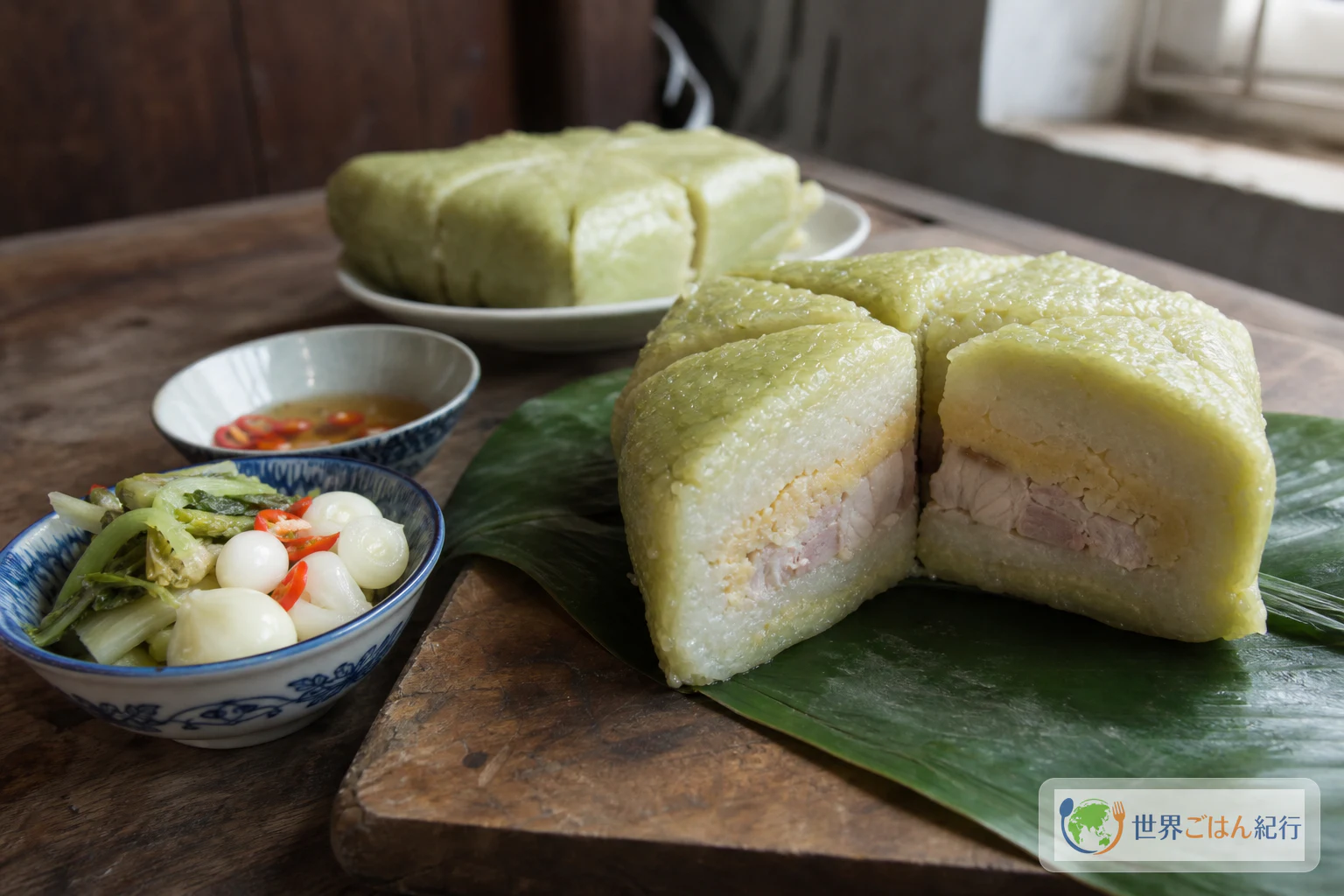
Ingredients
| Ingredient | Amount | Substitutes & notes |
|---|---|---|
| Glutinous rice | 1.25 lb (600 g) | Thai or domestic glutinous rice both work. Old rice leaves a hard core |
| Skinless mung beans (moong dal) | 8 oz (220 g) | Yellow split mung beans. Skin-on beans give a coarser texture |
| Pork belly block | 8.5 oz (240 g) | Pork shoulder also works. If there is too little fat, the center dries out |
| Banana leaves | 8–10 | Frozen leaves that can be cut to 14 inches (35 cm) squares or more. Include some for patching tears |
| Salt | 2 tsp | Divided among the rice, mung beans, and pork |
| Fish sauce | 1 tbsp | Stands in for Vietnamese nuoc mam. For seasoning the pork |
| Sugar | 1 tsp | Seasons the pork. Not to sweeten, but to round off the saltiness |
| Black pepper | 1 tsp | Use plenty on the pork |
| Onion or shallot | 1.5 oz (40 g) | Finely chopped. Shallot is closer in aroma |
| Rice bran oil | 1 tsp | Brushed thinly on leaves and mold |
| Water | 4.25 quarts (4 L) or more | For soaking, steaming, and simmering. Add boiling water as it simmers |
Steps
1Soak the rice and mung beans
6 hours
Wash 1.25 lb (600 g) glutinous rice, changing the water 3 times until it runs nearly clear, then soak in plenty of water for 6 hours. Wash 8 oz (220 g) skinless mung beans in a separate bowl and soak them for 6 hours as well. No heat is used in this step. The rice grains should be white and plump and soaked through to the center when you break one with your fingers, and the mung beans should split when pressed with a fingernail. If the soak is too short, a white core stays in the center even after a long simmer.
2Steam the mung beans and season the pork
25 min
Drain the mung beans in a colander. Bring the steamer water to a boil over high heat, lower to medium, and steam for 20 minutes with steam rising without a break. When the beans crush under a finger and have no chalky core, move them to a bowl, mix in 1/2 tsp salt, and mash roughly. Cut the pork belly into sticks about 0.5 inches (1.5 cm) thick and 2.5 inches (6 cm) long, and rub in 1 tbsp fish sauce, 1 tsp sugar, 1 tsp black pepper, 1.5 oz (40 g) finely chopped onion, and 1/2 tsp salt. The pork is not cooked yet, but the seasoning should coat the surface evenly and no watery liquid should be left at the bottom of the bowl.
3Soften the leaves and line the mold
15 min
Wash the thawed banana leaves under running water, wipe dry, and cut into 14 inches (35 cm) squares. Shave the hard veins thin with a knife, and set aside torn leaves for patching. Pour boiling water over them, or pass each side over a low flame at least 6 inches (15 cm) away for about 5 seconds, until the leaf folds without cracking. Brush the 4.5 inches (12 cm) square mold thinly with rice bran oil, lay 2 leaves crosswise and 2 more diagonally, and line it with no gaps in the bottom or corners. Charred black leaves taste bitter, so do not hold them too close to the flame.
4Layer the rice, mung beans, and pork
20 min
Drain the glutinous rice in a colander for 10 minutes and mix in 1 tsp salt. The grains should have a sheen on the surface and no watery liquid should be left at the bottom of the bowl. Put about 5.5 oz (150 g) rice in the bottom of the mold and press it flat out to the corners. Spread half the mung beans thinly on top, lay 2–3 pieces of pork down the center, then cover the pork with more mung beans. Finally cover with 5.5 oz (150 g) rice and level the surface. No heat is used in this step. If the corners are thin, the cake will crumble when cut, so the rice should reach all four corners with no mound only in the center. Repeat to make a second cake.
5Fold the leaves and tie crosswise
15 min
Fold the leaves sticking out of the top in order, left and right, then top and bottom, pressing lightly with your palm to push out air. For corners lacking leaf, tuck in patch leaves from the inside. Gently remove the cake from the mold and tie it crosswise with 4 pieces of 55 inches (140 cm) string, lengthwise and crosswise, so two lines show on each face. No heat is used in this step. Tighten the string just enough that the leaves do not lift, without biting in. When you pick it up the corners should hold, and it should keep flat faces when pressed lightly.
6Simmer long in gently bubbling water
4 hours
Put the cakes in a large pot and add enough water to cover them completely. If they float, hold them down with a heatproof plate or bamboo skewers. Bring to a boil over high heat, and when the water moves again, lower to medium-low and keep it gently bubbling at about 90–95 degrees C for 4 hours. Keeping it at a hard boil lets water in through gaps in the leaves and makes the rice watery. Check the water level every 30 minutes and add boiling water before the cakes rise out of the water. After 4 hours, open one cake. It is cooked if the pork in the center is 75 degrees C or more, the glutinous rice has no white core, and the mung beans are not chalky. If not, simmer 30 minutes more at the same heat.
7Drain and press with a weight
1 hour
Turn off the heat, lift out the cakes with tongs, and rinse the surface briefly under running water. Washing off the slime on the outside of the leaves makes the smell cleaner once cooled. Drain in a colander for 10 minutes, set on a cutting board, put another board on top, and press for 1 hour with a weight of about 4.5 lb (2 kg). No more heat is applied in this step. Pressing squeezes out excess moisture, leaves the leaf surface drier, and keeps the layers from warping when cut. If the weight is too heavy and rice pushes out, halve the weight.
8Cut with string and serve
10 min
Open the leaves and cut into 8 equal pieces using the tying string or clean thread. A knife makes the glutinous rice stick to the blade, so pass the thread underneath, cross it on top, and pull tight for a clean cut. A thickness of about 1 inches (3 cm) per slice is easy to eat. Serve at room temperature as is, or if cold and firm, warm for 10 minutes in a steamer over medium heat. It is a success when steam rises, the rice is plump again, and the leaf aroma, the crumbly mung bean, and the pork fat come together. Serve with pickled scallions, cucumber, fish sauce, and fried food such as cha gio for variety on the table.