Ingredients and steps on one page. Print it, or choose “Save as PDF” in the print dialog.
Sekai Gohan
Koshari Recipe: Egypt's National Dish at Home
Ingredients
Main (the three carbohydrate layers)
| Ingredient | Amount | Substitutes & notes |
|---|---|---|
| Rice (long-grain is ideal) | 1 cup (150g) | Basmati is best. Short-grain rice also works but tends to turn sticky |
| Brown lentils | 100g | Green lentils also work. Red lentils are unsuitable because they get too soft |
| Macaroni (elbow) | 150g | Ditalini or ziti, other short tube pasta, also works |
| Chickpeas (canned, cooked) | 1 can (240g) | If using dried, soak 80g overnight and boil for 40 minutes |
Tomato sauce
| Ingredient | Amount | Substitutes & notes |
|---|---|---|
| Canned tomatoes (chopped) | 1 can (14 oz / 400 g) | Whole canned tomatoes, crushed by hand, also work |
| Garlic | 4 cloves, minced | — |
| Neutral oil | 2 tbsp | — |
| Ground cumin | 1 tsp | The spice that defines koshari's flavor |
| Ground coriander | 1/2 tsp | — |
| Chili powder | 1/2–1 tsp | Adjust to your heat preference |
| White vinegar | 1 tbsp | A hidden touch that sharpens the tomato's acidity |
| Sugar | 1 tsp | Rounds off the tomato's sourness |
| Salt | 1 tsp | — |
Contains wheat (macaroni). If you have a wheat allergy, substitute gluten-free pasta, or leave out the macaroni and make a two-layer version of lentil rice and chickpeas.
Daqqa (garlic-vinegar sauce)
| Ingredient | Amount | Substitutes & notes |
|---|---|---|
| White vinegar | ½ cup (100 ml) | Plain distilled or grain vinegar is fine. Adding 2 tbsp lemon juice improves the flavor |
| Garlic | 4 cloves, grated | Plenty of garlic is the authentic taste |
| Dried red chili (powder) | 1 tsp | Ordinary chili flakes can substitute |
| Ground cumin | 1/2 tsp | — |
| Lemon juice | 1 tbsp | — |
| Salt | 1/2 tsp | — |
Fried onions
| Ingredient | Amount | Substitutes & notes |
|---|---|---|
| Onions (large) | 2 | Slice thinly. Even thickness is the secret to crispness |
| Frying oil | As needed (about 1 inch / 2 cm in the pan) | — |
| Salt | A pinch | Sprinkle lightly after frying |
Steps
1Cook the lentils and rice
20 min
- Put the lentils and 1¾ cups (400 ml) water in a pot and bring to a boil over medium heat in 3–4 minutes.
- Once boiling, skim off the foam and boil over low heat for 5 minutes. Stop when the lentils have swelled a little on the surface but are still firm in the center.
- Add the rinsed rice. If the water is lower than about 0.25 inch (5 mm) above the rice, add ½ cup (100 ml) water.
- Cover and cook over low heat for 15 minutes. Turn off the heat when the rice is plump and a lentil mashes easily between your fingers.
Turn off the heat and let it steam for 5 minutes, then fluff from the bottom with a fork. Season with 1/2 tsp salt once the grains of rice and lentils are evenly distributed and separate lightly without clumping.
CautionAvoid this mistake: If you put the lentils and rice in together from the start, the rice finishes cooking while the lentils are still hard. Always boil the lentils for 5 minutes first, then add the rice. The water for the rice is 1.2 times its amount (for 5.5 oz / 150 g of rice, ¾ cup / 180 ml plus the liquid the lentils were boiled in).
2Boil the macaroni
10 min
Bring water to a boil over high heat in a separate pot and boil the macaroni for 8–10 minutes over medium heat, as the package directs. Slightly softer than al dente is the authentic style. Drain it when it mashes through the center with no resistance when pressed lightly with a finger, and while it is still steaming, toss with 1 tsp oil to coat evenly. It is ready when a thin sheen appears on the surface and the pieces separate loosely without sticking.
3Make the tomato sauce
15 min
- Put 2 tbsp oil in a pan and cook the garlic over low heat for 1 minute. Move on when the raw whiteness is gone and the fragrance rises, before it burns.
- Add the ground cumin and coriander and cook over low heat for 30 seconds. They are ready when the powder has absorbed the oil, turned moist, and smells toasty.
- Add the canned tomatoes and simmer over medium heat for 10 minutes. Reduce until small bubbles keep popping and dragging a wooden spoon across the bottom leaves a trail for a moment.
- Add the chili powder, vinegar, sugar, and salt and adjust the seasoning.
Simmer another 3–5 minutes until thickened, and it is done. The tomato sauce plays two roles: it is the "mixing sauce" that ties everything together, and the "topping sauce" that people add as they eat. Make plenty so everyone can add as much as they like at the table. The cumin that also features in the tomato sauce of kebab (Turkey) is the base note of the flavors of the Middle East and North Africa.
4Make the daqqa
5 min
- Put ½ cup (100 ml) white vinegar in a small pot and warm over low heat for 1 minute. Just until light steam rises; do not boil hard.
- Add the grated garlic, chili powder, and cumin.
- Over low heat for another 2–3 minutes, bring to a gentle simmer with small bubbles at the edge. It is ready when the raw bite of the garlic is gone and the sharpness of the vinegar has softened a little.
- Add the lemon juice and salt, then turn off the heat.
Transfer to a clean jar or bowl. Daqqa is koshari's flavor-changer. The Egyptian way is to start with only the tomato sauce and add the daqqa little by little partway through to enjoy the change in taste.
TipStoring daqqa: It keeps for 2 weeks in the refrigerator. The vinegar's preserving effect also holds the garlic flavor. It is good on pasta and pizza as well, so it is handy to make extra.
5Make the fried onions
15 min
- Cut the onions into half-moons 2–3 mm thick. The more even the thickness, the less uneven the browning.
- Heat oil 1 inch (2 cm) deep in a pan to 350°F (170°C) over medium heat. Drop in one piece of onion; fine bubbles should appear right away.
- Add the onions and fry over medium heat for 10–12 minutes. Separate them 2–3 times along the way and cook until all are a pale gold.
- Lift them out a step before they turn golden brown and drain on paper towels. Residual heat deepens the color and leaves them crisp and light.
Sprinkle lightly with salt and they are done. Fried onions are an essential topping for mujaddara (Lebanon) too, but koshari uses far more of them.
CautionThe most important point for fried onions: Take the onions out when you think "it is still a bit early." The color keeps deepening from residual heat, so if they look perfect in the pan, they will be burnt once lifted out. Remove them at the pale gold stage.
Fried onions are koshari's most important topping. The crisp texture and caramelized sweetness add a dramatic accent to the layers of carbohydrate.
6Assemble
5 min
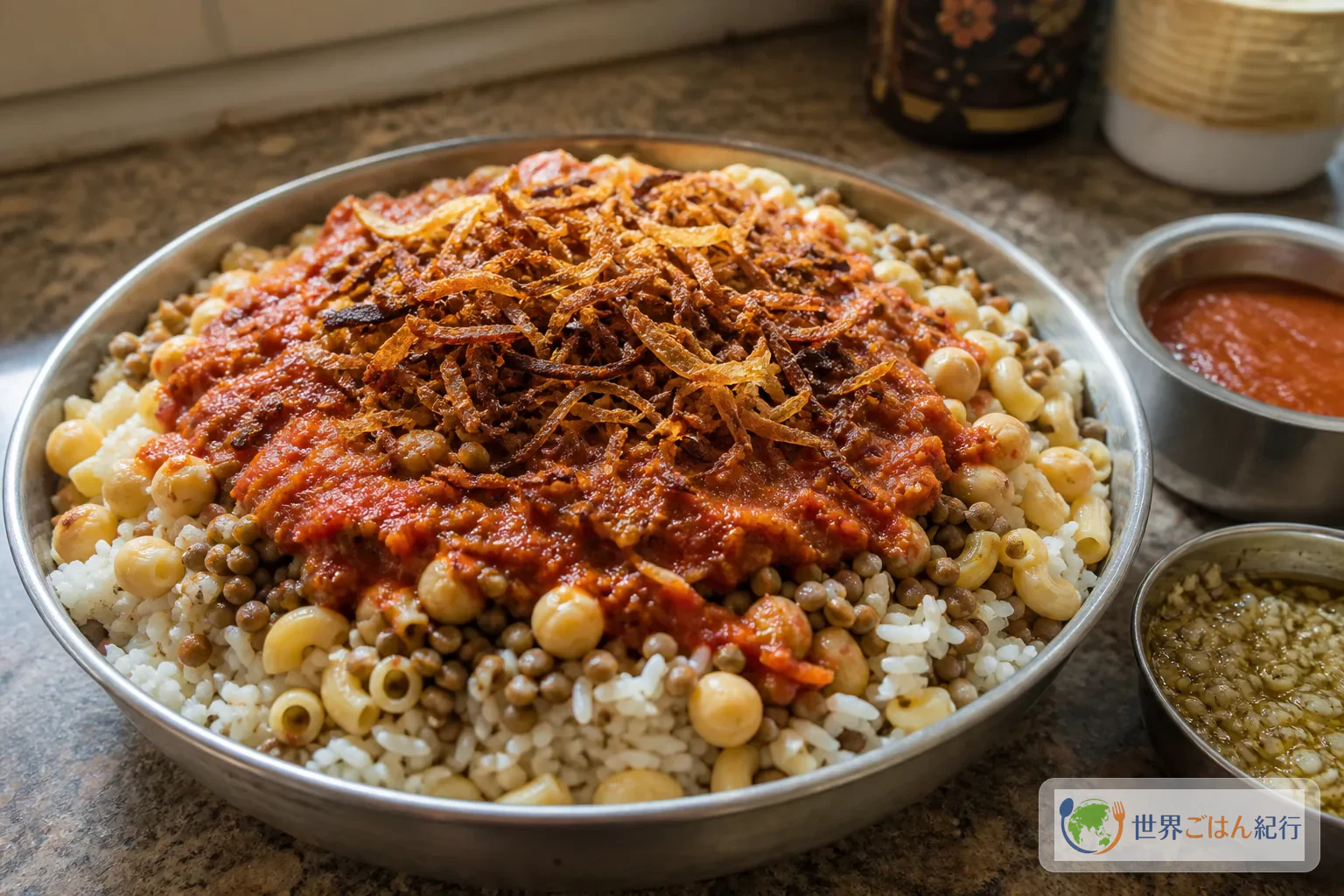
At a Cairo stall the layers go in this order. First, as the first layer, spread the lentil rice on the bottom of the bowl. Next, as the second layer, spread the macaroni over it. For the third layer, scatter the chickpeas, and to finish, spoon over plenty of tomato sauce and pile on the fried onions. Serve the daqqa on the side in a small dish.